
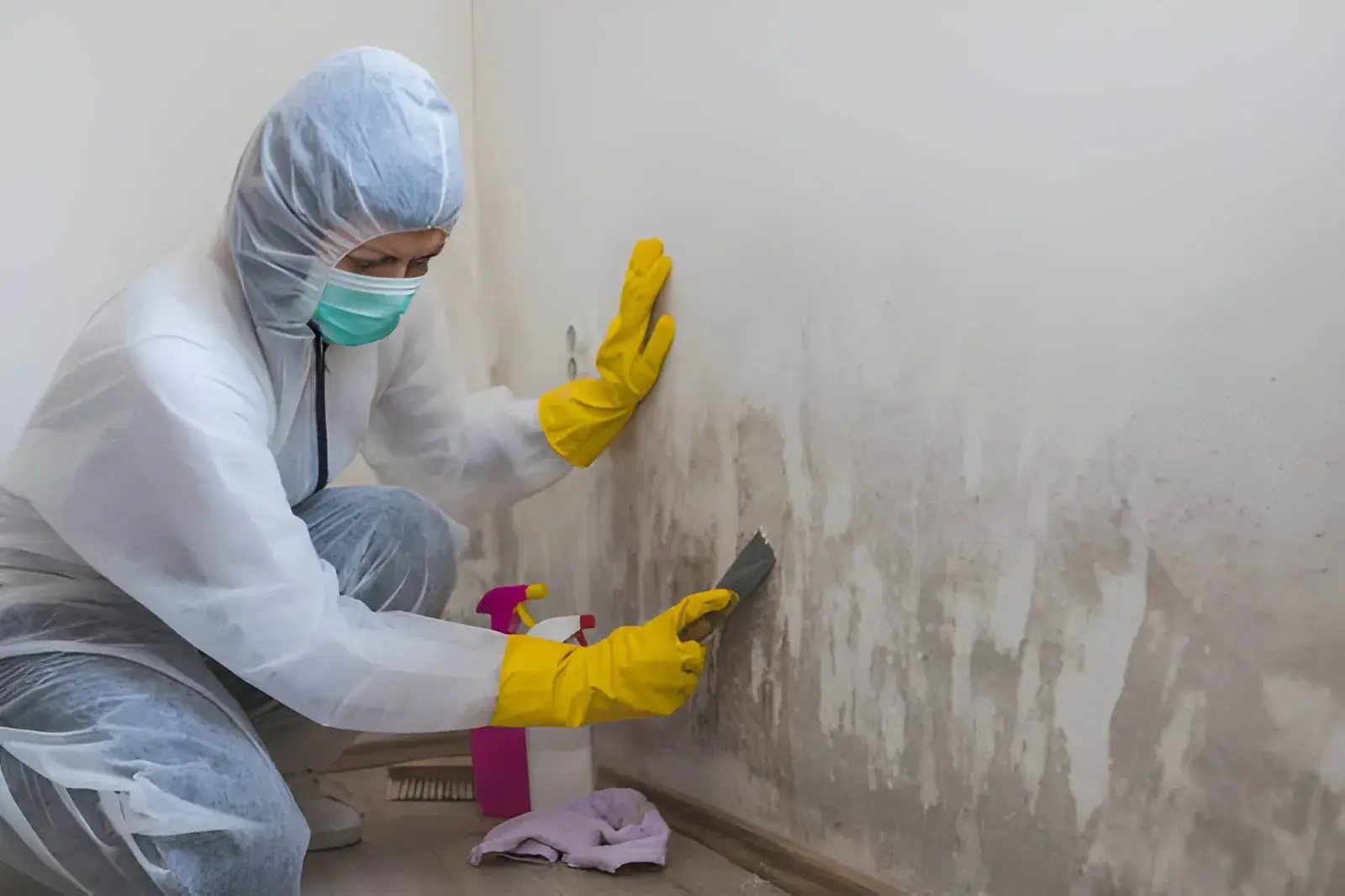
Mold Remediation in Parkville, MO
Active fungal colonies release hazardous mycotoxins and compromise structural framing timbers within days of water intrusion. Our Parkville certified remediation crew arrives within 60 minutes.
What Happens When You Call
Your call connects directly with an IICRC-certified Applied Microbial Remediation Technician who diagnoses moisture history and dispatches our Platte County unit.
Our crew arrives on site within 60 minutes to perform thermal moisture scanning, identify fungal amplification zones, and establish strict containment.
Technicians construct sealed polyethylene containment barriers and deploy commercial negative air HEPA scrubbers to isolate mold spores completely.
We mechanically eliminate fungal colonies via HEPA vacuuming, dry ice or soda blasting, and application of EPA-registered botanical antimicrobials.
Prompt, certified mold remediation is essential to eliminate toxic airborne spores, protect family health, and prevent structural wood decay in Parkville properties. Whether discovering black mold behind finished drywall in a Riss Lake walk-out basement, active colonies in a historic crawl space along Main Street, or ceiling mold in a hillside residence in Thousand Oaks or The National, X Response delivers rigorous scientific abatement. A certified microbial remediation supervisor manages every phase from negative air containment to third-party clearance testing. Call our 24/7 emergency dispatch line now for immediate response.
Why Parkville Homes Are Vulnerable to Mold
It is important to dry water-damaged areas and items within 24-48 hours to prevent mold growth. In Parkville and across southern Platte County, the regional climate and local topography create ideal incubators for fungal proliferation. Sitting directly along the northern bank of the Missouri River, Parkville experiences a humid continental climate marked by prolonged summer heat and humidity, with average ambient relative humidity frequently exceeding 70 percent. This heavy moisture load, combined with river valley fog and convective Midwestern rainstorms, creates chronic moisture tension against building envelopes and foundation masonry.
Parkville's topography and building inventory exhibit distinct fungal contamination patterns. In historic downtown Parkville and properties surrounding Park University, century-old residences and commercial buildings feature unsealed native limestone foundations, rubble stone basements, and dirt crawl spaces. Moisture wicks upward through porous masonry via capillary action, establishing chronic dampness that fosters hidden colonies of Stachybotrys chartarum and Chaetomium behind wood paneling and floor joists. Meanwhile, contemporary executive developments in Riss Lake, The National, and Creekside feature finished walk-out basements embedded into steep clay hillside bluffs. Hydrostatic pressure from saturated Menfro and Knox silt loam soils forces subterranean vapor through concrete slabs and foundation cove joints, fueling rapid mold colonization on drywall backing and carpet underlayment.
Missouri River Valley Microclimate and High Humidity
Proximity to the Missouri River produces localized morning fog and elevated summer humidity levels that keep unconditioned crawl spaces and basements above 60 percent relative humidity.
Steep Bluff Hydrostatic Pressure and Capillary Seepage
Precipitous topography channels heavy stormwater down hillside slopes, forcing groundwater through subterranean concrete joints and foundation cold seams.
Historic Porous Limestone and Rubble Foundations
Nineteenth-century commercial and residential buildings near Main Street contain unsealed stone mortar joints that continuously absorb dampness from surrounding soil.
HVAC Condensation and Attic Moisture Accumulation
High summer cooling demands cause substantial condensation along uninsulated ductwork, encouraging Cladosporium growth inside supply plenums and ceiling cavities.
Finished Walk-Out Basements and Trapped Moisture
Luxury residences throughout Riss Lake feature finished basement walls built directly against exterior foundation concrete, trapping subterranean moisture behind vapor-impermeable insulation.
Eradicating mold in Parkville requires an advanced mastery of psychrometrics, microbiology, and specialized containment protocols. From historic limestone basements to executive hillside walk-outs, X Response provides certified, rapid-recovery restoration.
What Happens to Your Home While You Wait
24–48 Hours
Dormant mold spores absorb moisture, germinate on damp drywall paper, and establish invisible hyphal rooting networks into organic cellulose materials.
3–7 Days
Visible fungal colonies expand across baseboards, wallboard, and subfloors. Colonies begin releasing volatile microbial compounds, causing noticeable musty odors.
1–2 Weeks
Fungal structures penetrate deep into structural wood framing. Fungal sporulation releases millions of microscopic spores into interior air currents, spreading contamination.
2–4 Weeks
Cellulose degradation weakens drywall assemblies and floor underlayment. Inhabitants may experience allergic rhinitis, coughing, eye irritation, and persistent respiratory distress.
One Month and Beyond
Pervasive fungal colonization degrades structural timber framing, requiring invasive structural demolition and comprehensive containment remediation.
Immediate intervention halts fungal colonization before structural timbers decay and indoor air is compromised. Contact X Response immediately for certified mold remediation in Parkville.
How We Restore Mold-Affected Parkville Homes
Our mold remediation methodology strictly conforms to the ANSI/IICRC S520 Standard for Professional Mold Remediation and EPA institutional guidelines, ensuring total fungal containment and safe spore removal.
Comprehensive Moisture Diagnostic and Thermal Imaging Scan
We arrive within 60 minutes in Parkville to inspect affected areas using FLIR thermal cameras, pin-type moisture meters, and calibrated hygrometers to pinpoint the active moisture intrusion source.
Negative Pressure HEPA Containment Setup
We construct airtight six-mil polyethylene containment barriers with zippered airlocks and deploy commercial negative air machines with true HEPA filtration to prevent spore dispersion.
Mechanical Elimination and Precision Surface Cleansing
Technicians perform HEPA vacuuming, wire brushing, and precision soda or dry ice blasting to physically eradicate fungal roots from structural wood framing and masonry walls.
EPA-Registered Botanical Antimicrobial Decontamination
We treat all structural surfaces with hospital-grade, EPA-registered botanical antimicrobials and fungistatic coatings to destroy residual pathogens and prevent recurrence.
Post-Remediation Verification and Clearance Testing
An independent environmental testing laboratory conducts independent air and surface sampling to officially certify that airborne spore counts have returned to clean baseline levels.
The X Response Difference
When toxic mold threatens your Parkville home or commercial facility, choose X Response for rapid arrival, certified microbial containment, and guaranteed clearance testing.
Insurance Claim Guidance for Parkville Homeowners
Navigating an insurance claim for mold remediation in Parkville requires meticulous documentation connecting fungal growth directly to a covered water peril. Missouri homeowners and commercial property insurance policies typically restrict mold coverage unless the colonization directly results from a sudden, accidental water discharge, such as a burst internal supply line or failed water heater. Standard policies often contain specific mold coverage sub-limits. Our restoration specialists record the physical failure point, capture infrared thermal imagery demonstrating moisture migration, and assemble standardized Xactimate line-item estimates to substantiate your claim.
How X Response Helps
- Document the covered water peril that triggered fungal growth to establish direct policy causality
- Record comprehensive high-resolution photo logs and thermal moisture maps of all contaminated building assemblies
- Itemize containment structures, HEPA filtration units, and antimicrobial treatments using standard Xactimate pricing
- Coordinate directly with your carrier adjuster to supply third-party laboratory clearance reports
- Assist in submitting complete remediation dossiers to accelerate insurance reimbursement under applicable policy limits
X Response is an independent disaster recovery and restoration contractor. We are not licensed insurance adjusters, public adjusters, or attorneys. We provide technical structural data and professional mitigation services to support your insurance claim.
Certified Restoration Specialists Serving Parkville
Our Parkville mold remediation team comprises IICRC-certified Applied Microbial Remediation Technicians, Water Restoration Specialists, and indoor air quality experts based right in the Kansas City metropolitan area. Having remediated extensive fungal contamination across Platte County, our specialists possess comprehensive knowledge of local river bluff geology, high groundwater tables, and the unique moisture dynamics of both historic limestone architecture and modern hillside walk-outs.
We operate a dedicated fleet of mobile remediation units fully stocked with commercial negative air machines, true HEPA air scrubbers, HEPA-filtered vacuum extraction systems, and EPA-registered botanical antimicrobials. Operating 24 hours a day, 365 days a year, our Parkville team delivers rapid containment, scientific mold eradication, and permanent moisture control.
In Parkville, X Response works with Best Option Restoration, an independent local restoration partner serving Platte County.
Mold Remediation FAQ for Parkville Homeowners
Other Emergency Services in Parkville

Water Damage Restoration
Burst pipes, storm flooding, standing water. We extract, dry, and restore before mold sets in.
Learn more
Fire Damage Restoration
Structural damage, soot, debris. We stabilize, clean, and rebuild what fire destroyed.
Learn more
Smoke Damage Restoration
Soot residue, chemical odors, HVAC contamination. We decontaminate surfaces, eliminate odors, and restore air quality.
Learn more
Sewage Cleanup
Sewer backups, contaminated water, biohazard. We extract, sanitize, and restore safely.
Learn more