
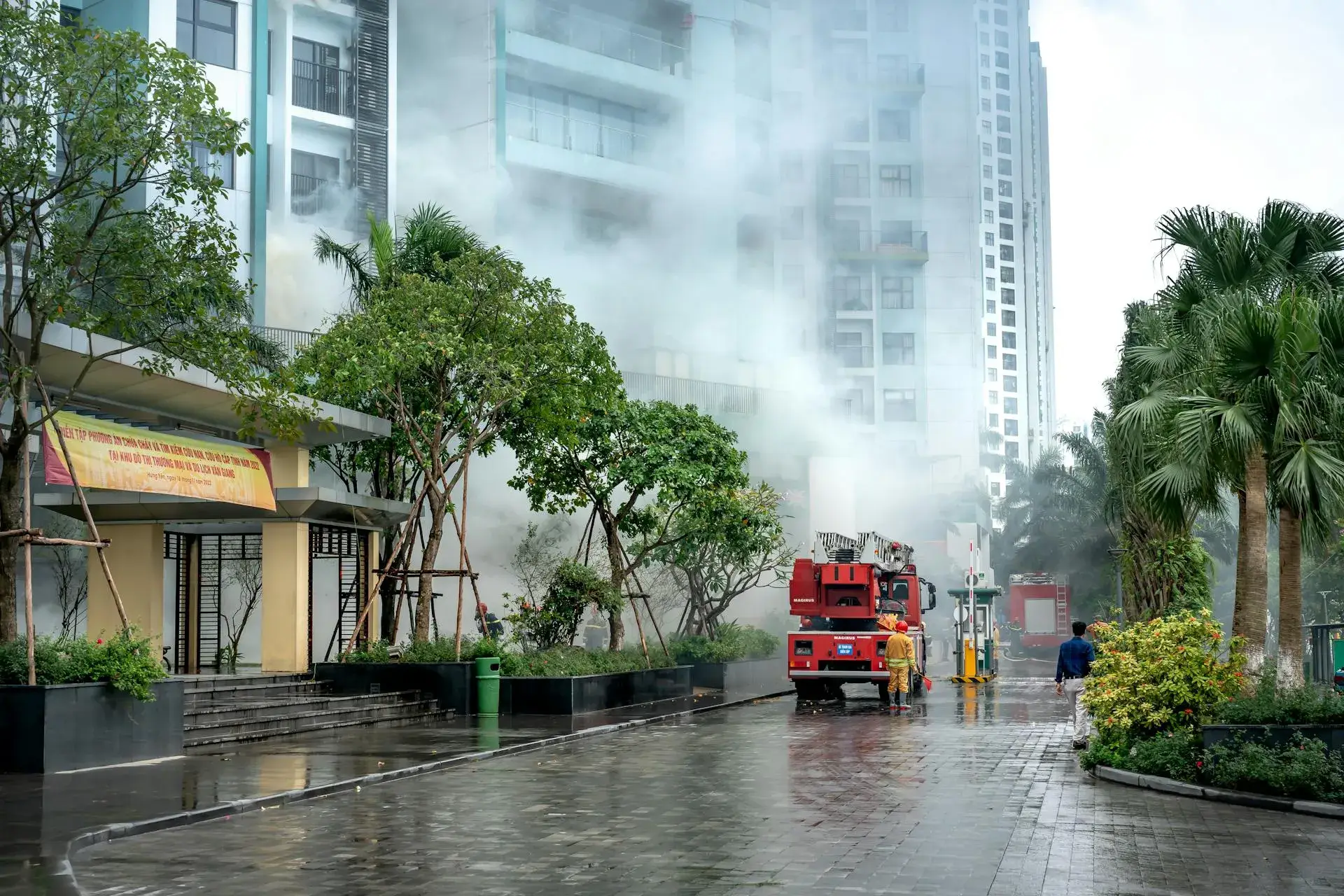
Smoke Damage Restoration
Wildfire impingement, protein residue, chemical odors, soot contamination. Smoke damage can affect your home even without a fire on your property. Our specialists use advanced deodorization and surface treatment to restore your indoor environment.
What Smoke Damage Does to Your Property
Smoke damage is one of the most misunderstood forms of property damage because it can happen without a fire ever touching your home. Wildfire smoke travels hundreds of miles on atmospheric currents and infiltrates buildings through HVAC fresh air intakes, gaps around doors and windows, utility penetrations, and dryer vents. The January 2025 Palisades and Eaton fires in Los Angeles County demonstrated this on a massive scale, contaminating thousands of homes that were never reached by flames. This is called smoke impingement, and it is a distinct damage event with its own restoration requirements and insurance considerations. It is the primary reason smoke damage restoration exists as a standalone service, separate from fire damage restoration.
Smoke Damage Without a Fire on Your Property
Many homeowners are surprised to learn that their home can suffer significant smoke damage even when the nearest fire is miles away. Wildfire smoke impingement affects homes that were never touched by flames, and the restoration it requires is fundamentally different from fire damage repair. There is no structural charring to rebuild and no suppression water to extract. Instead, the challenge is airborne particulate contamination that has settled on every surface, embedded into soft materials, and circulated through your HVAC system. Restoring a smoke-impinged home requires air quality testing, surface decontamination, HVAC cleaning, and specialized deodorization. The insurance claim process is also different, because coverage for smoke from a fire that did not occur on your property varies significantly by policy and state.
Types of Smoke Residue
The type of smoke residue determines the cleaning approach, and using the wrong method can make the damage permanent. There are four primary types, each produced by different materials burning under different conditions.
- Dry smoke residue: Produced by fast-burning, high-temperature fires involving wood, paper, and natural materials. Leaves a fine, powdery soot that is relatively easy to vacuum from hard surfaces but can penetrate deep into porous materials like drywall, insulation, and fabric. Dry smoke has less odor than other types but spreads widely due to the high combustion temperatures that carry particles further.
- Wet smoke residue: Produced by slow-burning, low-temperature fires involving plastics, rubber, and synthetic materials. Creates a thick, sticky, smeary residue with a strong, pungent odor. Wet smoke is the most difficult type to clean because wiping it smears the residue deeper into surfaces rather than removing it. It requires chemical sponges and specialized solvents matched to the specific synthetic compounds involved.
- Protein smoke residue: Produced by kitchen fires involving meat, grease, and organic materials. Nearly invisible on surfaces but produces an extremely strong, persistent odor that permeates the entire structure. Protein residue forms a thin, tacky film that discolors paints and varnishes over time. Because it is almost invisible, homeowners often do not realize the extent of contamination until the odor becomes unbearable.
- Fuel oil soot: Produced by furnace malfunctions, also called puffbacks, where unburned fuel oil ignites inside the combustion chamber and blasts soot through the HVAC ductwork into every room. Fuel oil soot is dense, oily, and extremely difficult to clean. It coats walls, ceilings, furniture, and contents with a fine black film and requires aggressive chemical cleaning and often full HVAC replacement.
How Wildfire Smoke Enters Your Home
Wildfire smoke particles, particularly PM2.5 (particles smaller than 2.5 microns in diameter), are small enough to pass through most standard building materials and HVAC filters. Research from the EPA and PNAS has shown that indoor PM2.5 concentrations can nearly triple during wildfire events, with infiltration rates depending on building age, HVAC configuration, and envelope tightness. Smoke enters through HVAC fresh air intakes where standard filters rated MERV 8 or lower cannot capture fine particulates, through gaps around door frames and window seals, through utility penetrations for wiring and plumbing, and through exhaust fan and dryer vent openings. Once inside, smoke particles settle on every surface, embed into soft furnishings and carpet fibers, and circulate through ductwork long after outdoor air quality improves.
Health Risks of Smoke-Contaminated Indoor Environments
Smoke residue is not just an aesthetic or odor problem. It contains fine particulate matter, volatile organic compounds (VOCs), polycyclic aromatic hydrocarbons (PAHs), and other toxic substances. PM2.5 particles are small enough to penetrate deep into the lungs and enter the bloodstream, where they can trigger respiratory irritation, aggravate asthma and cardiovascular conditions, and cause headaches, dizziness, and fatigue. Children, elderly individuals, and people with pre-existing respiratory or immune conditions face significantly higher risk from prolonged exposure. Professional smoke damage restoration is not optional when indoor air quality has been compromised. It is a health intervention.
The IICRC S700 Standard
Professional smoke damage restoration follows the ANSI/IICRC S700 Standard for Professional Fire and Smoke Damage Restoration, first published in 2025 as the first national consensus standard for this work. The S700 covers assessment of smoke residue presence and boundaries, cleaning and decontamination procedures, odor management techniques, HVAC decontamination, and post-restoration verification. When you contact X Response, our teams follow this standard to ensure your property is restored systematically and to a documented professional benchmark.
How We Restore Smoke-Damaged Properties
From emergency assessment through final air quality verification, here is exactly what happens when you contact X Response.
Emergency Assessment and Air Quality Testing
When you contact X Response, we begin with a thorough assessment of the smoke contamination. Our specialists test indoor air quality for particulate matter and volatile organic compounds, inspect every room for visible and invisible residue, and evaluate your HVAC system for contamination. We identify the type of smoke residue present, because the cleaning approach for dry soot from a wildfire is fundamentally different from protein residue after a kitchen fire. The assessment produces a detailed restoration plan and the documentation your insurance company needs.
Source Identification and Containment
Before cleaning begins, our team identifies how smoke entered the building and contains the affected areas to prevent cross-contamination during restoration. For wildfire impingement, this means sealing HVAC intakes, closing building envelope gaps, and isolating heavily contaminated zones. For interior smoke events like kitchen fires or furnace puffbacks, we identify the origin point and establish containment barriers. Air scrubbers with HEPA filtration are placed throughout the property to begin reducing airborne particulate levels immediately.
Surface Cleaning and Residue Removal
Every surface in the affected area is cleaned using techniques matched to the specific type of smoke residue. Dry soot is removed with HEPA-filtered vacuums and dry chemical sponges to avoid smearing. Wet smoke residue requires specialized solvents and degreasing agents. Protein residue demands enzymatic cleaners that break down the organic compounds causing the odor. Hard surfaces, walls, ceilings, and trim are cleaned systematically. Porous materials like carpet, upholstery, and drapes are evaluated for salvageability. Contents are inventoried, and salvageable items are cleaned using appropriate methods or sent to a specialized contents cleaning facility.
Specialized Deodorization
Surface cleaning removes visible residue, but smoke odor molecules penetrate deep into wall cavities, insulation, and porous materials where wiping cannot reach. Our team uses a combination of professional deodorization techniques based on the severity and type of contamination. Thermal fogging heats deodorizing agents into a fine fog that follows the same pathways smoke originally traveled, reaching behind walls and inside structural cavities. Hydroxyl generators produce hydroxyl radicals that break down odor molecules at the molecular level and are safe to use in occupied spaces. For severe contamination in unoccupied areas, ozone treatment oxidizes odor compounds. In cases of deep penetration, surfaces may be sealed with shellac-based primers before repainting to permanently lock in residual odor molecules.
HVAC Cleaning and Final Air Quality Verification
Smoke particles circulate through HVAC ductwork and settle inside air handlers, coils, and filters. If the HVAC system is not fully decontaminated, it will redistribute smoke residue throughout the building every time it runs, undoing the surface cleaning work. Our team cleans all ductwork, replaces filters, and decontaminates the air handler and coil assemblies. After all cleaning and deodorization is complete, a final air quality test confirms that particulate levels and VOC concentrations have returned to safe levels. A walkthrough with you ensures everything meets our standards and yours before the project closes.
Insurance Guidance for Smoke Damage Claims
Insurance coverage for smoke damage is one of the most contested areas in homeowner's claims, especially when the smoke originates from a wildfire that never reached your property. Most standard homeowner's policies include smoke damage under their fire coverage, but disputes arise over whether the fire needed to occur on the insured property for coverage to apply. The January 2025 Palisades and Eaton fires in Los Angeles brought this issue to national attention, with thousands of homeowners filing smoke impingement claims and many facing denials or underpayments. In response, California's Department of Insurance convened a Smoke Damage Claims and Remediation Task Force, and AB 1795 was introduced in 2026 to establish the first statewide standards for inspection, testing, and remediation of smoke-damaged homes. Other states have no comparable standards yet, which means coverage decisions often come down to individual policy language and adjuster interpretation.
How X Response helps with your smoke damage claim
- Detailed air quality testing results and smoke residue documentation that establishes the presence and extent of contamination
- Residue type identification and cleaning scope of work aligned with IICRC S700 standards
- Coverage alignment review so you understand how your policy applies to smoke impingement, interior smoke events, and HVAC decontamination
- Claims process guidance from initial filing through resolution, including documentation that supports your claim
X Response provides guidance and documentation support. We do not act as public adjusters, make coverage determinations, or guarantee claim outcomes.
Frequently Asked Questions About Smoke Damage Restoration
Other Emergency Restoration Services

Water Damage Restoration
Flooding, burst pipes, storm surges. We extract the water, dry the structure, and restore your property.
Learn more
Fire Damage Restoration
Structural damage, soot, debris. We stabilize, clean, and rebuild what fire destroyed.
Learn more
Mold Remediation
Testing, containment, removal. We find the source, eliminate the growth, and prevent it from returning.
Learn more
Sewage Cleanup
Biohazard situations handled safely with full sanitation, disinfection, and structural restoration.
Learn more