
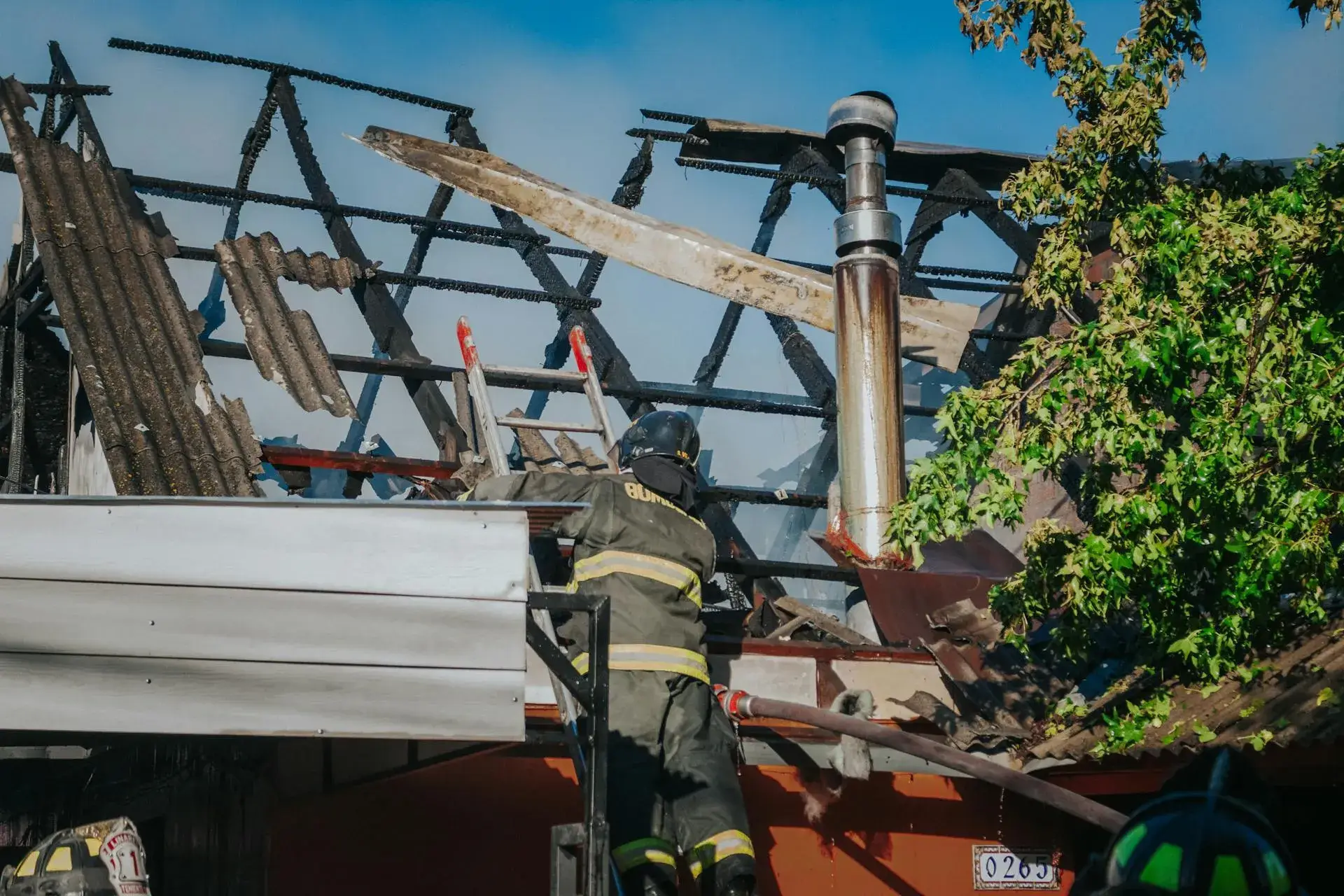
Fire Damage Restoration in Dundalk, MD
Acidic soot and extinguishing water begin permanently etching building finishes within hours. Our Baltimore County fire restoration teams respond to Dundalk within 60 minutes.
What Happens When You Call
Your emergency call is answered immediately by our Baltimore County fire response team, gathering crucial damage details and dispatching mitigation units.
Technicians arrive at your Dundalk property within 60 minutes to secure the structure with emergency window board-up, door replacement, and heavy roof tarping.
Our team conducts a thorough safety inspection alongside the Baltimore County Fire Department, evaluating structural load points and identifying immediate stabilization requirements.
Crews extract extinguishing water, set up negative air scrubbers to capture toxic airborne particulates, and initiate chemical sponge soot mitigation across salvageable surfaces.
A residential fire leaves behind a hazardous combination of structural compromise, corrosive soot, toxic combustion byproducts, and hundreds of gallons of extinguishing water. X Response delivers rapid, end-to-end emergency stabilization for Dundalk property owners. From emergency board-up and temporary weatherproofing to water extraction, structural shoring, soot removal, and complete reconstruction, our certified restoration team handles the entire recovery process. Call now. Your team is standing by.
Why Dundalk Homes Are Vulnerable to Fire Damage
Residential fire damage in Dundalk presents complex restoration challenges driven by the unique architectural heritage and dense construction patterns of this historic industrial community. The 2023 national estimates for residential building fires and losses show that there were: 344,600 fires. In Dundalk, where extensive residential tracts were developed during the early twentieth century by Bethlehem Steel to house thousands of shipyard workers, properties frequently feature continuous shared attic voids, dense brick rowhouse party walls, and early twentieth-century wood framing that facilitate rapid vertical and lateral fire spread.
When a structural fire breaks out in neighborhoods like Old Dundalk, St. Helena, or Inverness, primary suppression is executed by the Baltimore County Fire Department, frequently led by career crews from Dundalk Station 6 on Sollers Point Road and Eastview Station 15. While firefighting efforts successfully contain flames, the thousands of gallons of water pumped into the building saturate plaster, subflooring, and basement foundations. Compounding this moisture burden, burning synthetic modern furnishings produce highly acidic soot that corrodes copper plumbing, etches glass, and bonds permanently with damp surfaces if specialized chemical neutralizers are not applied immediately.
Balloon and Early Platform Framing Vulnerabilities
Many older Dundalk residences built between 1916 and the 1940s lack modern fire stops within exterior wall cavities. Fire originating in a kitchen, furnace room, or basement can travel upward through open wall bays into upper stories and attic rafters within minutes. Restoration requires deep structural evaluation to identify hidden charring along load-bearing studs and floor joists that appear intact on the surface.
Shared Party Walls in Duplexes and Rowhouses
Dense housing configurations throughout Turner Station, Gray Manor, and Dundalk proper feature brick or frame party walls separating adjoining dwellings. Even when fire is confined to a single unit, combustion gases, corrosive smoke, and extinguishing water bleed through mortar voids, floor joist pockets, and shared roof eaves into neighboring properties, requiring multi-unit air filtration and soot decontamination.
Aging Electrical and Heating Infrastructure
Decades of domestic renovations have left many older Dundalk properties with overloaded breaker panels, legacy knob-and-tube wiring fragments, or aging natural gas boilers and space heaters. Electrical arc faults behind lath-and-plaster walls and heating system malfunctions remain frequent ignition sources across mature residential neighborhoods during peak winter heating periods.
Firefighting Water Saturation Near Sea Level
Because Dundalk sits on flat coastal terrain near sea level with shallow groundwater tables, water discharged by fire hoses cannot drain away naturally. Hundreds of gallons accumulate in basements and crawlspaces, saturating structural timber sills and concrete block foundations. Without immediate mechanical water extraction, structural fire damage is rapidly overtaken by massive microbial infestation.
Acidic Soot Binding in Mid-Atlantic Humidity
The high relative humidity characteristic of the Chesapeake Bay estuary accelerates the corrosive chemical reaction between combustion residues and building finishes. Soot containing synthetic plastic compounds turns into an aggressive acid when combined with ambient moisture, etching chrome fixtures, pitting aluminum window frames, and staining porcelain within twenty-four to forty-eight hours.
Recovering from fire in Dundalk requires a specialized protocol that treats structural char, toxic air contamination, and deep moisture saturation simultaneously. Our local Baltimore County crews understand how local residential architecture responds to combustion and water, ensuring a complete and safe return to pre-loss condition.
What Happens to Your Home While You Wait
Within Minutes
Acidic soot and combustion gases settle over all exposed surfaces. Synthetic plastics and foam upholstery release yellowing residues that immediately begin etching glass, acrylic fixtures, and polished metals throughout your Dundalk property.
Hours to 24 Hours
Extinguishing water seeps deep into subfloor assemblies, plaster walls, and basement joists. Unprotected metal surfaces pit and tarnish under corrosive soot exposure. Fire-heated wood releases pungent smoke odors that penetrate sheetrock, carpet, and structural framing.
24 to 48 Hours
Soot residues chemically bond with painted walls, hardwood flooring, and fiberglass tubs, transforming easily cleanable deposits into permanent stains. In Dundalk coastal humidity, stagnant firefighting water begins breeding bacterial colonies and mold spores within saturated drywall.
48 to 72 Hours
Unrestored metals corrode severely, requiring complete replacement rather than refinishing. Wood framing begins warping under combined heat and moisture stress. Soot particles embedded in HVAC ductwork circulate corrosive particulate throughout unaffected rooms.
One Week and Beyond
Structural timber char compromises ceiling load capacities and roof trusses. Porous structural finishes deteriorate beyond recovery, drastically increasing the scope and cost of demolition and framing rebuilds. Prolonged delay risks total denial of salvageable contents coverage.
Immediate professional intervention stops the progression of chemical soot corrosion and water damage. Call X Response now for 24/7 emergency fire damage response in Dundalk.
How We Restore Fire-Damaged Dundalk Homes
We follow rigorous IICRC S540 standards for residential fire restoration, combining emergency structural stabilization with advanced chemical decontamination and certified reconstruction.
Emergency Security and Structural Stabilization
Our first priority upon arriving at your Dundalk property is securing the site against weather and intrusion. Technicians board up breached windows, install heavy-gauge exterior doors, and tarp compromised roof rafters with reinforced structural membranes.
Extinguishing Water Extraction and Environmental Drying
We deploy industrial extraction units and submersible pumps to remove stagnant water left by firefighting operations. Commercial LGR dehumidifiers and desiccant systems are installed immediately to dry saturated timber framing and prevent secondary mold proliferation.
Corrosive Soot and Particulate Removal
Technicians utilize dry chemical soot sponges, HEPA-filtered vacuum systems, and alkaline cleaning solutions to strip acidic combustion residues from walls, ceilings, fixtures, and framing without driving soot particles deeper into porous substrates.
Thermal Fogging and Hydroxyl Odor Neutralization
To eliminate deep-seated smoke odors, we deploy industrial hydroxyl generators and thermal foggers. These systems break down volatile organic combustion compounds at the molecular level within wall cavities, attic insulation, and structural floor systems.
Full Structural Reconstruction and Final Sign-Off
Our licensed Maryland construction team handles complete structural rebuilds, including framing repairs, electrical rewiring, insulation replacement, drywall finishing, and painting, restoring your home to pristine condition with full building permit compliance.
The X Response Difference
\"Trust X Response to deliver comprehensive fire restoration that addresses structural damage, corrosive residues, and insurance documentation under a single unified standard.\"
Insurance Claim Guidance for Dundalk Homeowners
\"Filing a residential fire insurance claim in Baltimore County involves managing complex policy provisions covering structural repairs, contents replacement, code upgrades, and additional living expenses (ALE). Because fire scenes involve both combustion destruction and extensive water saturation from suppression operations, claims adjusters require precise documentation distinguishing between direct fire impact, smoke damage, and secondary water degradation. We work alongside homeowners to deliver detailed, verifiable documentation directly to Maryland insurance adjusters.\"
How X Response Helps
- \"Emergency mitigation documentation proving immediate action was taken to protect the property from weather and secondary loss\"
- \"Comprehensive digital photo and video inventories cataloging charred structural components and non-salvageable personal belongings\"
- \"Detailed architectural scopes of work prepared in industry-standard Xactimate estimating software for transparent adjuster review\"
- \"Structural engineer coordination and Baltimore County permit documentation for required load-bearing frame rebuilds\"
- \"Itemized receipts and mitigation logs supporting Additional Living Expense (ALE) reimbursement while your home is uninhabitable\"
\"X Response provides professional fire mitigation, structural drying, and itemized restoration documentation. We do not act as public adjusters or provide legal representation; claim settlement decisions rest solely with your insurance provider.\"
Certified Restoration Specialists Serving Dundalk
\"Our Dundalk fire restoration division brings specialized experience restoring fire-damaged properties across southeastern Baltimore County. From historic wood-and-stucco cottages in Old Dundalk and brick duplexes along Sollers Point Road to newer residential developments near North Point State Park, our personnel understand how regional construction materials respond to fire, smoke, and suppression water. We pride ourselves on prompt, respectful communication during what is often the most stressful event a homeowner can face.\"
\"Every restoration specialist on our Dundalk team holds current IICRC certification in Fire and Smoke Damage Restoration (FSRT) and Odor Control (OCT). Operating under full Maryland home improvement licensing and comprehensive commercial liability insurance, our crews combine rapid emergency containment with meticulous craftsmanship to return your property safely and permanently to pre-loss condition.\"
In Dundalk, X Response works with Green Clean Restoration LLC, an independent local restoration partner serving Baltimore County.
Fire Damage Restoration FAQ for Dundalk Homeowners
Other Emergency Services in Dundalk

Water Damage Restoration
Burst pipes, storm flooding, standing water. We extract, dry, and restore before mold sets in.
Learn more
Smoke Damage Restoration
Soot residue, chemical odors, HVAC contamination. We decontaminate surfaces, eliminate odors, and restore air quality.
Learn more
Mold Remediation
Testing, containment, removal, prevention. We find the source, eliminate the growth, and stop it from returning.
Learn more
Sewage Cleanup
Sewer backups, contaminated water, biohazard. We extract, sanitize, and restore safely.
Learn more