
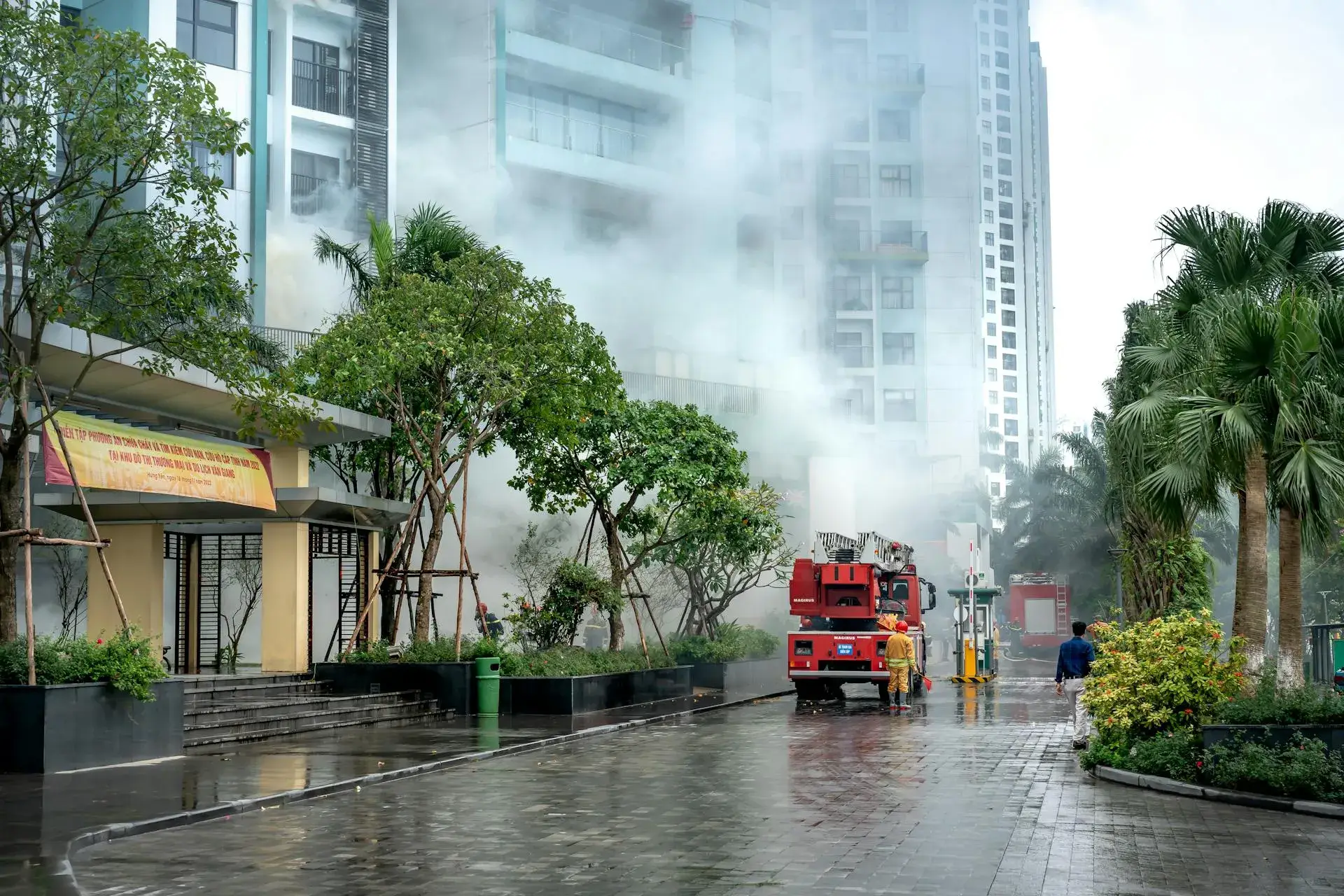
Smoke Damage Restoration in Dundalk, MD
Microscopic smoke particles settle deep inside wall cavities and HVAC systems within hours. Our certified Baltimore County smoke mitigation team responds to Dundalk within 60 minutes.
What Happens When You Call
Your call connects immediately with an emergency restoration specialist who identifies the fuel source, evaluates exposure risks, and dispatches a local Baltimore County crew.
Technicians arrive at your Dundalk property within 60 minutes to inspect the spread of soot, test residue types, and deploy industrial negative air machines.
Our team seals unaffected living zones and places HEPA air scrubbers to capture toxic airborne particulates, carbon compounds, and volatile organic chemicals.
Technicians apply chemical soot sponges, specialized degreasers, and thermal fogging to eliminate corrosive residues and pervasive smoke odors from every surface.
Smoke and corrosive combustion residues do not stay confined to the room where a fire occurred. In dense residential areas, airborne smoke penetrates floor joists, attic voids, and ductwork throughout the entire property. X Response delivers specialized smoke damage restoration across Dundalk, combining HEPA air filtration, chemical surface neutralization, molecular odor elimination, and structural sealing to return your indoor environment to safe, breathable condition. Call now. Your team is standing by.
Why Dundalk Homes Are Vulnerable to Smoke Damage
Smoke damage presents severe indoor air quality and structural challenges throughout southeastern Baltimore County. Dundalk is considered one of the first inner-ring suburbs of Baltimore. Because the community developed rapidly with dense clusters of brick rowhouses, semi-detached duplexes, and compact single-family residences during the twentieth century, smoke and combustion byproducts spread easily across structural partitions, shared party wall assemblies, and interconnected roof spaces.
In Dundalk neighborhoods such as Old Dundalk, St. Helena, Turner Station, and Watersedge, smoke intrusion stems not only from full-scale structural fires but also from localized electrical burnouts, kitchen grease fires, and furnace puffbacks. Burning synthetic furnishings, plastics, and foam insulation produce oily, highly acidic soot that settles over flooring, cabinetry, and home appliances. In the humid coastal climate of the Chesapeake Bay basin, ambient moisture activates these acidic compounds, causing rapid discoloration of painted walls, tarnishing of metal plumbing hardware, and deep embedding of noxious odors into structural wood framing.
Dense Inner-Ring Housing and Party Wall Migration
As an established inner-ring suburb, Dundalk features extensive rows of attached brick duplexes and townhomes. When smoke is released in one unit, combustion gases under high thermal pressure force their way through masonry gaps, electrical conduit raceways, and shared attic voids into adjoining homes, depositing unseen soot layers and creating pervasive smoke odors across multiple households.
Synthetic and Protein Soot Chemistry
Modern household fires burn synthetic materials, including vinyl flooring, plastic electronics, and polyurethane foam furniture, producing sticky, toxic black soot. Meanwhile, kitchen grease flare-ups generate invisible, intensely pungent protein residues. Each residue type requires distinct chemical cleaning agents, because water-based cleaners can permanently smear protein residues into paint and wallpaper.
Coastal Humidity Accelerates Chemical Etching
Dundalk's coastal position along the Patapsco and Back rivers generates sustained atmospheric humidity. When airborne soot particles containing sulfur and chloride compounds settle on damp surfaces, they react with water vapor to form dilute acids. These acids permanently etch polished stone countertops, pit brass and chrome bathroom fixtures, and cause yellowing on synthetic fiberglass tubs within forty-eight hours.
HVAC and Ductwork Contamination
Forced-air heating and central cooling systems draw smoke particulates directly into supply plenums and return ducts. Once inside the ductwork, soot settles on fiberglass duct board and metal conduits, blowing toxic particulate and acrid odors into every room whenever the blower runs. Complete recovery requires mechanical duct cleaning and antimicrobial encapsulation.
Deep Odor Penetration in Historic Lath and Plaster
Historic homes in Old Dundalk built with thick lath and plaster absorb volatile combustion gases deeply. Standard surface cleaning cannot reach particles trapped inside porous plaster matrices. Without advanced molecular neutralization like hydroxyl generation and thermal fogging, ambient temperature and humidity shifts will cause walls to release smoke odors for years.
Effective smoke restoration in Dundalk requires technical precision to remove corrosive chemical residues and destroy odor molecules at the cellular level. Our certified local specialists deploy tailored protocols designed specifically for Baltimore County's unique housing stock and climate.
What Happens to Your Home While You Wait
Within Minutes
Airborne soot particles deposit over ceilings, walls, and horizontal surfaces throughout your Dundalk home. Porous plastics, unsealed wood, and porous upholstery absorb volatile combustion gases, causing immediate yellowing and acrid odor absorption.
Hours to 24 Hours
Acidic residues begin chemically etching painted surfaces, porcelain finishes, and metal hardware. Countertops and appliance finishes suffer permanent staining if corrosive soot films are not removed with specialized chemical sponges.
24 to 48 Hours
Soot chemically binds with wall paint, wood finishes, and flooring materials. Grout lines in bathrooms discolor permanently, fiberglass fixtures yellow, and unprotected metals undergo irreversible corrosion, requiring replacement rather than restoration.
48 to 72 Hours
Smoke odors penetrate deeply into structural wall studs, floor joists, and attic rafters. HVAC ducts distribute soot into unaffected areas, and secondary chemical degradation of carpeting and window treatments forces extensive replacement.
One Week and Beyond
Severe, prolonged soot exposure causes permanent chemical etching of glass and structural degradation of painted surfaces. Remediation scope increases dramatically, requiring complete encapsulation of structural framing, extensive drywall removal, and whole-house duct replacement.
Prompt smoke remediation halts chemical etching and saves thousands of dollars in contents and finishes. Contact X Response today for emergency smoke damage restoration in Dundalk.
How We Restore Smoke-Damaged Dundalk Homes
Our smoke mitigation protocol complies with strict IICRC S540 standards, targeting microscopic particulates and volatile chemical odors through a five-stage restoration system.
Comprehensive Residue Assessment and Testing
Upon arrival in Dundalk, technicians test soot residues across multiple surfaces to distinguish between wet smoke, dry smoke, protein films, and oil-based soot. Identifying the exact chemical composition dictates the selection of non-destructive cleaning agents.
Air Scrubbing and Particulate Containment
We establish negative air pressure containment zones and install industrial HEPA air scrubbers capable of capturing airborne particulates down to 0.3 microns. This stops soot migration into clean areas and immediately improves indoor air quality.
Specialized Surface Decontamination
Technicians utilize dry vulcanized chemical rubber sponges, alkaline soot-stripping foams, and HEPA vacuums to lift soot from ceilings, walls, woodwork, and light fixtures without embedding residues into underlying materials.
HVAC and Ductwork Sanitation
We thoroughly vacuum and sanitize the entire HVAC air delivery system, brushing supply ducts, clearing blower assemblies, and applying EPA-registered odor-encapsulating sealants to prevent future odor recirculation.
Molecular Odor Neutralization and Sealing
Using commercial hydroxyl generators, thermal foggers, and specialized vapor phase counteractants, we neutralize embedded odor compounds within framing and masonry before applying clear odor-barrier primers to salvageable framing.
The X Response Difference
\"Choose X Response for definitive smoke and soot remediation that protects your property value and restores healthy indoor breathing air.\"
Insurance Claim Guidance for Dundalk Homeowners
\"Smoke damage claims in Maryland require thorough documentation proving the extent of particulate penetration throughout living areas and HVAC systems. Insurance carriers often attempt to limit smoke restoration to superficial cleaning, overlooking hidden soot inside wall cavities, ceiling voids, and ductwork. Because smoke particulates contain corrosive acids that degrade metals, electronics, and porous finishes over time, detailed technical reports are critical. Our Baltimore County specialists provide adjusters with itemized inventories, photo evidence, and certified IICRC scopes of work.\"
How X Response Helps
- \"Detailed photographic evidence of soot accumulation across wall surfaces, attic framing, and mechanical equipment\"
- \"Chemical residue testing logs identifying specific soot types and required remediation procedures\"
- \"Comprehensive inventories of non-salvageable personal belongings, textiles, and porous contents for adjuster review\"
- \"Detailed HVAC contamination reports and certified duct cleaning estimates aligned with Maryland insurance guidelines\"
- \"Pre-cleaning and post-cleaning indoor air particulate verification reports confirming complete decontamination\"
\"X Response provides professional smoke mitigation and comprehensive insurance documentation. We do not act as public adjusters; final coverage decisions remain the responsibility of your insurance carrier.\"
Certified Restoration Specialists Serving Dundalk
\"Our Dundalk smoke remediation team is committed to providing prompt, compassionate, and technically rigorous restoration services throughout southeastern Baltimore County. Serving residential communities from Old Dundalk and Inverness to Watersedge and St. Helena, our technicians understand the unique structural characteristics of local homes, including shared party walls, historic lath-and-plaster assemblies, and dense neighborhood layouts. We treat your property and personal belongings with the utmost care and respect.\"
\"Every technician on our response team holds active IICRC certifications in Fire and Smoke Damage Restoration (FSRT) and Odor Control (OCT). Equipped with commercial hydroxyl generators, thermal foggers, and HEPA air scrubbing fleets, our specialists possess the expertise and technology required to eliminate stubborn smoke odors and corrosive residues permanently. You can rely on our team for prompt 24/7 emergency response and exceptional restoration results.\"
In Dundalk, X Response works with Green Clean Restoration LLC, an independent local restoration partner serving Baltimore County.
Smoke Damage Restoration FAQ for Dundalk Homeowners
Other Emergency Services in Dundalk

Water Damage Restoration
Burst pipes, storm flooding, standing water. We extract, dry, and restore before mold sets in.
Learn more
Fire Damage Restoration
Structural damage, soot, debris. We stabilize, clean, and rebuild what fire destroyed.
Learn more
Mold Remediation
Testing, containment, removal, prevention. We find the source, eliminate the growth, and stop it from returning.
Learn more
Sewage Cleanup
Sewer backups, contaminated water, biohazard. We extract, sanitize, and restore safely.
Learn more