
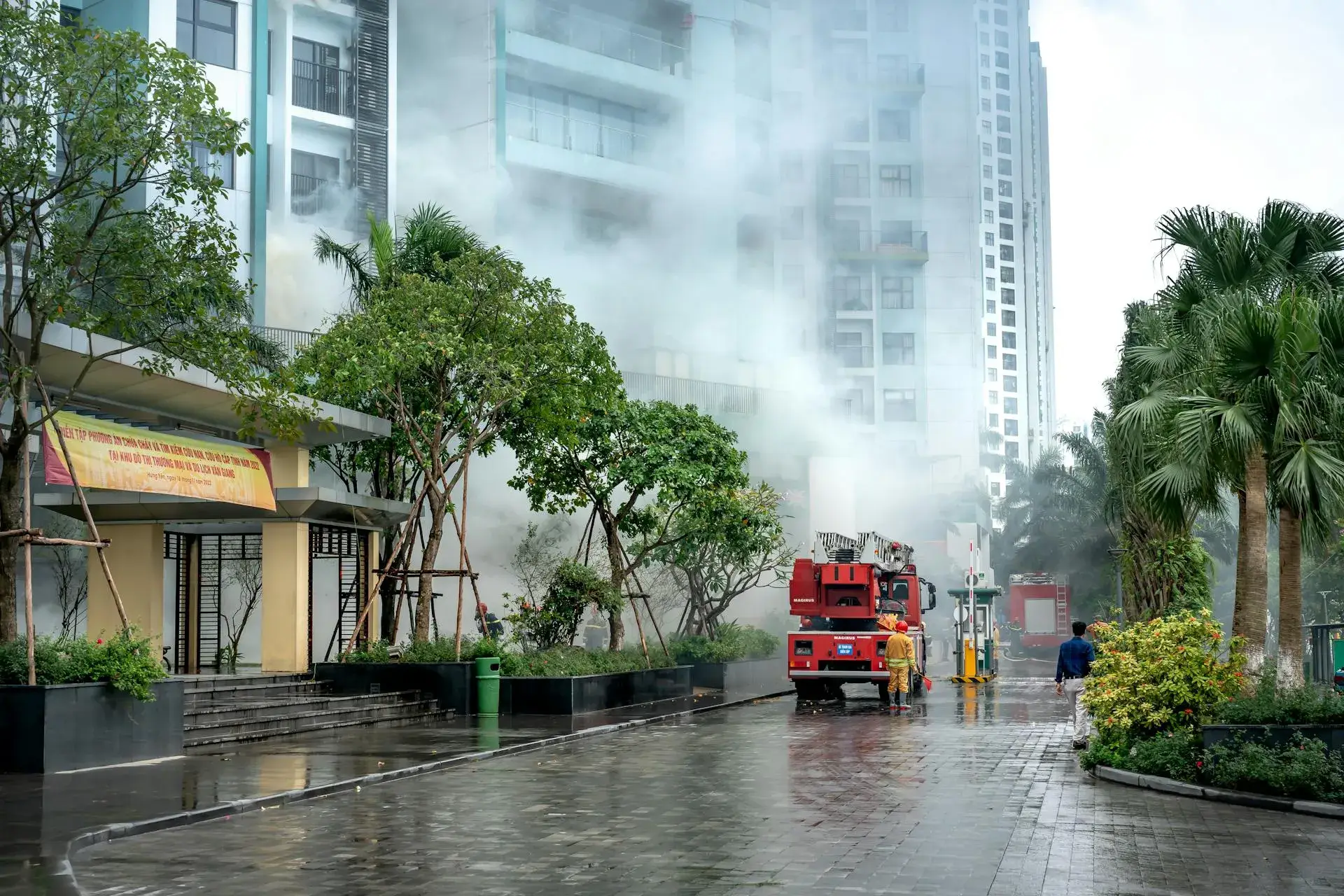
Smoke Damage Restoration in Buffalo Grove, IL
Smoke residue bonds permanently to surfaces within hours and penetrates deeper into materials with every passing day. Our local team responds to Buffalo Grove smoke emergencies within 60 minutes.
What Happens When You Call
A real person answers, not a call center. We assess your smoke damage situation, ask the right questions, and begin coordinating your response immediately.
Your dedicated restoration team is dispatched from our local base serving Buffalo Grove and the surrounding northwest suburban communities.
Team arrives with air quality testing equipment, soot identification tools, and specialized cleaning systems. Assessment and mitigation begin immediately.
Damage mapped, cleaning protocols established, HVAC contamination assessed. You know exactly what the restoration involves and how long it will take.
Smoke damage does not wait for convenient timing. Whether it followed a structure fire in your home, migrated from a neighbor's fire through shared walls, or infiltrated from an outdoor air quality emergency, the residue is actively bonding to your surfaces and penetrating your materials right now. X Response exists for exactly this moment. When you reach out, your restoration team is mobilized within minutes and on site within the hour. From that point forward, one team manages everything: assessment, cleaning, odor elimination, and documentation. Call now. Your team is standing by.
Why Buffalo Grove Homes Are Vulnerable to Smoke Damage
Buffalo Grove sits in the northwest suburbs of Chicago, approximately 35 miles from downtown, straddling the Lake County and Cook County border. The village of 43,212 residents encompasses 9.6 square miles of primarily residential development built between the 1960s and 1980s. This housing stock, with its vintage HVAC systems, original window seals, and decades-old weatherstripping, is particularly susceptible to smoke infiltration from both structure fires and outdoor environmental events. On June 27, 2023, smoke from Canadian wildfires pushed the Chicago metropolitan area's Air Quality Index to 250, a reading classified as 'very unhealthy' by the EPA, with the Illinois Environmental Protection Agency air monitors confirming the conditions. IQAir ranked Chicago as having the worst air quality of any major city in the world that day, surpassing cities traditionally associated with severe pollution. The fine particulate matter (PM2.5) from Quebec's wildfire smoke infiltrated homes throughout the northwest suburbs, settling on surfaces, penetrating HVAC systems, and embedding in soft materials across Buffalo Grove.
The June 2023 event demonstrated a smoke damage mechanism that most homeowners had never previously encountered: prolonged environmental smoke infiltration over multiple days. Unlike a structure fire that produces intense but brief smoke exposure, the wildfire smoke event exposed Buffalo Grove homes to sustained elevated particulate levels for approximately 48 hours. During that period, every HVAC system in every home that continued operating drew outdoor air through its fresh-air intake and distributed wildfire particulates throughout the ductwork and into every room with a supply register. Homes with older construction, deteriorated weather seals, or any gap in the building envelope experienced additional infiltration through those pathways. The result was a community-wide contamination event that left residue on surfaces, odors in soft materials, and particulates embedded in HVAC systems across thousands of homes.
The June 2023 Canadian Wildfire Smoke Event
On June 27, 2023, the Chicago metropolitan area experienced its worst recorded fine-particulate air pollution as smoke from Quebec wildfires descended on the upper Midwest. The Air Quality Index reached 250 in the Chicago area, classified as 'very unhealthy' by the EPA. Illinois Environmental Protection Agency monitors confirmed the conditions, and Chicago Mayor Brandon Johnson issued a public statement noting that the EPA had categorized the region's Air Quality Index as 'unhealthy.' For Buffalo Grove residents, this meant that the outdoor air they were breathing, and that their HVAC systems were drawing into their homes, contained wildfire particulates at concentrations exceeding anything previously experienced in the northwest suburbs. The smoke was visible: residents described orange-tinted skies, reduced visibility, and a persistent burning smell that permeated indoor spaces despite closed windows. The event lasted approximately two days before a thunderstorm complex on June 29 blew through and cleared the air, but the particulates that had already infiltrated homes remained on surfaces and within HVAC systems.
HVAC-Distributed Contamination in 1960s-1980s Homes
Buffalo Grove's housing stock was built predominantly in an era when residential HVAC systems were designed for basic heating and cooling without high-efficiency filtration. Standard 1-inch fiberglass filters, common in the forced-air systems installed in these homes, capture large dust particles but allow fine particulate matter like wildfire smoke (PM2.5, particles smaller than 2.5 micrometers) to pass directly through. During the June 2023 smoke event, every furnace and air handler that operated drew contaminated outdoor air through its fresh-air intake, passed it through an ineffective filter, and distributed it to every supply register in the home. The particulates then settled on surfaces in every room, embedded in carpet fibers, penetrated upholstery fabric, and coated the interior surfaces of the ductwork itself. Once in the ductwork, those particles are redistributed every time the system cycles, making the HVAC system a persistent re-contamination source until it is professionally cleaned.
Structure Fire Smoke Migration in Attached Housing
Beyond environmental smoke events, Buffalo Grove's townhome and condominium developments create a unique smoke damage pattern following structure fires. When fire occurs in one unit of an attached building, smoke follows the path of least resistance through shared wall cavities, ceiling plenums, electrical and plumbing penetrations, and any gap in the party wall assembly. The March 2025 fire at Le Parc Circle demonstrated this pattern: smoke migrated through the building's structural frame into all six units. But smoke migration is not limited to the building where the fire occurs. Smoke from an exterior structure fire travels with prevailing winds and infiltrates neighboring buildings through open windows, HVAC intakes, and envelope gaps. Buffalo Grove's townhome density means that a fire in one building can produce smoke damage in adjacent buildings dozens of feet away, particularly when strong winds carry smoke horizontally across the development.
Smoke Types and Their Distinct Behaviors
Not all smoke damage responds to the same cleaning approach. The smoke from a kitchen fire that burned food and grease produces a sticky, yellowish protein residue with a distinctive rancid odor that bonds aggressively to surfaces. Smoke from a fire that burned synthetic materials like plastics, foam cushions, or engineered wood products produces a black, smearing soot that requires dry-cleaning methods before any wet cleaning can occur. Smoke from an electrical fire produces a fine, powdery residue that infiltrates micro-pores in wood and concrete. And smoke from a wildfire event like June 2023 produces an extremely fine particulate that is invisible on individual surfaces but accumulates as a haze on glass, a musty odor in soft materials, and a gritty residue in HVAC components. Each type requires specific cleaning chemistry, specific techniques, and specific equipment. Using the wrong approach on the wrong soot type can drive residue deeper into materials, converting a cleanable surface into one that requires replacement.
Odor Penetration in Porous Building Materials
Smoke odor is not just a surface phenomenon. The volatile organic compounds and microscopic particulates that carry smell penetrate into porous materials at a molecular level. In Buffalo Grove homes with original 1960s and 1970s construction, the concrete foundation walls, exposed framing in unfinished basements, original hardwood subflooring, and gypsum drywall all absorb smoke odor. Carpet, carpet padding, drapes, upholstered furniture, mattresses, and clothing trap odor in their fiber structure. Even sealed surfaces like painted walls absorb smoke volatiles through microscopic pores in the paint film. Superficial cleaning removes visible soot but does not address the odor embedded below the surface. Professional odor elimination requires thermal fogging, ozone treatment, or hydroxyl generation that reaches the molecular-level contamination within porous materials, not just the residue sitting on top. Without this deeper treatment, the smell returns every time temperature and humidity rise because warmth releases the trapped volatiles back into the air.
Smoke damage in Buffalo Grove comes from multiple sources and each demands a distinct restoration approach. Environmental wildfire smoke infiltrates entire homes through HVAC systems and building envelope gaps, contaminating every room simultaneously but at low visible intensity. Structure fire smoke concentrates intense contamination in the fire-origin area while migrating at lower concentrations through shared structural cavities into adjacent spaces. And each fire type produces a different soot chemistry that requires matched cleaning techniques. The common thread is time sensitivity: smoke residue bonds more permanently to surfaces with every hour that passes, and odor compounds penetrate deeper into porous materials as temperature and humidity drive them inward. Professional intervention within the first 24 hours preserves materials that become unsalvageable at 72 hours.
What Happens to Your Home While You Wait
Within 1 Hour
Fresh soot sits on surfaces in a loose, removable state. Acidic components begin reacting with metals, causing initial tarnishing on chrome, brass, and aluminum fixtures. Smoke odor is present but has not yet fully penetrated porous materials. This is the optimal window for professional intervention: most surfaces can be cleaned without aggressive chemical treatment, and materials that would otherwise require replacement can still be saved. In Buffalo Grove's attached buildings, smoke may still be actively migrating through shared cavities from the source into adjacent units.
1–24 Hours
Soot begins chemically bonding to painted surfaces, finished wood, and synthetic materials. Cleaning becomes more difficult and requires stronger chemical agents. Acidic residue etches metal surfaces, producing visible corrosion on light fixtures, door hardware, and appliance fronts. Smoke odor penetrates the first layer of porous materials: carpet fibers, fabric weaves, and the surface cells of raw wood. HVAC systems that continue to operate redistribute particulates to previously uncontaminated areas of the home and embed them deeper into ductwork surfaces.
24–48 Hours
Permanent discoloration develops on light-colored surfaces that were not sealed or cleaned. Yellowish staining appears on walls, ceilings, and light fixtures. Metal corrosion becomes visible without magnification. Smoke odor penetrates deeper into soft materials and begins embedding in concrete, framing lumber, and subfloor materials. The distinction between cleanable and replaceable shifts significantly toward replacement. Cleaning that could have been accomplished with standard methods now requires aggressive chemical treatment that may itself damage delicate surfaces.
48–72 Hours
Smoke residue has fully bonded to most surfaces. Many porous materials, including some hardwoods, natural stone, and specialty finishes, sustain permanent damage that cannot be reversed through cleaning. Odor has penetrated multiple layers into soft materials and structural elements. Restoration scope and cost increase substantially. Materials that could have been cleaned in the first 24 hours now require replacement. The total project cost at this point can be two to three times what it would have been with immediate intervention.
One Week and Beyond
Extensive permanent damage throughout. Metals deeply corroded. Soft materials require disposal rather than cleaning. Odor is fully embedded in structural materials and may require encapsulation with specialized sealants or physical removal of affected drywall, insulation, and framing. HVAC systems that operated during and after the event have distributed contamination into every duct run, register, and component, typically requiring system-wide replacement rather than cleaning. The project approaches full interior renovation rather than targeted restoration.
Every hour that smoke residue sits on your surfaces, more of it bonds permanently and more odor penetrates deeper. Contact X Response now. Our Buffalo Grove team responds within 60 minutes to begin the preservation window.
How We Restore Smoke-Damaged Buffalo Grove Homes
Smoke damage restoration requires precise identification of the smoke type, systematic cleaning from least to most damaged areas, and verified odor elimination. Here is exactly what the process involves for Buffalo Grove properties.
Smoke Source Identification and Damage Mapping
Our team begins by identifying the smoke type and mapping the full extent of contamination. Different sources, whether a kitchen fire, synthetic-material fire, electrical fire, or environmental wildfire smoke, produce different residue types that require different cleaning chemistry. We test surfaces throughout the property to determine where smoke reached, how deeply it penetrated, and which materials can be restored versus which require replacement. In Buffalo Grove's multi-unit buildings, we trace smoke migration paths through shared structural cavities to document the full extent of contamination across all affected units. For environmental smoke events, we assess the HVAC system's role in distributing particulates and map contamination levels room by room.
Air Quality Stabilization
Before detailed cleaning begins, we establish air quality control throughout the affected areas. HEPA air scrubbers with activated carbon pre-filters are positioned to capture airborne particulates and volatile organic compounds. Negative air pressure may be established in heavily contaminated areas to prevent cross-contamination to cleaner spaces during the restoration process. For homes where the HVAC system distributed smoke throughout, we seal supply registers in unaffected areas to prevent the cleaning process from disturbing settled particulates in those rooms until we are ready to address them. This containment strategy ensures that our cleaning work does not inadvertently spread contamination to areas that escaped the initial event.
Surface Cleaning and Soot Removal
Using cleaning agents and techniques matched to the specific soot type identified during assessment, our team systematically removes smoke residue from all affected surfaces. We work top-down and from least-damaged to most-damaged areas to prevent recontamination. Protein residue from kitchen fires requires enzymatic cleaners. Synthetic soot requires dry-sponge pre-cleaning before any wet methods. Wildfire particulate requires HEPA vacuuming before chemical treatment. Hard surfaces are cleaned and sealed. Porous surfaces are evaluated for salvageability and either deep-cleaned or removed. Contents including clothing, documents, electronics, and soft furnishings are categorized and either cleaned on-site or packed for off-site specialist treatment. Throughout, we protect cleaned areas from recontamination by maintaining air quality controls and sequencing the work directionally.
Odor Elimination
Surface cleaning removes visible residue but does not fully eliminate smoke odor embedded in porous materials. We deploy professional odor elimination technology appropriate to the contamination level. For moderate smoke exposure, hydroxyl generators neutralize odor compounds safely while occupants can remain in unaffected areas. For heavy contamination, thermal fogging penetrates porous materials with deodorizing agents that reach the same depths the smoke volatiles did. For severe cases, ozone treatment oxidizes odor molecules at the molecular level, though this requires the space to be unoccupied during treatment. In most Buffalo Grove projects, we use a combination approach: hydroxyl generation throughout the project, thermal fogging for specific materials, and targeted ozone treatment for enclosed spaces like closets, cabinets, and HVAC plenums where odor concentrates.
HVAC Decontamination and Verification
The forced-air HVAC system in every Buffalo Grove home is either a victim of smoke contamination or a distribution mechanism that spread it. In either case, the system must be professionally addressed before the restoration is complete. We clean all accessible ductwork, replace filters, clean blower components, and treat the air handler interior. For systems heavily contaminated by prolonged smoke exposure, complete duct replacement may be more effective than repeated cleaning. After all cleaning and odor treatment is complete, we verify results with air quality testing and surface sampling. If any area does not meet our standards, we retreat it. Final documentation includes before-and-after photos, air quality readings, and a written scope of all work performed for your insurance records.
The X Response Difference
When you contact X Response for smoke damage in Buffalo Grove, you get a restoration team that understands smoke at the chemical level, not just the visible level. We identify what burned, how it contaminated your property, and what it takes to fully eliminate both the residue and the odor, permanently.
Insurance Claim Guidance for Buffalo Grove Homeowners
Smoke damage insurance coverage in Illinois depends on the source of the smoke. Smoke from a structure fire on your property or an adjacent property is covered under standard homeowner's policies as fire damage, including smoke migration to areas the fire never directly reached. Smoke from an environmental event like the June 2023 Canadian wildfire event falls into a grayer area that depends on your specific policy language and carrier interpretation. Some policies cover smoke damage from any source under the broad 'direct physical loss' provision, while others may attempt to classify prolonged environmental exposure differently. For Buffalo Grove homeowners in attached buildings, smoke that migrates from a neighbor's fire through shared structural cavities is covered under your own policy as damage from a covered peril, regardless of whose unit the fire started in. The key to successful claims in all smoke damage scenarios is thorough documentation of the extent, type, and source of contamination from the earliest possible point in the restoration.
How X Response Helps
- Document all smoke damage with professional photos, soot type identification, and air quality measurements from the moment our team arrives
- Identify and document the smoke source clearly, as structure fire smoke and environmental smoke may trigger different coverage provisions
- For townhome and condo owners, document smoke migration through shared structural elements to establish the connection to the covered fire event
- Prepare a detailed scope of work that distinguishes between cleaning, odor treatment, and material replacement so your adjuster can evaluate each component
- Maintain air quality test results and completion verification data that proves the restoration achieved documented standards
X Response does not file claims on your behalf, adjust claims, or make coverage determinations. We provide documentation and guidance to help you make informed decisions about your property and your policy. Coverage decisions are made solely by your insurance carrier.
Certified Restoration Specialists Serving Buffalo Grove
When you contact X Response for smoke damage in Buffalo Grove, your restoration team is drawn from certified professionals who specialize in smoke chemistry and odor science, not general cleaning. They understand the difference between protein residue from a kitchen fire, synthetic char from burning plastics, fine particulate from wildfire events, and the complex mix produced by structure fires that burned multiple material types simultaneously. They know how Buffalo Grove's 1960s-1980s housing stock with its original HVAC systems and aging building envelopes responds to smoke infiltration. They have worked through multi-unit smoke migration events in the Le Parc and Cambridge townhome complexes, single-family smoke damage following localized fires in the original subdivisions, and the widespread environmental contamination from the June 2023 wildfire smoke event that affected homes across the northwest suburbs.
Every technician on your team holds current IICRC certification in fire and smoke restoration, with specific training in odor control technology and air quality verification. Equipment includes HEPA air scrubbers, hydroxyl generators, thermal foggers, ozone generators, commercial air quality monitors, and the full range of specialized cleaning chemistry matched to every soot type. When your team arrives, they bring the diagnostic capability to identify what you are dealing with and the treatment capability to resolve it, without delays for equipment sourcing or chemistry procurement.
In Buffalo Grove, X Response works with Scene Cleaners, an independent local restoration partner serving Lake County.
Smoke Damage Restoration FAQ for Buffalo Grove Homeowners
Other Emergency Services in Buffalo Grove
Water Damage Restoration
Burst pipes, storm flooding, standing water. We extract, dry, and restore before mold sets in.
Learn more
Fire Damage Restoration
Structural damage, soot, debris. We stabilize, clean, and rebuild what fire destroyed.
Learn more
Mold Remediation
Testing, containment, removal, prevention. We find the source, eliminate the growth, and stop it from returning.
Learn more
Sewage Cleanup
Sewer backups, contaminated water, biohazard. We extract, sanitize, and restore safely.
Learn more