
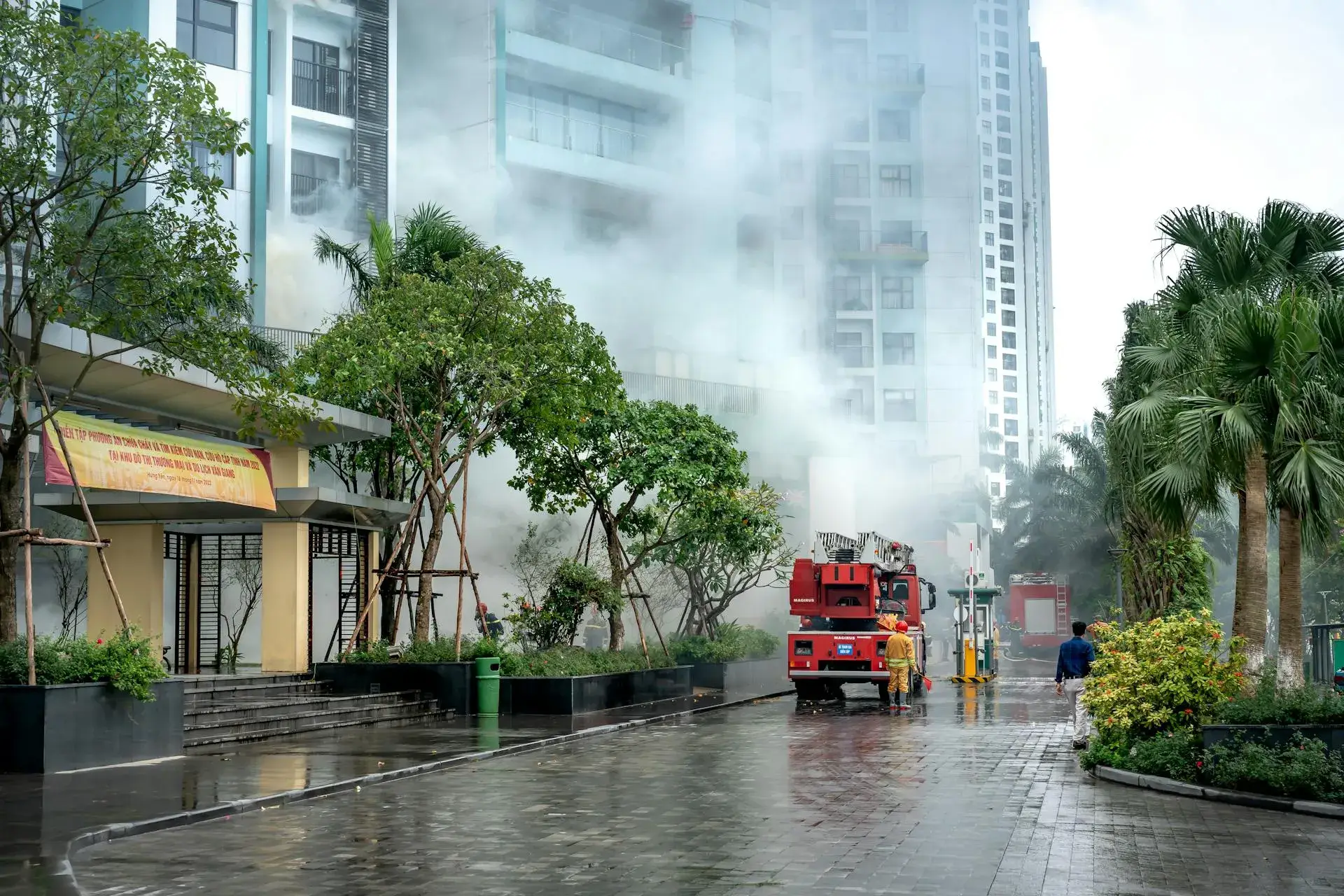
Smoke Damage Restoration in Overland Park, KS
Smoke residue bonds to surfaces within hours and becomes permanently damaging within days. Our local team responds to Overland Park smoke emergencies immediately.
What Happens When You Call
A real person answers, not a call center. We assess your situation, identify the likely smoke source and residue type, and begin coordinating your response immediately.
Your dedicated restoration team is dispatched from our local base serving Overland Park and the surrounding Johnson County communities.
Team arrives with air scrubbers, thermal fogging equipment, and professional cleaning supplies matched to your specific residue type. Assessment and mitigation begin immediately.
Smoke pathways traced, initial residue addressed, air quality stabilized, and restoration plan documented. You know exactly what comes next.
Smoke is still in your home. Whether from a house fire, a neighbor's fire, a furnace puffback, or wildfire haze that infiltrated your living space, microscopic particles are embedding into every porous surface they touch. The longer they sit, the deeper they bond. You need a team that can trace where smoke traveled, identify what type of residue you are dealing with, and eliminate it at the source before permanent damage sets in. Call now. Your team is standing by.
Why Overland Park Homes Are Vulnerable to Smoke Damage
Overland Park is a city of approximately 203,000 residents in Johnson County, Kansas, covering more than 75 square miles of suburban development on the Kansas side of the Kansas City metro. The city's housing stock ranges from 1950s-era homes along the northern Metcalf Avenue corridor to brand-new construction in the far south past 175th Street. This diversity creates multiple smoke damage scenarios: older homes with aging furnace systems are vulnerable to puffbacks that blast soot through ductwork, while newer homes with tight building envelopes trap smoke that enters from external sources. The forced-air HVAC systems standard throughout all of Overland Park's residential construction become distribution networks that spread smoke contamination from any source to every room with a supply register.
In late June 2023, smoke from Canadian wildfires drifted into the Kansas City metro and pushed air quality into the unhealthy range across Overland Park and Johnson County. KMBC reported reduced visibility and air quality advisories urging residents to limit outdoor activity. That event demonstrated how external smoke can infiltrate homes even without a fire on the property: particles enter through gaps around doors and windows, through fresh-air intakes on HVAC systems, and through any unsealed penetration in the building envelope. Homes that ran their HVAC systems during the smoke event pulled contaminated outdoor air through their fresh-air intakes and distributed it throughout the house, depositing fine particulate on every surface the airstream touched. That residue does not leave when the outdoor air clears. It remains embedded in soft furnishings, carpet fibers, drapery, and HVAC ductwork until professionally removed.
Wildfire Smoke Intrusion Events
The June 2023 Canadian wildfire smoke event was not a one-time anomaly for the Kansas City metro. The region sits in the central corridor where upper-level wind patterns carry wildfire smoke from both Canadian fires to the north and western U.S. fires into the Midwest. When these smoke events push AQI readings into the unhealthy range, the fine particulate matter (PM2.5) is small enough to pass through standard HVAC filters and enter homes through building gaps that homeowners never notice under normal conditions. In Overland Park's newer construction south of 135th Street, homes with mechanical fresh-air ventilation systems are particularly vulnerable because those systems are designed to bring outdoor air inside continuously. During a smoke event, they bring contaminated air directly into the living space and distribute it through every supply duct. Even after the outdoor smoke clears, the residue deposited on interior surfaces, in carpet fibers, and throughout ductwork remains and continues off-gassing volatile compounds that irritate respiratory systems.
Furnace Puffback Events in Older Homes
A furnace puffback occurs when unburned fuel accumulates in the combustion chamber and then ignites all at once, blasting soot and combustion byproducts out of the furnace and into the home's ductwork. The soot is then distributed to every room with a supply register before the homeowner even understands what happened. In Overland Park's older northern neighborhoods between 75th and 103rd streets, where homes built in the 1950s through 1970s often retain original or aging gas furnaces, puffbacks are a recurring problem, particularly at the start of the heating season when systems fire up after months of dormancy. The residue from a puffback is oily, fine-grained, and extremely difficult to clean because it bonds to painted surfaces, settles into carpet fibers, and coats the interior of ductwork along its entire length. A single puffback event can contaminate an entire home through the forced-air system in minutes.
Neighbor and Adjacent Structure Fires
Overland Park's suburban density means that a fire in one home or structure can drive smoke into neighboring properties even when flames never cross the property line. Radiant heat cracks windows, allowing smoke to enter directly. Smoke plumes settle over adjacent lots, and particles enter through attic vents, soffit gaps, and any opening in the building envelope. The 8-alarm construction fire that destroyed two apartment buildings in Overland Park and damaged surrounding homes demonstrated this exposure pattern clearly: adjacent properties that never caught fire still required smoke damage restoration because the volume of smoke generated by the multi-structure fire saturated everything downwind. In dense residential neighborhoods, even a moderate single-home fire can deposit enough smoke on neighboring properties to require professional cleaning of exterior surfaces, HVAC systems, and interior soft furnishings.
Forced-Air HVAC as a Smoke Distribution System
Virtually every home in Overland Park uses a forced-air heating and cooling system with supply and return ducts running to every room. This is efficient for climate control but catastrophic for smoke distribution. When smoke enters the return air stream from any source, whether a kitchen fire, a puffback, wildfire infiltration, or smoke entering through an open window during a neighbor's fire, the blower distributes contaminated air to every register in the house within minutes. The ductwork itself then becomes a reservoir of deposited residue that re-releases particles every time the system cycles. In Johnson County's climate, where heating and cooling run for most of the year, contaminated ductwork means continuous low-level smoke exposure for occupants long after the original event has passed. Professional smoke restoration must include ductwork assessment and cleaning or replacement to eliminate this ongoing re-contamination cycle.
Seasonal Humidity and Odor Reactivation
Johnson County's humid continental climate creates conditions where smoke odor can appear to return even after initial cleaning. During summer months when relative humidity rises and temperatures climb into the upper 80s and 90s, moisture in the air reactivates smoke compounds that have bonded to porous materials at a molecular level. Surfaces that seemed clean during the drier months of initial treatment may begin off-gassing odor again as humidity penetrates the material and releases trapped compounds. This is particularly common in basements where humidity levels run higher than the rest of the home, and in attic spaces where summer heat activates residue in insulation and sheathing. Professional smoke restoration must account for this seasonal reactivation by treating materials deeply enough to eliminate the molecular bond, not just the surface-level residue that is evident during treatment.
Smoke damage in Overland Park comes from multiple sources and travels through homes in ways that make it invisible until the odor, discoloration, or health effects appear. Wildfire smoke infiltrates through building gaps and HVAC fresh-air intakes. Furnace puffbacks distribute soot through every duct in minutes. Neighbor fires drive smoke through the building envelope. And in every case, the forced-air systems that heat and cool these homes become the mechanism that spreads contamination from a single entry point to every room in the house. Professional restoration must trace each pathway, address the source material where smoke bonded, and prevent the seasonal reactivation that Johnson County's humidity cycle creates.
What Happens to Your Home While You Wait
Within 1 Hour
Smoke particles settle on every exposed surface and begin embedding into porous materials: carpet fibers, upholstery fabric, painted drywall, and clothing left in the open. In Overland Park homes with forced-air HVAC running, contamination spreads through every duct and deposits on surfaces in rooms that never had direct smoke exposure. Acidic residue begins reacting with metal fixtures, appliance surfaces, and electronics.
1–24 Hours
Smoke odor bonds chemically to painted surfaces, wallpaper, and soft furnishings. Soot residue begins etching glass, tarnishing chrome and brass hardware, and permanently staining light-colored grout and natural stone surfaces. In Johnson County's humid conditions, moisture in the air accelerates these chemical bonding reactions. Plastic items throughout the home begin yellowing from particulate contact.
24–48 Hours
Residue that migrated into wall cavities, attic insulation, and the interior of HVAC ductwork bonds to cooler surfaces and becomes significantly harder to remove. Fabrics and upholstery absorb smoke compounds deep into their fiber structure where surface cleaning cannot reach. Smoke-damaged electronics develop corrosion at circuit board connections that may not manifest as failure for weeks but is now irreversible without professional intervention.
48–72 Hours
Permanent staining sets in on surfaces that have not been professionally cleaned. Odor permeates into concrete, subfloor sheathing, and structural framing where it becomes extremely difficult to treat without aggressive methods. The forced-air system has now cycled contaminated air hundreds of times, embedding residue deeper into ductwork lining with each pass. The scope of restoration expands significantly as the window for surface-level cleaning closes.
One Week and Beyond
Smoke damage at this stage requires aggressive treatment methods including thermal fogging, ozone treatment, and in many cases removal and replacement of porous materials that have absorbed residue beyond recoverable levels. Ductwork may need full replacement rather than cleaning. Insulation in attic and wall cavities may need to be stripped and replaced. What might have been a professional cleaning project in the first 24 hours becomes a partial demolition and rebuild. Health effects from ongoing particulate exposure may begin manifesting in occupants, particularly those with respiratory conditions.
The window for effective smoke damage restoration narrows with every hour. Residue that can be cleaned from a surface today may permanently stain that surface tomorrow. Contact X Response now. Our Overland Park team responds immediately.
How We Restore Smoke-Damaged Overland Park Homes
Smoke damage restoration requires tracing invisible contamination through an entire building system. Here is exactly how our team handles smoke damage in Overland Park homes, from initial assessment through verified completion.
Source Identification and Smoke Path Mapping
Our team arrives and first identifies the smoke source and type, because different sources produce different residue that requires different treatment approaches. A house fire produces complex mixed soot. A furnace puffback produces oily petroleum-based soot. Wildfire smoke produces fine dry particulate. A kitchen grease fire produces protein-based residue. Once we identify the residue type, we trace its path through the home using visual inspection, thermal imaging to find hidden deposits in wall cavities, and air quality monitoring to detect contamination in rooms that appear clean. In Overland Park homes, that always includes the HVAC system, attic space, and basement level where smoke naturally settles.
Air Quality Stabilization
Before detailed surface cleaning begins, we stabilize indoor air quality by deploying HEPA air scrubbers in every affected zone. These units cycle the air volume in each room multiple times per hour, capturing suspended particulate that continues circulating long after the visible smoke has cleared. In Overland Park homes, we isolate the HVAC system during this phase to prevent it from redistributing residue while we work. If the smoke source was external, whether wildfire or a neighbor's fire, we identify and seal the entry points that allowed smoke to infiltrate so the problem does not recur during the next event.
Surface Cleaning and Residue Removal
Each surface is cleaned using the method appropriate to its material and the type of residue present. Hard non-porous surfaces are cleaned with chemical solutions matched to the soot type. Porous surfaces like drywall, wood trim, and cabinetry receive dry sponge treatment for dry soot or solvent cleaning for oily residue. Soft contents such as upholstery, drapery, and clothing are either cleaned in place with specialized equipment or removed for professional off-site cleaning depending on contamination severity. In Overland Park homes with finished basements, the basement level typically requires the most intensive cleaning because smoke particles settle to the lowest point in the structure and concentrate there.
HVAC Decontamination
The forced-air system in every Overland Park home must be addressed during smoke restoration, because contaminated ductwork re-releases residue every time the blower cycles. Our team inspects the entire duct system, including supply runs, return runs, the air handler cabinet, and the evaporator coil. Depending on contamination severity, ducts are either professionally cleaned using negative-pressure equipment with HEPA filtration, or sections are replaced entirely if the duct lining has absorbed residue beyond cleanable levels. The furnace filter, blower motor, and evaporator coil are cleaned or replaced. Until the HVAC system is verified clean, the home will continue re-contaminating itself every time the thermostat calls for heating or cooling.
Odor Elimination and Verification
Smoke odor is eliminated using thermal fogging, ozone treatment, or hydroxyl generators depending on the materials involved and the depth of penetration. Thermal fogging creates a vapor that penetrates the same microscopic pathways smoke used to enter materials, neutralizing odor compounds at the molecular level. For severe contamination, ozone treatment oxidizes organic odor molecules but requires the home to be unoccupied during treatment. We verify odor elimination with follow-up inspections after treatment equipment is removed and the home has been through at least one humidity cycle, because Johnson County's seasonal humidity fluctuations can reactivate odors that appeared eliminated during drier conditions.
The X Response Difference
When you contact X Response for smoke damage in Overland Park, you get a team that understands smoke travels invisibly through building systems and that surface cleaning alone is never sufficient. We trace, treat, and verify elimination throughout the entire structure.
Insurance Claim Guidance for Overland Park Homeowners
Smoke damage insurance claims in Kansas depend on the source of the smoke. If the smoke originated from a covered fire on your property, smoke damage throughout the home is covered under the same fire damage claim regardless of how far the smoke traveled from the fire's origin. If smoke damage comes from an external source, such as a neighbor's fire or a wildfire event, coverage typically falls under your own policy's fire or smoke peril provision since the damage is to your property. Wildfire smoke intrusion coverage varies by carrier and policy language. Furnace puffback damage is generally covered as a sudden and accidental equipment failure. The key to a successful smoke damage claim is documenting the full extent of contamination, including hidden areas like ductwork and wall cavities, not just the visibly sooty surfaces.
How X Response Helps
- Document smoke contamination throughout the home including hidden areas: wall cavities, attic insulation, ductwork interior, and basement surfaces
- Identify and photograph the smoke source to establish which policy coverage applies
- Catalog affected contents including soft furnishings, electronics, clothing, and HVAC components that require cleaning or replacement
- Provide air quality testing results that demonstrate contamination beyond visible surfaces
- Track all restoration activities with dated photos and progress reports that map to your adjuster's documentation requirements
X Response does not file claims on your behalf, adjust claims, or make coverage determinations. We provide documentation and guidance to help you make informed decisions about your property and your policy. Coverage decisions are made solely by your insurance carrier.
Certified Restoration Specialists Serving Overland Park
When you contact X Response for smoke damage in Overland Park, your restoration team is drawn from certified professionals who work across Johnson County and understand how smoke behaves in homes built across this metro. They know how the forced-air systems throughout Johnson County's housing stock turn a localized smoke event into whole-home contamination. They understand how the 2023 wildfire smoke event infiltrated homes through fresh-air intakes and building gaps, leaving residue that homeowners did not discover for weeks. They have managed puffback cleanup in the older homes along Metcalf, neighbor-fire smoke infiltration in dense subdivisions, and post-fire smoke restoration after major structure fires. This is a local team with local expertise, not a crew dispatched from hours away with no understanding of how Johnson County homes are built and how their systems distribute air.
Every technician on your team holds current IICRC certification in smoke and odor restoration and carries appropriate licensing for the work being performed. Equipment includes HEPA air scrubbers, thermal fogging systems, hydroxyl generators, ozone treatment units, and professional-grade cleaning agents matched to each residue type. When your team arrives, they bring everything needed to begin assessment and mitigation immediately, including air quality monitoring to detect contamination in areas that appear clean to the eye.
In Overland Park, X Response works with Best Option Restoration, an independent local restoration partner serving Johnson County.
Smoke Damage Restoration FAQ for Overland Park Homeowners
Other Emergency Services in Overland Park

Water Damage Restoration
Burst pipes, storm flooding, standing water. We extract, dry, and restore before mold sets in.
Learn more
Fire Damage Restoration
Structural damage, soot, debris. We stabilize, clean, and rebuild what fire destroyed.
Learn more
Mold Remediation
Testing, containment, removal, prevention. We find the source, eliminate the growth, and stop it from returning.
Learn moreNearby Service Areas
Also serving nearby: