
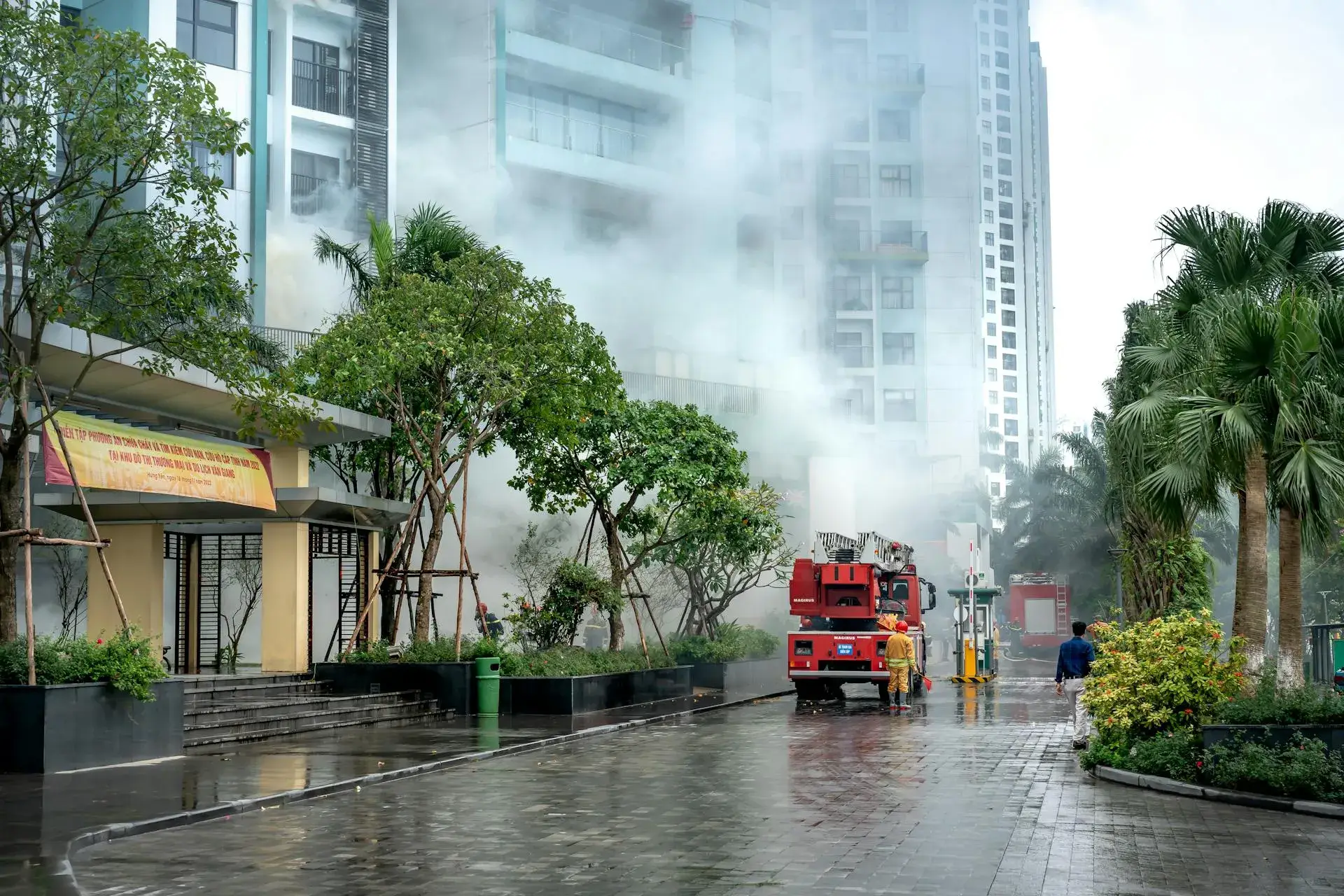
Smoke Damage Restoration in La Vergne, TN
Smoke residue bonds deeper into materials with every passing hour. Soot acidifies in humid air, causing permanent staining and corrosion. Our local team responds to La Vergne smoke damage emergencies within 60 minutes.
What Happens When You Call
A real person answers, not a call center. We assess the smoke source, scope, and urgency, then begin coordinating your response immediately.
Your dedicated restoration team is dispatched from our local base serving La Vergne and the surrounding Rutherford County communities.
Team arrives with HEPA air scrubbers, soot removal equipment, thermal foggers, and air quality testing tools. Assessment and mitigation begin immediately.
Contamination mapped, soot removal underway, air scrubbers running, restoration plan documented. You know exactly what comes next.
Smoke damage is not always dramatic. Sometimes it arrives silently through your HVAC system from a neighboring unit's fire. Sometimes it seeps in from wildfire haze that blankets Middle Tennessee for days. Sometimes it is the aftermath of a kitchen fire that seemed small but left soot on every surface in the house. Whatever the source, smoke residue is actively damaging your property right now. X Response exists for this moment. When you reach out, your restoration team is mobilized within minutes and on site within the hour. Call now. Your team is standing by.
Why La Vergne Homes Are Vulnerable to Smoke Damage
La Vergne is a city of approximately 42,000 residents in northern Rutherford County, positioned along the Interstate 24 corridor between Nashville and Murfreesboro. The city's smoke damage risks come from two distinct categories: structural fires within the community and regional atmospheric events that push outdoor smoke into indoor spaces. Both categories have affected La Vergne in recent years. The city experienced multiple residential fires in 2025 and 2026 that generated smoke damage extending well beyond the burned structures. And in June 2023, smoke from Canadian wildfires drifted into Middle Tennessee and triggered air quality alerts across the Nashville metro area, with pollution levels reaching 8.7 times the World Health Organization's recommended guidelines for PM2.5 particulate matter. That wildfire smoke event affected every building in La Vergne with outdoor air intake, infiltrating homes through HVAC systems, open windows, and building envelope gaps.
Smoke damage from structural fires in La Vergne extends far beyond the properties where flames were visible. The April 2026 apartment fire that displaced residents sent smoke through shared HVAC ductwork and wall cavities into units that never experienced direct flame contact. The November 2025 lithium battery fire that spread from a garage to the attic distributed chemical-laden smoke throughout the home's living space. In dense residential areas along the I-24 corridor, where homes and apartments sit in close proximity, smoke from one property can infiltrate neighboring structures through open windows, shared walls, and the thermal draft created by the fire itself. Smoke damage restoration in La Vergne frequently involves properties that were never on fire but absorbed smoke from an adjacent event.
Canadian Wildfire Smoke and Regional Air Quality Events
In June 2023, smoke from Canadian wildfires traveled thousands of miles and settled over Middle Tennessee, pushing PM2.5 levels to 8.7 times the World Health Organization's recommended guidelines in the Nashville metro area. An Air Quality Alert was issued for the region as haze visibly obscured the sky for days. The smoke infiltrated every building with outdoor air exchange: homes with HVAC systems drawing outdoor air through fresh-air intakes, buildings with open windows, and structures with gaps in their building envelope. Fine particulate matter from wildfire smoke is far smaller than standard household dust, measuring 2.5 microns or less, which allows it to bypass standard furnace filters and deposit throughout HVAC ductwork, on furnishings, and in the lungs of occupants. For La Vergne residents, the June 2023 event coated interior surfaces with a thin but pervasive layer of particulate that standard cleaning cannot fully address because the particles embed in fabric, carpet fiber, and porous surfaces at a microscopic level.
Apartment and Townhome Smoke Transfer
La Vergne's apartment and townhome complexes along the I-24 corridor house thousands of residents in connected structures where smoke from one unit travels rapidly into others. The mechanism is straightforward: connected HVAC systems or shared return air plenums pull smoke from the fire unit and distribute it throughout neighboring spaces. Even in buildings with separate mechanical systems, smoke travels through shared wall cavities, ceiling plenums, plumbing penetrations, and the pressure differentials created by the fire itself. The April 2026 apartment fire in La Vergne demonstrated this pattern when smoke affected the neighboring unit and portions of the structure beyond the fire's origin. Residents in adjacent units may not realize the extent of contamination until days later when odor persists or soot appears on surfaces near HVAC registers.
HVAC Systems as Smoke Distribution Networks
Forced-air heating and cooling systems, present in virtually every La Vergne home, act as distribution networks for smoke particulate. When a fire occurs in one room, the HVAC system's return air intakes pull smoke-laden air from the affected space and push it through ductwork to every room in the home. Even a small kitchen fire that appears contained to the stovetop can deposit soot throughout the entire duct network while the system runs. Similarly, wildfire smoke entering through a fresh-air intake during an air quality event is distributed to every room served by the system. The ductwork itself becomes contaminated, with soot depositing on interior surfaces, in the blower housing, across the evaporator coil, and in the filter compartment. Until the HVAC system is professionally cleaned, it continues to recirculate contamination every time it cycles, redepositing particles on surfaces that have already been cleaned.
Furnace Puffbacks and Heating Season Incidents
La Vergne's climate requires heating from November through March, and the city's homes use a mix of gas furnaces, heat pumps, and oil furnaces depending on the era of construction. Gas and oil furnaces can experience puffbacks, events where ignition is delayed and fuel vapor accumulates in the combustion chamber before igniting explosively, blowing soot and combustion residue back into the home through every gap in the furnace housing and ductwork. A furnace puffback can coat an entire home's interior with a fine, oily soot in seconds. The soot is particularly aggressive because it contains unburned fuel residues and carbon compounds that bond rapidly to surfaces and stain permanently if not cleaned within hours. Older furnaces in La Vergne homes from the 1970s and 1980s are especially susceptible as burner assemblies and ignition components age.
Smoke Odor Persistence in Rutherford County's Humid Climate
Smoke odor is not simply airborne particles that dissipate when you open windows. The odor-causing molecules embed in porous materials at a molecular level: carpet fibers, fabric upholstery, unsealed wood, drywall paper facing, insulation, and the organic binders in paint. In Rutherford County's humid climate, moisture in the air reactivates these embedded molecules, causing odor to resurface repeatedly even after surfaces appear clean. This is why homeowners report that smoke smell returns on humid days or when the HVAC system runs, weeks or months after the original event. The humidity creates a cycle where odor molecules are released from materials, perceived by occupants, and then re-absorbed as conditions change. Breaking this cycle requires treating the odor at its molecular source rather than masking it with air fresheners or fragrances that merely compete with the smell.
These factors combine to create a smoke damage environment where contamination spreads invisibly through HVAC systems, infiltrates from neighboring fires and regional air events, embeds at a molecular level in porous materials, and reactivates in Rutherford County's humid air. Effective smoke damage restoration in La Vergne means identifying the full extent of contamination including concealed areas, cleaning at a level that addresses microscopic and molecular deposits rather than just visible residue, and eliminating odor at its source rather than attempting to cover it.
What Happens to Your Home While You Wait
Within 1 Hour
Smoke particles settle on every exposed surface in the affected area. Acidic residue from burned synthetics begins bonding to chrome, glass, and metal surfaces. The HVAC system, if running during the event, has already distributed contamination to every room it serves. Porous materials including carpet, upholstery, and drapes begin absorbing odor-causing molecules. In La Vergne's humid air, soot residue begins its acidification process immediately.
1–24 Hours
Soot permanently discolors light-colored fabrics and painted surfaces if not cleaned. Metal fixtures, particularly chrome and brass, begin pitting from acid exposure. Smoke odor bonds deeper into porous materials and becomes increasingly difficult to remove. The longer soot sits on surfaces in Rutherford County's humid conditions, the more it etches and stains. Items that could have been cleaned begin crossing the threshold into requiring replacement.
24–72 Hours
Acidic soot causes visible corrosion on untreated metal surfaces. Painted walls develop yellow or brown discoloration that penetrates through the paint layer. Smoke odor becomes deeply embedded in structural materials, insulation, and carpet padding. Cleaning difficulty and cost increase substantially as chemical bonding progresses. HVAC ductwork that has not been cleaned continues redistributing contamination with every cycle.
One Week and Beyond
Permanent etching on glass and metal surfaces that no amount of cleaning can reverse. Smoke odor becomes structurally embedded, requiring treatment of framing, insulation, and concealed cavities rather than just finished surfaces. Contents that could have been saved with prompt attention now require disposal. The scope shifts from cleaning to comprehensive decontamination and material replacement, with proportionally higher cost and longer timeline.
Smoke damage is a race against chemistry. Every hour that soot sits on surfaces in La Vergne's humid air, the bonding becomes more permanent and the restoration more invasive. Contact X Response now. Our team responds within 60 minutes to begin professional smoke removal before damage becomes irreversible.
How We Restore Smoke-Damaged La Vergne Homes
Smoke damage restoration demands precision. The wrong cleaning method on the wrong surface type can drive soot deeper into materials rather than removing it. Here is exactly how we approach smoke damage in La Vergne properties.
Source Identification and Contamination Mapping
We identify the smoke source and map the full extent of contamination using visual inspection, particulate testing, and thermal imaging. The source matters because it determines the soot type and the cleaning protocol: protein soot from kitchen fires, synthetic soot from burned plastics and furnishings, wet smoke from smoldering fires, dry smoke from fast-burning fires, fuel oil soot from furnace puffbacks, and fine wildfire particulate each require different chemistry and technique. We check every room, every HVAC register, every concealed space that the smoke may have reached. In La Vergne's apartments and connected structures, we assess adjacent units when smoke transfer is suspected.
HVAC System Assessment and Isolation
The HVAC system is assessed immediately because it is typically the primary distribution path for smoke throughout a structure. We inspect the return air intakes, blower housing, evaporator coil, filter compartment, and supply ductwork for contamination. If the system circulated during the smoke event, it has deposited particles throughout the duct network and is actively redistributing contamination every time it runs. We isolate the system, preventing further redistribution while the cleaning plan is executed. In wildfire smoke infiltration cases, the fresh-air intake path is inspected to determine how outdoor particulate entered the system.
Professional Soot Removal
Soot removal follows strict protocols matched to the soot type and substrate. Dry smoke residue on hard surfaces responds to chemical sponges and HEPA vacuuming. Synthetic soot requires specialized detergents that break the chemical bond without smearing the residue deeper. Wet smoke, the stickiest and most difficult type, demands solvent-based cleaning matched to the surface below. Furnace puffback soot contains oily fuel residues that require degreasing before standard soot removal can proceed. We clean every affected surface in the correct order, from ceilings down, so that disturbed particles fall onto surfaces not yet cleaned. Nothing is skipped because missed contamination will continue off-gassing odor indefinitely.
HVAC Decontamination
The HVAC system is cleaned component by component: supply ducts, return ducts, blower assembly, evaporator coil, condensate pan, and the furnace or air handler cabinet. We use mechanical agitation and HEPA-filtered vacuum collection to remove deposited soot from duct interiors. The evaporator coil receives specialized cleaning because its wet surface traps particulate differently than dry duct walls. New filters are installed. The system is tested to confirm it is no longer redistributing contamination before being returned to service. For homes with multiple zones or mini-split systems, each head and line set is assessed independently.
Smoke Odor Elimination
Odor elimination targets the molecules embedded in materials, not just the airborne smell. We use thermal fogging to penetrate the same pathways smoke traveled, reaching into wall cavities, framing bays, and insulation. Hydroxyl generators neutralize odor compounds in occupied spaces without requiring evacuation. For heavily saturated materials, ozone treatment is applied to sealed zones at concentrations that destroy odor molecules chemically. We treat the structural cavity, not just the finished surface, because that is where embedded odor resides. Final air quality testing confirms odor and particulate levels have returned to acceptable standards before we release the space.
Verification and Documentation
Final inspection confirms that all surfaces are clean, the HVAC system is decontaminated, air quality meets clearance standards, and odor has been eliminated rather than masked. We provide documentation including before-and-after photos, treatment logs, HVAC cleaning verification, and air quality test results. This record supports insurance claims and provides evidence that the contamination has been professionally resolved rather than temporarily covered.
The X Response Difference
Insurance Claim Guidance for La Vergne Homeowners
Smoke damage insurance coverage depends on the source. Smoke damage from a fire within or adjacent to your property is typically covered under standard homeowners or renters policies. Smoke from external sources like wildfire haze or a neighbor's fire may be covered if it causes demonstrable damage to your property's interior, contents, or systems. Furnace puffback damage is generally covered as a sudden and accidental mechanical failure. The critical factor for claims is documentation: proving the extent of contamination, the source, and the necessity of professional restoration rather than standard cleaning.
How X Response Helps
- Document the smoke source and the extent of contamination with professional inspection and testing from day one
- Photograph soot deposits on surfaces, HVAC registers, and any visible discoloration before cleaning begins
- Record air quality measurements showing elevated particulate levels that require professional intervention
- Inventory contents affected by smoke, distinguishing between items requiring professional cleaning and those requiring replacement
- Document the HVAC system's condition and the scope of ductwork contamination as a system-level claim element
X Response does not file claims on your behalf, adjust claims, or make coverage determinations. We provide documentation and guidance to help you make informed decisions about your property and your policy. Coverage decisions are made solely by your insurance carrier.
Certified Restoration Specialists Serving La Vergne
When you contact X Response for smoke damage in La Vergne, your restoration team is drawn from certified professionals who work across Rutherford County and understand smoke behavior in this specific climate and building environment. They know how forced-air systems distribute contamination to rooms that appear untouched. They understand why smoke odor returns on humid summer days when it seemed eliminated weeks earlier. They have cleaned soot from the chemical residue of lithium battery fires, the protein deposits of kitchen fires, the oily residue of furnace puffbacks, and the fine particulate of wildfire infiltration events. Each type requires different chemistry, different technique, and different verification standards.
Every technician on your team holds current IICRC certification in smoke and odor restoration and carries the appropriate Tennessee state licensing for the work performed. Equipment includes HEPA air scrubbers, thermal foggers, hydroxyl generators, ozone generators, particulate monitors, chemical sponge systems, specialized detergents for each soot type, and HVAC inspection and cleaning tools. When your team arrives, they bring the full complement of tools needed to assess, clean, decontaminate, and verify, so the job begins at the first visit rather than requiring multiple mobilizations.
In La Vergne, X Response works with Tennessee Water and Fire, an independent local restoration partner serving Rutherford County.
Smoke Damage Restoration FAQ for La Vergne Homeowners
Other Emergency Services in La Vergne

Water Damage Restoration
Burst pipes, storm flooding, standing water. We extract, dry, and restore before mold sets in.
Learn more
Fire Damage Restoration
Structural damage, soot, debris. We stabilize, clean, and rebuild what fire destroyed.
Learn more
Mold Remediation
Testing, containment, removal, prevention. We find the source, eliminate the growth, and stop it from returning.
Learn more
Sewage Cleanup
Sewer backups, contaminated water, biohazard. We extract, sanitize, and restore safely.
Learn more