
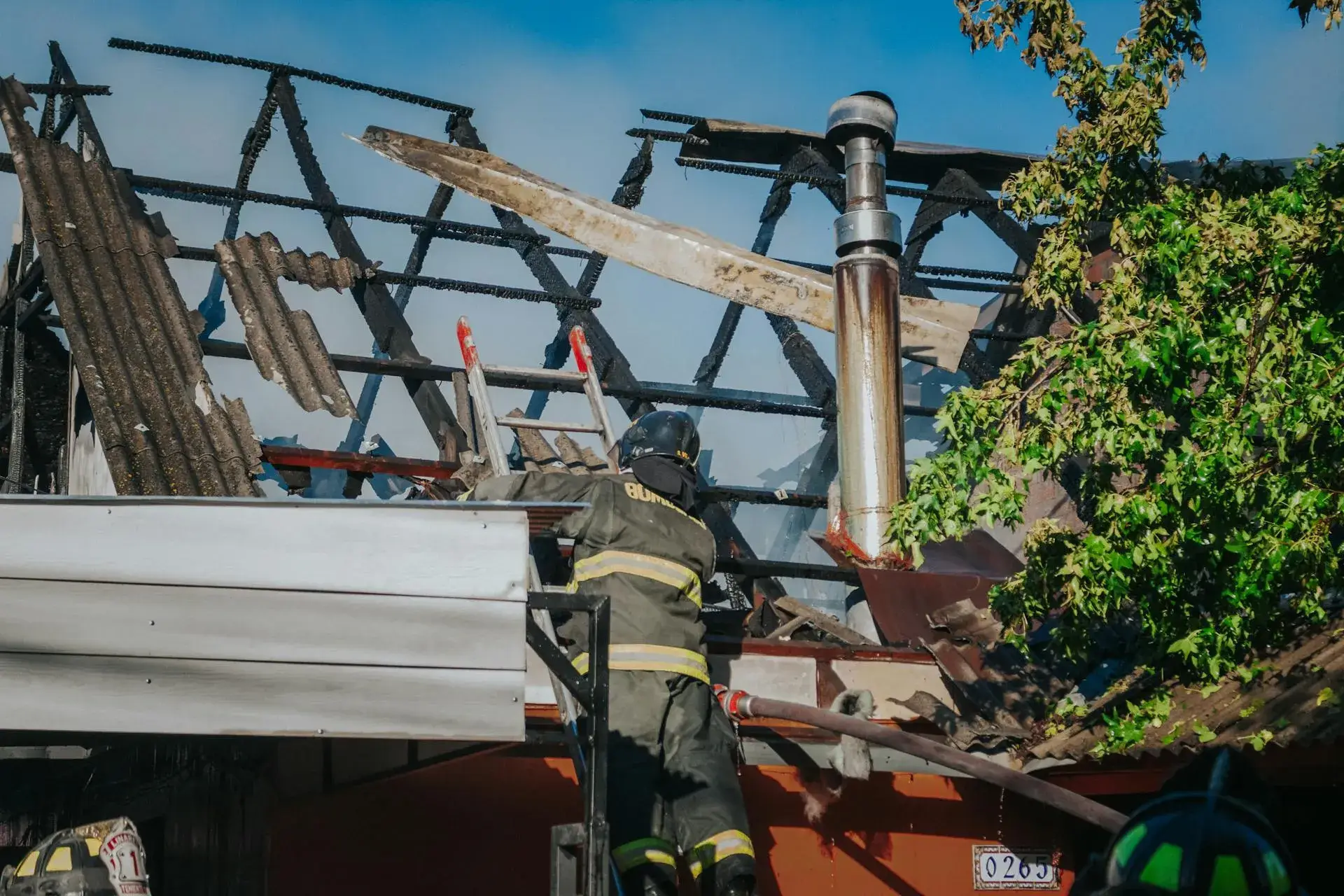
Fire Damage Restoration in Dearborn, MI
Fire damage compounds by the hour as acidic soot corrodes surfaces and smoke residue works deeper into wall cavities and ductwork. Our local team responds to Dearborn and Wayne County emergencies within 60 minutes.
What Happens When You Call
A real person answers, not a call center. We assess your situation, confirm the scene is safe and released by the fire department, and begin coordinating your response immediately.
Your dedicated restoration team is dispatched from our local base serving Dearborn and the surrounding Wayne County communities.
The team arrives with board-up materials, HEPA filtration, soot removal equipment, and structural assessment tools. Emergency stabilization begins immediately.
Structure secured, initial soot and debris cleared from critical areas, restoration plan documented. You know exactly what comes next.
Your home just came through a fire. Whether the Dearborn Fire Department contained it quickly or the structure was fully involved before crews arrived, the damage is active and compounding right now. Soot is acidic and corrodes every surface it touches. Smoke residue penetrates deeper into wall cavities, insulation, and ductwork with each passing hour, and a running furnace carries contamination through the entire house. X Response exists for exactly this moment. When you reach out, your restoration team is mobilized within minutes. From that point forward, one team manages everything: stabilization, cleaning, demolition, and rebuild. Call now. Your team is standing by.
Why Dearborn Homes Are Vulnerable to Fire Damage
Fire damage in Dearborn is shaped by the city's dense residential fabric, its mix of pre-war and mid-century housing stock, and Michigan's long heating season that places sustained demand on aging mechanical systems. On May 11, 2025, Dearborn Fire Chief Joseph Murray confirmed that crews arrived at approximately 8:07 p.m. to a house on Carlysle Street near Harding Street where they found the structure fully engulfed in flames. A man was found collapsed in a hallway and later pronounced dead. Just months earlier, on September 2, 2024, a three-alarm fire at a home on Detroit Street near Rotunda Drive killed a resident when the home's hoarder-like conditions made interior access extremely dangerous, forcing firefighters to flee the structure after running out of air. These events illustrate two recurring patterns in Dearborn residential fires: homes that are fully involved before the department arrives because the fire started undetected, and interior conditions that complicate suppression and extend the burn time before containment.
Dearborn's residential neighborhoods include distinct housing eras that each present different fire restoration challenges. East Dearborn's pre-World War II bungalows and colonials feature plaster-and-lath walls, balloon-frame construction in some cases, narrow lot spacing of 30 to 40 feet between structures, and original electrical systems that have been modified multiple times over a century. Balloon framing, where wall studs run continuously from the sill plate to the roof plate without horizontal fire stops between floors, allows fire to travel vertically inside the wall from the basement to the attic in minutes. West Dearborn's 1950s through 1970s ranches and colonials have platform framing with inherent fire stops between floors, but they also feature the aging electrical panels, aluminum wiring in some homes from the 1960s and 1970s, and the accumulated storage in basements and attached garages that concentrates fuel load in proximity to heating equipment and electrical panels.
The narrow lot spacing in Dearborn's older neighborhoods creates exposure risk that is uncommon in suburbs built after 1960. When homes sit 30 to 40 feet apart, a working fire on one property can radiate enough heat to ignite the siding, eaves, or roof of the adjacent house. Vinyl siding melts and ignites at relatively low radiant heat exposure, and wood eaves and fascia boards on older Dearborn homes dry out over decades until they are essentially kindling. Even when the adjacent structure does not ignite, the radiant heat blisters paint, warps siding, and damages windows, while windborne embers and heavy smoke contaminate the exterior surfaces and enter through any opening. For neighbors of a fully involved house fire, the damage may not be structural but the smoke contamination, heat damage to exterior finishes, and ember damage to roofing still require professional assessment and restoration.
Michigan's heating season runs from October through April, seven months of continuous furnace operation that places sustained thermal and mechanical stress on aging equipment. Natural gas forced-air furnaces are the dominant heating type in Dearborn, and the city's housing stock means many of these systems are second or third-generation replacements operating in original ductwork from the 1950s or earlier. Furnace failures, gas valve malfunctions, and heat exchanger cracks can allow combustion gases or unburned fuel to escape the appliance. Space heaters, used as supplements in rooms the main system does not adequately warm, add ignition risk when placed too close to furniture, curtains, or stored materials. In east Dearborn's smaller bungalows where the furnace shares the basement with storage, laundry, and sometimes a finished recreation area, a mechanical fire in the utility corner can involve the entire basement before smoke reaches the main-floor detector.
Pre-War Balloon Framing and Vertical Fire Spread
East Dearborn's pre-World War II homes include examples of balloon-frame construction, where wall studs extend uninterrupted from the foundation sill plate to the roof plate without the horizontal blocking that platform framing uses at each floor level. In a balloon-framed home, a fire that starts in the basement or first-floor wall cavity can travel vertically through the open stud channels to the attic in minutes, bypassing each floor level inside the wall without producing visible flame or triggering detectors until it reaches the attic space and erupts through the roof. By the time firefighters arrive to a balloon-frame fire that started in a wall cavity, the fire has often spread to multiple floors and the attic simultaneously, making containment extremely difficult. Restoration of a balloon-frame fire typically involves opening walls on every floor to locate the full extent of charring within the concealed vertical channels, then rebuilding with modern fire stopping installed in the previously open cavities.
Narrow Lot Spacing and Radiant Heat Exposure
Dearborn's pre-war and early postwar neighborhoods were built on 40 to 50-foot-wide lots with homes placed close together by modern suburban standards. When a fire becomes fully involved on one property, the radiant heat output can be sufficient to ignite combustible materials on the adjacent home's exterior. Vinyl siding softens at approximately 160 degrees and ignites at roughly 700 degrees Fahrenheit, temperatures easily reached at distances of 15 to 20 feet from a fully involved structure. Even when ignition does not occur, radiant heat blisters and peels paint, warps vinyl, damages windows, and degrades roofing materials on the exposure side of the adjacent home. Smoke from the original fire deposits heavy soot on the neighbor's exterior surfaces, enters through any opening or ventilation intake, and contaminates the interior. Restoration for an exposure-damaged home involves exterior finish replacement, interior smoke cleaning, and often HVAC decontamination.
Electrical Fires in Multi-Era Wiring
Dearborn's housing spans every decade from the 1920s forward, and each era installed different wiring technology. East Dearborn homes from the 1920s and 1930s may retain original knob-and-tube wiring on some circuits, which becomes a fire hazard when blown-in insulation was added around the conductors decades later, trapping heat that was designed to dissipate into open air. Homes from the 1950s have early Romex wiring with two-prong ungrounded circuits. Homes from the 1960s and early 1970s may contain aluminum branch wiring with connections that oxidize over time and create high-resistance hot spots. Across all eras, panels from Federal Pacific and Zinsco have documented failure rates for tripping during overcurrent events. An electrical fire ignites inside the wall and can burn for minutes along the wiring pathway before producing visible smoke, giving it time to spread through the concealed space and char framing across multiple stud bays before detection.
Heating System Fires During Extended Cold
Dearborn's gas furnaces run nearly continuously during cold snaps, and the thermal cycling stresses heat exchangers, inducer motors, and gas valves that may already be past their recommended service life. A cracked heat exchanger allows combustion products into the supply air stream. A malfunctioning gas valve can permit unburned gas to accumulate in the furnace cabinet or plenum. Draft inducer failure can allow flame rollout from the burner compartment. In Dearborn's older homes, the furnace sits in a basement alongside the water heater, stored belongings, holiday decorations, paint cans, and cleaning supplies, all of which become fuel if a mechanical failure produces flame outside the combustion chamber. The forced-air system then becomes a smoke distribution network, carrying combustion byproducts to every room before anyone detects the problem.
Fire Suppression Water and Basement Flooding
When the Dearborn Fire Department suppresses a working structure fire, the water volume is substantial: 150 to 250 gallons per minute from each hose line, often running for 15 to 30 minutes or more. In a Dearborn home with a basement, every gallon drains downward through the floor system and collects at the lowest point. A home that already has chronic basement moisture issues from Dearborn's flooding problems now has an additional layer: suppression water carrying dissolved soot, char, and fire retardant chemicals that contaminate everything it contacts in the basement. The secondary water damage must be addressed in parallel with the fire and smoke restoration upstairs, because leaving suppression water standing in the basement triggers mold colonization within 24 to 48 hours, adding a mold remediation scope to an already complex fire restoration project.
Fire damage restoration in Dearborn requires understanding the city's specific housing construction, lot spacing, and the intersection between fire damage and the chronic flooding vulnerability that defines this community. A fire in a balloon-framed east Dearborn bungalow demands a different approach than a furnace fire in a 1960s west Dearborn ranch, and both must account for the suppression water that inevitably floods the basement. Our team assesses each situation on its own terms and builds a restoration plan that addresses fire, smoke, water, and structural damage as interconnected problems.
What Happens to Your Home While You Wait
Within 1 Hour
Soot begins corroding metal surfaces, tarnishing fixtures, and embedding into porous materials throughout the home. Smoke residue settles on horizontal surfaces and begins penetrating upholstery, carpet, and drapery. If the HVAC system is running, it pulls smoke through the return and distributes contamination to every room. Acidic residue etches glass, chrome, and stainless steel on contact. Suppression water pools in the basement.
1 to 24 Hours
Soot permanently discolors grout, porous tile, fiberglass, and unfinished wood. Smoke odor absorbs deeper into fabrics, carpet, and soft furnishings. Metals continue corroding under acidic residue. In the basement, suppression water saturates carpet, padding, and drywall, beginning its own secondary damage cycle. The restoration scope begins expanding beyond the fire's immediate footprint.
24 to 48 Hours
Smoke penetrates lacquered and varnished surfaces, causing permanent yellowing. Wall paint absorbs odor at a molecular level. Suppression water in the basement triggers mold colonization on drywall and carpet. Materials cleanable within the first day now require replacement. The project scope grows as both smoke and water damage extend beyond their initial boundaries.
48 to 72 Hours
Corrosion on appliances, wiring terminals, and HVAC components becomes irreversible. Smoke migrates into insulation, concrete, and structural wood where surface cleaning cannot reach. Basement mold from suppression water becomes visible. The restoration increasingly shifts from cleaning to demolition and rebuild across both the fire-affected upper level and the water-affected basement.
One Week and Beyond
Without intervention, soot corrosion permanently destroys electronics and mechanical systems. Smoke odor embeds at a molecular level requiring thermal fogging or material removal. Basement mold from suppression water spreads through wall cavities and ductwork. A project that began as fire restoration expands to encompass comprehensive mold remediation, structural demolition, and full reconstruction.
Every hour of delay allows soot to corrode deeper, smoke to penetrate further, and suppression water to trigger secondary mold. Contact X Response now. Our Dearborn team responds within 60 minutes.
How We Restore Fire-Damaged Dearborn Homes
Fire damage restoration involves multiple overlapping damage types that must be coordinated into a single plan. Here is how we approach fire restoration in a Dearborn home.
Emergency Stabilization and Board-Up
Our team arrives to secure the property immediately after the fire department releases the scene. In Dearborn's dense neighborhoods where homes sit close together, securing a fire-damaged property protects both the homeowner and the neighbors from further risk. Openings created by the fire or by firefighter ventilation are boarded and tarped to prevent weather entry, which is critical in a city where the next rainstorm could flood the basement through a compromised roof. We assess structural stability, identify any balloon-frame fire pathways that may have spread damage vertically, and establish safe working zones.
Damage Assessment and Scope Development
A thorough inspection maps fire, smoke, soot, and water damage throughout the entire home. In Dearborn's older homes, we specifically check for concealed fire spread through balloon-frame wall cavities and along wiring pathways that may have carried fire between floors or rooms. We inspect the HVAC system for smoke contamination because Dearborn's forced-air systems distribute soot to rooms the fire never reached. For homes with suppression water in the basement, we include that water damage in the scope immediately rather than treating it as a separate project. The assessment produces a comprehensive scope of work with photos and measurements for your insurance claim.
Soot and Smoke Removal
Different fire types produce different soot requiring specific cleaning chemistry. A kitchen grease fire leaves thin protein residue with intense odor. A furnace puffback deposits oily soot through every register. A structural fire in a Dearborn bungalow's balloon-frame walls produces heavy char-laden soot that requires aggressive removal from every surface. We match technique to soot type and work methodically from ceilings down. HEPA air scrubbers run continuously to capture airborne particles and prevent recontamination of cleaned areas.
Deodorization and Air Quality Restoration
Smoke odor penetrates porous materials at a molecular level. Surface cleaning removes visible residue but does not eliminate embedded odor from wall cavities, insulation, and structural wood. We deploy thermal fogging equipment that produces vapor capable of reaching the same spaces smoke penetrated, neutralizing odor at the source. Hydroxyl generators break down volatile organic compounds in the air. The HVAC system is fully cleaned and sealed registers remain closed until air quality verification confirms the ductwork is no longer a contamination source.
Structural Repair and Rebuild
Once cleaning, deodorization, and demolition are complete, reconstruction restores the home to pre-fire condition. Charred framing is sistered or replaced. Fire-damaged electrical, plumbing, and HVAC systems are brought to current Michigan code. In east Dearborn balloon-frame homes, the rebuild incorporates modern fire stopping in previously open wall cavities. Drywall, flooring, trim, and finishes are installed to match the home. We manage the complete rebuild from rough framing through final finishes, maintaining one team and one point of contact throughout.
The X Response Difference
Fire restoration in Dearborn requires managing fire, smoke, soot, suppression water, and structural damage as one project. X Response provides that coordination from board-up to final inspection.
Insurance Claim Guidance for Dearborn Homeowners
Fire damage is generally well-covered under standard Michigan homeowner's policies as a named peril. The complexity in Dearborn fire claims typically involves scope: how far smoke contamination extends beyond the fire's footprint, whether the insurer agrees that materials require replacement versus cleaning, and how suppression water damage in the basement is handled. For homes adjacent to a fire that sustained radiant heat damage, smoke contamination, or ember damage, the claim involves the neighbor's liability carrier rather than your own homeowner's policy in some cases, adding another layer of documentation and coordination. Thorough documentation from day one protects your claim against scope disputes regardless of how the coverage is structured.
How X Response Helps
- Document the full extent of fire, smoke, soot, and suppression water damage with professional photos before any cleaning or demolition
- Map concealed fire spread through wall cavities and wiring pathways with thermal imaging, providing evidence of damage beyond what is visible from the room surface
- Document HVAC contamination with surface testing showing soot in distant rooms to justify whole-house cleaning
- Track suppression water damage separately with moisture readings establishing the need for basement extraction, drying, and antimicrobial treatment
- For exposure damage from a neighboring fire, document the source and radiant heat pattern to support claims against the responsible party
X Response does not file claims on your behalf, adjust claims, or make coverage determinations. We provide documentation and guidance to help you make informed decisions about your property and your policy. Coverage decisions are made solely by your insurance carrier.
Certified Restoration Specialists Serving Dearborn
When you contact X Response after a fire in Dearborn, your restoration team is drawn from certified professionals who work across Wayne County and understand the specific fire dynamics of this city's housing stock. They know how east Dearborn's balloon-frame bungalows allow fire to spread vertically inside walls, how the narrow lot spacing creates exposure risk for adjacent homes, and how suppression water floods the same basements that are already vulnerable to chronic flooding from the Rouge watershed. They have restored homes after furnace fires, electrical fires in aging wiring, fully involved structure fires, and exposure damage from neighboring properties. This is a local team with direct experience in Dearborn's construction and fire patterns.
Every technician holds current IICRC certification in fire and smoke restoration and carries appropriate Michigan licensing for structural work. Equipment includes HEPA air scrubbers, thermal fogging units, hydroxyl generators, thermal imaging cameras for locating concealed fire spread, and the full range of cleaning chemistry for different soot types. For structural rebuild, our team includes tradespeople experienced with Michigan building code and the specific challenges of restoring and modernizing pre-war construction.
In Dearborn, X Response works with H2O Pros, an independent local restoration partner serving Wayne County.
Fire Damage Restoration FAQ for Dearborn Homeowners
Other Emergency Services in Dearborn


Nearby Service Areas
Also serving nearby: