
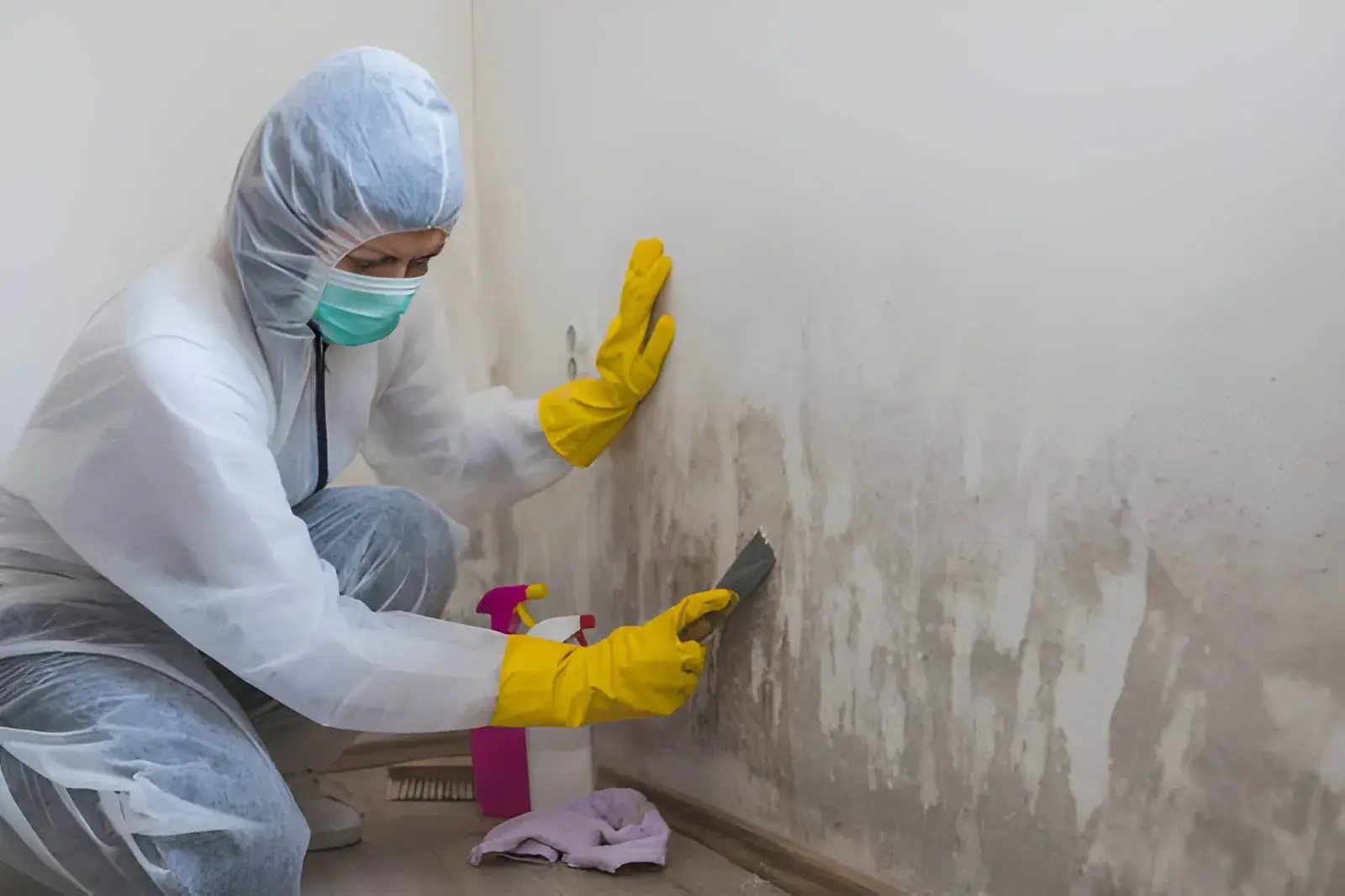
Mold Remediation in Prospect Heights, IL
Mold spreads through hidden spaces in as little as 24 to 48 hours after water intrusion. Our local team responds to Prospect Heights mold emergencies quickly to contain the growth before it compromises your home and your health.
What Happens When You Call
A real person answers, not a call center. We assess your situation, ask the right questions about moisture history and visible signs, and begin coordinating your response immediately.
Your dedicated remediation team is dispatched from our local base serving Prospect Heights and the surrounding northwest suburban communities.
Team arrives with containment materials, HEPA air scrubbers, and moisture detection equipment. Assessment begins immediately to determine the full extent of growth and its moisture source.
Containment established, remediation plan documented, moisture source identified. You know exactly what comes next.
Mold does not wait. It begins colonizing damp materials within 24 to 48 hours and can spread through wall cavities, beneath flooring, and into HVAC systems within days. By the time you see visible growth or smell that musty odor, the colony has already established behind the surfaces you can see. X Response exists for exactly this moment. When you reach out, your remediation team is mobilized and on site quickly. From that point forward, one team manages everything: assessment, containment, removal, and prevention. Call now. Your team is standing by.
Why Prospect Heights Homes Are Vulnerable to Mold
Prospect Heights is a city of 16,058 residents in Wheeling Township, Cook County, Illinois, with a housing stock built predominantly during the 1960s and 1970s that includes single-family ranch homes, garden-level condominium units, mid-rise apartment buildings, and high-rise structures like the 349-unit Lake Run Condos (1967). The city sits within the McDonald Creek and Des Plaines River watersheds, both of which have produced repeated flooding events that leave behind the moisture conditions mold requires to colonize. The June 2018 flash flood (4.3 inches of rain in one hour) saturated ground-level and below-grade living spaces throughout the Willow Road corridor. The city's ongoing $4 million stormwater improvement project and the MWRD's additional $1.8 million in flood control funding reflect the chronic nature of this moisture exposure. For residents in the hundreds of garden-level condo units and finished basements throughout Prospect Heights, mold is not a rare event resulting from a single catastrophic failure. It is a predictable consequence of living in below-grade or at-grade spaces within a flood-prone community where the housing stock's original waterproofing has deteriorated over five to six decades.
Effective January 1, 2025, the Illinois Mold Remediation Registration Act (SB 1087, codified at 410 ILCS 105) requires all parties providing mold remediation services in residential, public, and commercial buildings in the state to register with the Illinois Department of Public Health and provide proof of both third-party certification (such as IICRC, ACAC, or equivalent) and financial responsibility. This legislation addresses a previous gap where any company could advertise mold remediation services without verifiable credentials or accountability. For Prospect Heights residents, particularly those in condominium buildings where an association may select remediation vendors for common-area work, this law provides a minimum quality floor: registered providers must demonstrate certified expertise and carry insurance specifically covering mold remediation work. The Illinois Department of Public Health has historically advised against mold testing as a first step, recommending instead that if mold growth is visible, the appropriate action is remediation guided by the IICRC S520 standard rather than species identification. X Response's technicians hold the third-party certifications required under this act and have maintained them since before the registration requirement took effect.
Garden-Level Condo Units and Below-Grade Living Spaces
A significant portion of Prospect Heights' population lives in garden-level condominium units where the finished living space sits partially or fully below grade. These units were common in 1960s and 1970s multi-family construction because they maximized unit count per building footprint by creating livable space at or below ground level. The concrete or block foundation walls of these units are in direct contact with soil on three sides, and the original exterior waterproofing applied during construction has degraded over 50 to 60 years. Moisture migrates through the foundation wall by capillary action, vapor transmission, and direct leakage at joints and cracks. This moisture accumulates behind any finished surface installed against the foundation: drywall, paneling, carpet, or vinyl flooring applied directly over the concrete slab. Mold colonies establish in these concealed spaces where they receive continuous moisture and organic food sources (drywall paper, carpet backing, wood furring strips) without any airflow to interrupt growth. By the time residents notice musty odor or visible growth at a baseboard, the colony behind the finished surface may extend across large sections of wall. In condominium buildings, this problem multiplies: every garden-level unit in the building faces the same moisture conditions, and remediation in one unit does not address the colonies developing behind walls in adjacent units.
Post-Flood Moisture in the McDonald Creek Corridor
The Willow Road and McDonald Creek Tributary A area of Prospect Heights has experienced repeated flooding events, including the June 2018 flash flood and subsequent events in 2019 that forced road closures. Homes and ground-level units in this corridor have absorbed stormwater through foundation walls, window wells, and ground-level entries during these events. When floodwater is extracted but the structure is not professionally dried, residual moisture remains in materials with high absorption capacity: concrete block walls, dimensional lumber framing, fiberglass insulation, and the gap between a concrete slab and the flooring material above it. This residual moisture creates the sustained damp conditions that mold requires to establish and grow. The timing of these flooding events in late spring and summer is significant: warm temperatures accelerate mold germination, with visible colonization possible within 24 to 48 hours of water intrusion at summer temperatures. Residents who experienced basement flooding during the 2018 storm and extracted the visible water themselves but did not verify structural drying with moisture meters likely have mold colonies that have been growing undisturbed for years within wall cavities and beneath flooring materials.
Shared HVAC Systems and Cross-Contamination in Multi-Family Buildings
In Prospect Heights' multi-family buildings, HVAC systems frequently serve as unintentional mold distribution networks. When mold establishes in one unit, its spores are microscopic and become airborne at the slightest disturbance. These spores enter the HVAC return, travel through ductwork, and deposit on the evaporator coil and in supply ducts, where the condensation that naturally forms on the cold coil surface provides the moisture needed for secondary colonies to establish inside the ductwork itself. From there, every unit served by that system receives a continuous supply of mold spores with each cooling or heating cycle. In buildings with central HVAC serving multiple units, a mold problem that appears isolated to one unit may have already spread biologically to every connected unit through the shared air distribution system. The evaporator coil is particularly problematic: its combination of moisture (from condensation), organic food (dust accumulation on the coil fins), and darkness makes it an ideal mold habitat. Professional remediation in multi-family buildings must include HVAC system assessment to determine whether the ductwork is serving as a contamination vector, not just cleaning the visible mold in the affected unit.
Displacement-Related Mold After Fire Events
Prospect Heights' history of condo fire events has created a secondary mold problem that occurs during extended displacement periods. When residents are displaced from a building after a fire (as documented at Willow Heights in 2022, where 16 units remained uninhabitable 11 months after the fire), the unoccupied units are often left without climate control, without dehumidification, and without the human activity that normally keeps indoor spaces ventilated. Suppression water from the fire that was not fully extracted saturates building materials. Summer humidity enters through the unsealed building envelope. Without air conditioning removing moisture from the air, relative humidity in closed units can run high continuously. Mold colonies that would have been preventable with timely drying after the fire establish throughout these neglected spaces over the months of displacement. When residents finally return or restoration work begins, the mold damage discovered in previously unaffected units can rival or exceed the original fire and water damage in scope and cost. This pattern is particularly insidious because it is entirely preventable with prompt dehumidification and monitoring during displacement.
Flat-Roof Moisture Intrusion in Multi-Family Buildings
Many of Prospect Heights' multi-family buildings feature flat or low-slope roofing systems that are common in 1960s and 1970s commercial and multi-family construction. These roofing assemblies have a finite service life (typically 20 to 30 years for the original materials), and buildings on their second or third roof replacement cycle may have hidden moisture trapped between roof layers from previous failures. Flat roofs are susceptible to ponding water at low spots where the membrane has settled or where drainage is blocked. Ponding water degrades roofing membranes through UV exposure and thermal cycling, eventually creating slow leaks that introduce moisture into the roof deck and ceiling assembly below. These leaks are often small enough that water stains on ceiling tiles or drywall are the only visible evidence, while behind the ceiling surface, insulation holds moisture against the structural deck and mold colonies grow across large areas. In top-floor condo units, this moisture enters from above and may go unnoticed until the ceiling shows visible staining or the musty odor becomes pronounced. The mold growth on the concealed side of the ceiling can be extensive by the time it produces any visible or olfactory signal in the living space.
Mold remediation in Prospect Heights is shaped by the intersection of three factors: a flood-prone geography that repeatedly introduces moisture into buildings, a housing stock built in an era before modern waterproofing and vapor barriers were standard, and a high concentration of multi-family buildings where shared systems distribute spores and individual unit owners may not address moisture problems before they affect neighbors. The Illinois Mold Remediation Registration Act provides regulatory backing for the quality standards that effective remediation requires, but the physical challenges remain: garden-level units with compromised waterproofing, post-flood structures with inadequate drying, shared HVAC systems distributing contamination between units, and displacement-era mold growing unchecked in unoccupied fire-damaged buildings. Effective remediation here requires identifying and stopping the moisture source, containing and removing the visible growth, and then verifying that hidden colonies in wall cavities, beneath flooring, and within HVAC systems are also addressed.
What Happens to Your Home While You Wait
Within 24 Hours
Moisture from flooding, leaks, or suppression water saturates porous materials. Mold spores, which are always present in indoor air at background levels, land on these damp surfaces and begin germinating. At summer temperatures typical of Prospect Heights (75 to 85 degrees indoors without air conditioning), germination happens rapidly. No visible growth is present yet, but the biological clock has started. Extracting water and establishing dehumidification within this window can prevent mold growth entirely.
24–48 Hours
Mold germination completes and hyphal growth begins on the surface of damp materials. The first colonies may be visible as small spots on drywall paper, carpet backing, or organic debris on concrete surfaces. In garden-level condo units where moisture enters continuously through foundation walls, colonies establish in concealed spaces behind baseboards, beneath edge-glued carpet, and behind any paneling or drywall installed against the foundation. The musty odor associated with active mold growth may become noticeable at this stage.
48 Hours–1 Week
Visible mold growth expands across affected surfaces. Colonies produce spores that become airborne with any air movement, distributing to new surfaces and entering HVAC returns. In multi-family buildings, spores travel through shared ductwork to units that have no direct moisture problem. Materials with high organic content (paper-faced drywall, carpet padding, particle board) become heavily colonized. The remediation scope expands beyond the original wet footprint as airborne spores establish secondary colonies on any surface maintaining sufficient moisture.
1–4 Weeks
Mold growth becomes extensive in concealed spaces that maintain moisture: inside wall cavities behind finished surfaces, beneath flooring materials over concrete slabs, inside HVAC ductwork where condensation provides continuous dampness. The living space may show only limited visible growth while behind walls and beneath floors the colonization is widespread. Health symptoms (allergic reactions, respiratory irritation, sinus congestion) often intensify during this period as spore concentrations in indoor air rise. Professional remediation at this stage typically involves demolition of colonized drywall, flooring, and insulation rather than surface cleaning.
One Month and Beyond
Chronic mold infestation where colonies have established throughout the building's hidden spaces. Structural wood in contact with persistent moisture shows signs of decay. Remediation scope extends to major demolition of finish materials, potential structural repair, and comprehensive decontamination of all air-handling systems. In Prospect Heights' multi-family buildings where the moisture source has not been corrected (ongoing foundation seepage, unrepaired flat-roof leak), mold will return after remediation unless the underlying moisture pathway is permanently eliminated. Insurance claims become increasingly contested as carriers argue that chronic moisture represents a maintenance failure rather than a sudden loss.
undefined
How We Restore Mold-Affected Prospect Heights Homes
From the moment our team arrives, every step is documented, measured, and verified. Here is exactly what the mold remediation process involves for Prospect Heights properties.
Assessment and Moisture Source Identification
Effective mold remediation begins with understanding where the moisture is coming from, not just where the mold is growing. We use moisture meters, thermal imaging, and visual inspection to map the moisture pathways feeding the mold growth. In Prospect Heights' garden-level condo units, this often means identifying foundation wall seepage, slab moisture vapor transmission, or condensation from inadequate insulation on below-grade walls. In upper units, flat-roof leaks and HVAC condensation are common sources. We do not begin removal until the moisture source is identified because removing mold without stopping the moisture that feeds it guarantees recurrence. The assessment includes air quality sampling when needed to determine whether spore levels in occupied spaces warrant immediate containment.
Containment and Air Quality Control
Before any mold disturbance begins, we establish engineering controls to prevent cross-contamination of unaffected areas. Polyethylene barriers sealed with tape isolate the work area. HEPA-filtered negative air machines create pressure differentials that ensure air flows into the contained area rather than out of it, preventing spores released during removal from reaching clean spaces. In Prospect Heights' multi-family buildings, containment extends to sealing HVAC registers, return grilles, and any penetrations in shared walls that could allow spores to migrate to adjacent units during remediation. Workers enter and exit through a decontamination chamber. These protocols follow the IICRC S520 standard and meet the requirements that the Illinois Mold Remediation Registration Act was designed to ensure.
Mold Removal and Material Demolition
Colonized porous materials that cannot be adequately cleaned are removed: affected drywall, insulation, carpet, padding, and particle-board materials are cut out, bagged within the containment, and disposed of as construction waste. Non-porous structural materials (concrete, dimensional lumber, metal studs) are cleaned using HEPA vacuuming, wire brushing, and antimicrobial application. We remove materials to a point 24 inches beyond the visible mold boundary to account for hyphal growth that has penetrated beyond the visible colony edge. In garden-level condo units where foundation walls are the moisture source, we remove all finished materials from the affected walls, treat the exposed foundation surface, and create a system that allows the wall to dry rather than trapping moisture behind new finishes.
HVAC Decontamination
If the HVAC system has been operating during the period of active mold growth, the ductwork, coil, and air handler require decontamination. Mold spores that entered the return air path will have deposited on the evaporator coil (where condensation provides moisture for growth) and throughout the supply ductwork. We clean the system using source-removal methods: mechanical agitation combined with negative-pressure collection removes accumulated debris and biological growth from duct surfaces. The evaporator coil, blower wheel, and drain pan are individually cleaned and treated. New MERV 13 or higher filters are installed. In multi-family buildings with shared HVAC, we assess and clean shared components in coordination with the association.
Verification and Prevention
After remediation is complete and the contained area has been cleaned, we verify success through visual inspection and, where warranted, post-remediation air sampling to confirm that spore levels have returned to normal background concentrations. We then address the moisture source permanently: this may involve exterior waterproofing, interior drainage systems, dehumidifier installation, insulation improvements on below-grade walls, or repairs to flat-roof systems. The goal is not just removing the current growth but eliminating the conditions that allowed it to establish. We provide specific recommendations for your Prospect Heights property based on its construction type, moisture source, and ongoing risk factors.
The X Response Difference
When you contact X Response for mold remediation in Prospect Heights, you get a team that follows IICRC S520 protocols from inspection through verified clearance. One team, one standard, documented results.
Insurance Claim Guidance for Prospect Heights Homeowners
Mold damage insurance coverage in Illinois is complex and depends on both the cause of the mold and your specific policy language. Standard homeowner's policies typically cover mold remediation when the mold results from a covered peril, such as a sudden pipe burst or appliance failure that introduces water and leads to mold growth before the damage could reasonably be discovered or mitigated. However, most policies exclude mold that results from chronic moisture conditions, deferred maintenance, gradual water intrusion, or long-term humidity issues. In Prospect Heights, where garden-level condo units with deteriorated foundation waterproofing experience ongoing moisture intrusion, and where post-flood residual dampness from McDonald Creek corridor flooding enables mold growth, the coverage determination often hinges on whether the moisture source qualifies as sudden and accidental or chronic and preventable. Policies may also carry mold-specific sublimits, typically $5,000 to $25,000, that cap coverage regardless of the actual remediation cost. Displacement-related mold following a condo fire (as documented at Willow Heights in 2022) is typically covered as secondary damage from the original fire loss.
How X Response Helps
- Document the moisture source and timeline clearly, establishing whether the condition was sudden (covered) or chronic (likely excluded)
- Photograph all visible mold growth with measurement references before any remediation begins
- Provide professional moisture readings that establish the extent and source of the water intrusion enabling mold growth
- Separate remediation costs from moisture-source repair costs in the scope of work, as they may trigger different coverage provisions
- Explain your policy's mold coverage provisions, sublimits, and exclusions before you file, so you understand your likely recovery and out-of-pocket exposure
X Response does not file claims on your behalf, adjust claims, or make coverage determinations. We provide documentation and guidance to help you make informed decisions about your property and your policy. Coverage decisions are made solely by your insurance carrier.
Certified Restoration Specialists Serving Prospect Heights
When you contact X Response for mold remediation in Prospect Heights, your team is drawn from certified professionals who work across Cook County's northwest suburbs and understand the specific mold challenges in this community's housing stock. They know how 1960s and 1970s garden-level condo units without modern vapor barriers create chronic dampness conditions, how the McDonald Creek watershed's repeated flooding introduces moisture that leads to concealed mold growth, how shared HVAC systems in multi-family buildings distribute spores from one affected unit to others, and how extended displacement after condo fires allows mold to establish throughout unoccupied units. They have remediated mold in every configuration common to Prospect Heights: post-flood growth behind drywall in garden-level units, chronic foundation wall colonization from vapor transmission, flat-roof leak damage in top-floor condos, and displacement-era mold in fire-damaged buildings left unoccupied for months. This is not a crew dispatched from hours away with generic mold knowledge. It is a local team with local expertise, operating under national IICRC S520 standards.
Every technician on your team holds current IICRC AMRT (Applied Microbial Remediation Technician) certification and follows S520 protocols for containment, removal, and verification. Equipment includes professional moisture meters and thermal imaging for inspection, negative-air machines with HEPA filtration for containment, commercial dehumidifiers for structural drying, air sampling equipment for pre- and post-remediation verification, and all PPE required for safe handling of contaminated materials. Effective January 1, 2025, the Illinois Mold Remediation Registration Act requires all remediation providers to register with the state and demonstrate third-party certification. Our credentials and documented protocols meet and exceed that standard.
In Prospect Heights, X Response works with Scene Cleaners, an independent local restoration partner serving Cook County.
Mold Remediation FAQ for Prospect Heights Homeowners
Other Emergency Services in Prospect Heights

Water Damage Restoration
Burst pipes, storm flooding, standing water. We extract, dry, and restore before mold sets in.
Learn more
Fire Damage Restoration
Structural damage, soot, debris. We stabilize, clean, and rebuild what fire destroyed.
Learn more
Smoke Damage Restoration
Soot residue, chemical odors, HVAC contamination. We decontaminate surfaces, eliminate odors, and restore air quality.
Learn more
Sewage Cleanup
Sewer backups, contaminated water, biohazard. We extract, sanitize, and restore safely.
Learn more