
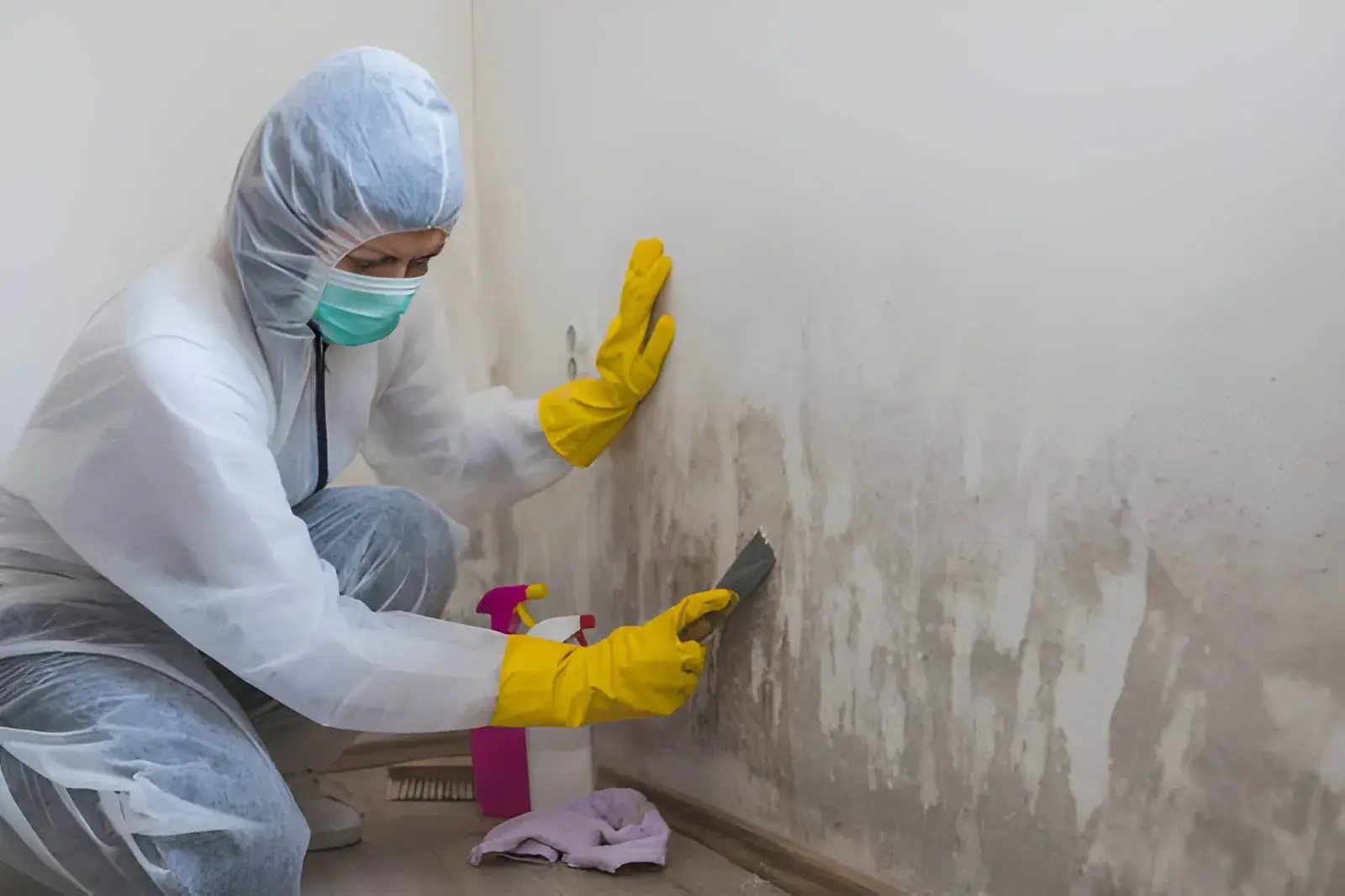
Mold Remediation in Basehor, KS
Mold spores colonize damp organic materials within 24 to 48 hours. Our Basehor mold remediation specialists respond immediately.
What Happens When You Call
Your inquiry connects with a certified mold specialist who reviews your symptoms, property history, and observable signs of moisture.
Our inspection crew arrives in Basehor with thermal cameras, moisture meters, and bioaerosol air testing equipment to map hidden fungal activity.
Technicians construct sealed containment zones using heavy polyethylene sheeting and establish negative air machines to prevent spore migration.
We remediate colonized drywall, HEPA-vacuum structural framing, apply botanical antimicrobials, and conduct clearance air testing.
Discovering mold inside your home is distressing. Whether it appears as dark spotting along basement baseboards, powdery growth on floor joists, or a persistent musty smell that causes nasal congestion and headaches, visible mold is almost always a sign of a larger, hidden moisture problem. X Response provides scientific, certified mold remediation throughout Basehor. We isolate contamination with physical containment, eliminate active fungal colonies under negative pressure, and resolve the underlying moisture source so the mold never returns. Schedule your mold inspection today.
Why Basehor Homes Are Vulnerable to Mold
Basehor is situated in the rolling countryside of southern Leavenworth County, positioned between the Kansas River valley to the south and the Missouri River basin to the north. As of the 2020 United States Census, Basehor had a population of 6,896, making it the third-largest city in Leavenworth County. Over the past twenty years, rapid suburban expansion has brought hundreds of modern single-family residences to master-planned subdivisions such as Falcon Lakes, Wolf Creek Meadows, Prairie Gardens, and Glenwood. These homes predominantly feature large below-grade concrete basements, which face distinct climatic and geological conditions that promote fungal growth. Eastern Kansas experiences a humid continental climate characterized by long, sweltering summers where outdoor relative humidity frequently hovers between seventy and eighty percent, accompanied by high dew points that drive moisture deep into subterranean building materials.
In Basehor homes, subterranean foundation walls remain naturally cooler than the surrounding humid summer air. When warm, moisture-laden air infiltrates basements through open windows, foundation gaps, or unsealed crawl space access hatches, it hits cold concrete surfaces and condenses instantly, creating sustained microclimates where relative humidity exceeds sixty percent. Under these conditions, dormant mold spores germinate on organic food sources, including paper-backed drywall, carpet padding, and spruce-pine-fir floor joists, in as little as twenty-four to forty-eight hours. The problem is exacerbated by Leavenworth County's dense clay soils, which hold moisture against basement foundation perimeters for weeks following heavy thunderstorms. Furthermore, many homeowners finish their basements with fiberglass insulation and poly vapor barriers placed against foundation walls, inadvertently trapping moisture behind drywall where aggressive colonies of Aspergillus, Penicillium, and Stachybotrys chartarum thrive undetected.
Subterranean Basement Condensation and Thermal Bridging
During eastern Kansas summer months, ground temperatures around Basehor basements remain between fifty-five and sixty-two degrees, while outdoor temperatures regularly exceed ninety degrees. When warm summer air enters below-grade spaces, it reaches its dew point upon contacting cold concrete walls and uninsulated rim joists. This condensation produces a constant supply of liquid water on organic wood framing and paper gypsum facing, fueling prolific mold colonies behind baseboards and storage shelving without any plumbing leak occurring.
Claypan Soils and Chronic Hydrostatic Foundation Seepage
The silty clay loam soils of Leavenworth County expand when saturated and drain very slowly into regional drainage basins like Stranger Creek and Wolf Creek. After spring rains and summer thunderstorms, water stands against basement foundation walls under sustained hydrostatic pressure. Moisture travels through porous concrete pores via capillary action, elevating moisture content within finished wall cavities above twenty percent, which is the critical threshold required for wood-decay fungi and toxic mold proliferation.
Finished Basement Enclosures and Vapor Barrier Traps
Many residences in Basehor feature finished walkout or daylight basements where contractors installed polyethylene vapor barriers directly against foundation walls before framing interior partition walls. This obsolete building practice traps moisture between the concrete and the plastic sheet. Because the moisture cannot evaporate into the basement air, it saturates the wooden bottom plates, studs, and drywall, creating hidden fungal blooms that silently release billions of spores into interior wall cavities.
High Seasonal Dew Points and Summer Humidity
From late May through September, atmospheric moisture across the Kansas City metropolitan area pushes outdoor dew points above sixty-five to seventy degrees. When central air conditioning systems are oversized or run on short cooling cycles, they cool the air inside Basehor homes without removing adequate moisture. Indoor relative humidity stays elevated above sixty percent, allowing mold colonies to establish on closet walls, behind furniture, under mattresses, and within forced-air HVAC supply vents.
Attic Moisture and Inadequate Roof Ventilation
Attics in Basehor homes face intense thermal and moisture stress. In winter, warm, moist air from living spaces escapes through recessed can lights and ceiling penetrations into cold attics, condensing on cold roof sheathing. In summer, excessive humidity combines with roof heat to degrade wood decking. In both seasons, poor soffit and ridge ventilation traps moisture, causing dark fungal staining across roof rafters and sheathing that degrades structural wood and contaminates ceiling insulation.
Resolving mold contamination in Basehor requires a rigorous approach based on the IICRC S520 standard for professional mold remediation. Surface spraying with bleach or cosmetic painting fails to address root environmental causes. True remediation requires complete physical containment, HEPA air filtration under negative pressure, the physical removal of colonized substrates, and lasting moisture control engineered for the Kansas climate.
What Happens to Your Home While You Wait
24–48 Hours
Microscopic mold spores germinate on damp cellulose surfaces, including drywall backing, subflooring, and wooden baseboards. Hyphae spread across surfaces, anchoring fungal root networks into porous building materials out of sight.
3–7 Days
Visible colonies appear as black, green, or white powdery patches along baseboard seams, window trim, and cold foundation corners. Fungal digestion of cellulose begins breaking down drywall cores. Occupants often notice persistent earthy, musty odors.
1–2 Weeks
Colonies begin sporulating actively, releasing millions of microscopic spores and mycotoxins into ambient room air. Spores enter return registers of forced-air HVAC systems, spreading contamination into bedrooms and living spaces. Sensitive individuals develop allergy symptoms, throat irritation, and headaches.
2–4 Weeks
Fungal growth spreads deep into structural wall cavities, insulating batting, and subfloor framing. Wood decay fungi weaken sill plates and subflooring around plumbing fixtures. Paint bubbles and drywall sags as moisture and fungal enzymes destroy material integrity.
One Month and Beyond
Extensive structural contamination necessitates full-scale environmental remediation. Major demolition of finished basements, replacement of floor joists, and intensive duct cleaning become mandatory. Remediating large-scale contamination requires formal clearance air sampling and substantial financial investment.
Do not allow hidden mold to compromise your home's structural framing and family's health. Contact X Response today. Our certified Basehor mold remediation crew will inspect and isolate the issue.
How We Restore Mold-Affected Basehor Homes
Our mold remediation protocol follows strict IICRC S520 guidelines, ensuring that spores are completely contained, physical contamination is eliminated, and indoor air is thoroughly purified.
Comprehensive Moisture and Thermal Inspection
We utilize FLIR infrared thermal cameras, pin-type moisture meters, and digital hygrometers to trace the exact moisture source fueling fungal growth. Our technicians inspect basement perimeter framing, crawl spaces, plumbing chases, and attic spaces, establishing baseline moisture parameters before remediation begins.
Engineering Controls and Negative Pressure Containment
To prevent mold spores from cross-contaminating clean areas of your Basehor home, we seal off the work zone using six-mil fire-retardant poly sheeting and zip-entry magnetic doors. Industrial negative-air machines exhaust through HEPA filters to the outside, ensuring airborne spores cannot escape the containment boundary.
Removal of Colonized Materials and HEPA Vacuuming
Non-salvageable materials, such as mold-infested drywall, fiberglass insulation, and saturated carpet, are bagged in sealed heavy-duty poly bags and safely disposed of. Structural framing, foundation walls, and joists are HEPA-vacuumed and aggressively cleaned using mechanical sanding or wire brushing to remove rooted fungal structures.
Antimicrobial Treatment and Environmental Scrubbing
All exposed structural surfaces are treated with EPA-registered broad-spectrum botanical antimicrobials to kill remaining microscopic spores and inhibit future germination. Heavy-duty HEPA air scrubbers run continuously inside containment, completing multiple air exchanges per hour to cleanse the ambient atmosphere of airborne particulates.
Post-Remediation Verification and Independent Clearance
After cleaning and drying are complete, a thorough visual inspection confirms that all visible fungal growth has been eliminated and building components have reached their dry standard. We facilitate independent third-party air sampling to verify that airborne spore counts inside the containment are equal to or lower than outdoor background levels.
The X Response Difference
When you choose X Response, you receive certified environmental remediation that protects your home's value and ensures your family breathes clean, healthy air.
Insurance Claim Guidance for Basehor Homeowners
Navigating property insurance coverage for mold remediation in Kansas can be complex and depends heavily on the originating cause of loss. Standard homeowner insurance policies in Leavenworth County frequently exclude mold resulting from long-term maintenance neglect, ongoing foundation seepage, or ambient high humidity. However, mold growth that directly results from a covered sudden and accidental peril, such as a ruptured plumbing pipe, a water heater failure, or an appliance line burst, is generally covered under the policy's water damage provisions, often subject to a specific mold endorsement sub-limit (commonly five thousand to ten thousand dollars). Our team provides clear, objective moisture mapping, source identification, and line-item documentation to assist your insurance adjuster in evaluating your claim accurately.
How X Response Helps
- Conduct precise origin-and-cause moisture mapping that links mold colonies directly to a sudden covered plumbing failure
- Provide comprehensive photographic evidence and moisture meter readings before, during, and after remediation
- Prepare itemized repair estimates utilizing standard industry estimating software recognized by insurance adjusters
- Provide chain-of-custody documentation and third-party laboratory spore trap analysis to substantiate remediation scopes
- Coordinate communication with your carrier's claims department to ensure all required documentation is submitted promptly
X Response is an independent certified remediation contractor. We do not make coverage determinations or represent clients as licensed insurance adjusters. Policy coverage decisions rest solely with your insurance company.
Certified Restoration Specialists Serving Basehor
Our mold remediation specialists serving Basehor and Leavenworth County are dedicated to providing scientifically sound, health-focused environmental solutions. We understand how concerning fungal contamination is for homeowners, particularly families with young children, elderly relatives, or individuals with respiratory conditions. Our team treats every property with the utmost care, maintaining impeccable job-site cleanliness, respecting your privacy, and communicating transparently throughout the remediation process.
Every crew leader maintains active certification from the IICRC as an Applied Microbial Remediation Technician (AMRT) and Water Damage Restoration Technician (WRT). We utilize commercial-grade air scrubbers equipped with certified HEPA filtration, calibrated thermal imaging cameras, and EPA-registered botanical biocides. By adhering to the highest environmental health and safety standards, our team ensures your Basehor home is restored to a safe, pristine living environment.
In Basehor, X Response works with Best Option Restoration, an independent local restoration partner serving Leavenworth County.
Mold Remediation FAQ for Basehor Homeowners
Other Emergency Services in Basehor

Water Damage Restoration
Burst pipes, storm flooding, standing water. We extract, dry, and restore before mold sets in.
Learn more
Fire Damage Restoration
Structural damage, soot, debris. We stabilize, clean, and rebuild what fire destroyed.
Learn more
Smoke Damage Restoration
Soot residue, chemical odors, HVAC contamination. We decontaminate surfaces, eliminate odors, and restore air quality.
Learn more
Sewage Cleanup
Sewer backups, contaminated water, biohazard. We extract, sanitize, and restore safely.
Learn more