
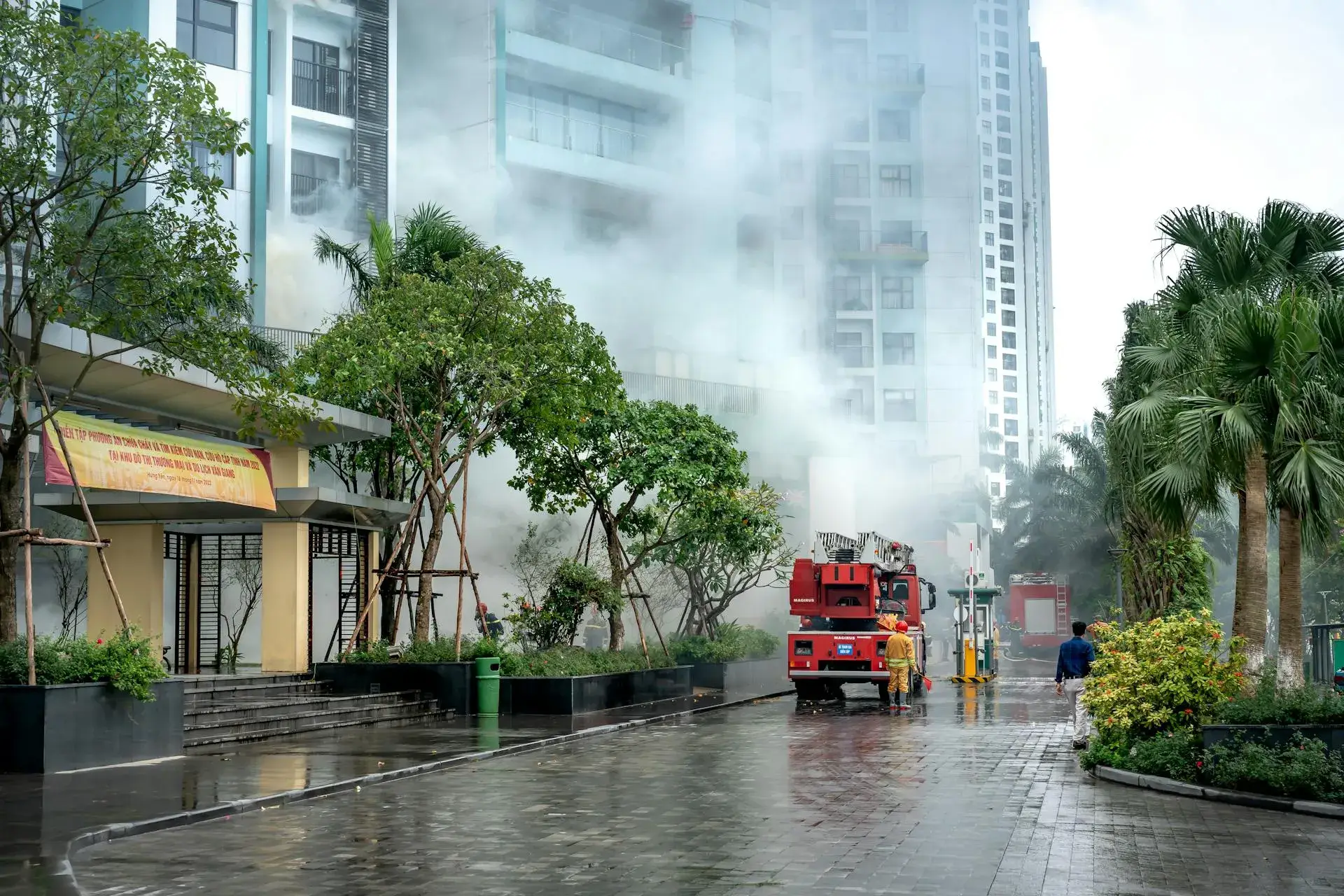
Smoke Damage Restoration in Clarkston, GA
Smoke residue acidifies and bonds to surfaces within hours. Odor penetrates deeper into materials with every passing day. Our local team responds to Clarkston emergencies within 60 minutes.
What Happens When You Call
A real person answers, not a call center. We assess your situation, ask the right questions, and begin coordinating your response immediately.
Your dedicated restoration team is dispatched from our local base serving Clarkston and the surrounding DeKalb County communities.
Team arrives with air quality testing equipment, HEPA scrubbers, chemical cleaning systems, and deodorization tools. Assessment and mitigation begin immediately.
Contamination sources identified, immediate air quality stabilized, cleaning and deodorization plan documented. You know exactly what comes next.
Smoke damage does not stop when the visible haze clears. Residue is acidifying on surfaces, odor molecules are bonding into porous materials, and particulates are circulating through your HVAC system right now. Whether the smoke came from a structure fire in your building, a brush fire outside your property, or an industrial chemical event, the damage progresses until professional intervention stops it. X Response exists for this exact moment. When you reach out, your restoration team is mobilized within minutes and on site within the hour. Call now. Your team is standing by.
Why Clarkston Homes Are Vulnerable to Smoke Damage
Clarkston faces smoke damage risks from an unusually wide range of sources for a city of its size. On September 29, 2024, a fire at the BioLab chemical manufacturing facility in Conyers, Georgia, roughly 12 miles east of Clarkston, released a massive plume of toxic smoke containing chlorine and other hazardous substances. The U.S. Chemical Safety Board confirmed that the incident resulted from reactive materials stored in a warehouse coming into contact with water, triggering a chemical decomposition that generated intense heat, multiple fires, and a toxic plume that traveled across DeKalb County and the broader metro Atlanta area. The City of Clarkston issued official notices advising residents on air quality and safety measures as the plume drifted westward. A June 2026 Georgia Public Broadcasting study found the BioLab plume produced numerous toxic compounds beyond what early warnings identified, including bromine as the dominant compound rather than chlorine alone. For Clarkston's dense apartment communities where residents could not easily evacuate or seal their units against infiltration, the chemical plume represented a smoke damage event that had nothing to do with fire on their own property.
In July 2023, Canadian wildfire smoke traveled more than 1,000 miles south to blanket metro Atlanta for days, triggering a Code Orange air quality alert from the Georgia Department of Natural Resources Environmental Protection Division. The Georgia Tech School of Earth and Atmospheric Sciences confirmed PM2.5 levels exceeding 55 micrograms per cubic meter south of Atlanta, well into the unhealthy range for sensitive populations. For Clarkston's ground-floor apartment units with aging window seals, limited weatherization, and window-unit air conditioning that draws directly from outdoor air, that extended smoke event deposited fine particulates on interior surfaces, contaminated soft furnishings, and degraded indoor air quality for days. Beyond these regional events, Clarkston experiences localized smoke damage from its own recurring apartment fires, including the August 2025 Clarkston Oaks fire that pushed smoke through 32 units and the April 2026 brush fire series that sent smoke drifting across residential areas near the GSU campus.
Industrial Chemical Plume Exposure
The September 2024 BioLab fire in Conyers demonstrated that Clarkston's smoke damage risk extends beyond traditional structure fires. The facility sits roughly 12 miles east of Clarkston along the I-20 corridor, and the toxic plume traveled westward across DeKalb County, depositing chemical residues on exterior surfaces, infiltrating buildings through ventilation systems and unsealed openings, and degrading indoor air quality across the area. The U.S. Chemical Safety Board confirmed the plume contained chlorine and other hazardous substances, and a 2026 study found additional toxic compounds including bromine. For Clarkston's apartment buildings where HVAC systems draw outdoor air and window units have no filtration, chemical plume events contaminate interior spaces in ways that residents cannot see or smell until the irritants have already settled on surfaces and circulated through ductwork. Restoration after chemical smoke exposure requires different techniques than traditional fire soot: specialized surface testing to identify the contaminants present, targeted chemical neutralization rather than standard cleaning, and air quality verification against specific compound thresholds rather than general particulate levels.
Wildfire Smoke Infiltration Events
The July 2023 Canadian wildfire smoke event that blanketed metro Atlanta for multiple days deposited fine particulate matter (PM2.5) throughout Clarkston's residential and commercial spaces. Georgia Tech monitoring confirmed concentrations exceeding 55 micrograms per cubic meter, and the Georgia DNR issued Code Orange alerts indicating unhealthy conditions for sensitive groups. PM2.5 particles are small enough to pass through standard window screens and older weatherstripping, infiltrating apartments even when windows and doors are closed. Once inside, they settle on surfaces, embed in carpet fibers and upholstery, and circulate through HVAC systems that lack HEPA-grade filtration. For Clarkston's densely occupied apartment complexes where many units rely on window air conditioning that pulls directly from outdoor air with minimal filtration, wildfire smoke events contaminate interior spaces at rates significantly higher than in sealed, centrally-filtered buildings. The resulting damage is not dramatic but pervasive: a fine gray-yellow film on surfaces, degraded air quality, aggravated respiratory conditions, and odor that lingers in soft materials long after outdoor air clears.
Multi-Unit Structure Fire Smoke Migration
When fire occurs in one of Clarkston's aging apartment buildings, smoke does not stay in the unit of origin. It travels through every unsealed penetration: shared wall cavities, continuous attic spaces, gaps around plumbing and electrical penetrations between units, HVAC ductwork that connects multiple apartments, and hallway corridors that function as chimneys drawing smoke upward through stairwells. The August 2025 Clarkston Oaks fire damaged 32 units from a single ignition point, with smoke contamination extending far beyond the units that experienced direct flame damage. Many of those 32 units suffered smoke damage only, requiring professional cleaning, deodorization, and air quality restoration without any structural fire repair. In buildings where attic spaces are continuous across an entire building section, smoke can travel the full length of the structure within minutes, depositing soot on ceiling surfaces, insulation, and roof sheathing in units 100 feet from the fire origin.
Brush Fire and Exterior Smoke Intrusion
The April 2026 arson series that produced 15 brush fires within a half-mile of Clarkston's residential areas generated smoke that drifted across apartment complexes, entered through open windows and ventilation systems, and deposited particulates on exterior surfaces and in units where residents had windows open or running window AC units. Brush fire smoke carries a distinct mixture of organic particulates from burned vegetation, soil minerals, and ash that differs from structure fire soot. It tends to be less acidic than synthetic soot but more pervasive because it is produced in large volumes outdoors and distributed by wind across wide areas. For ground-floor units positioned near the overgrown lots and wooded margins where brush fires ignite, smoke intrusion can be significant even from a fire that never touches the building itself. The fine ash and particulate settle on every horizontal surface, embed in window screens and weatherstripping, and require professional cleaning to fully remove.
Apartment HVAC Systems as Smoke Distribution Networks
Many of Clarkston's apartment complexes use forced-air HVAC systems that connect multiple units through shared ductwork, return air plenums, and mechanical closets. When smoke enters any part of this system, whether from a fire in one unit, outdoor infiltration from a chemical plume or wildfire event, or even excessive cooking smoke, the HVAC distributes it to every connected space each time the system cycles. Ductwork accumulates soot and residue on interior surfaces, and that contamination continues to degrade air quality and release odor for weeks or months after the original smoke event ends. In older buildings where duct seams are not sealed with mastic and where filter racks accept only minimal filtration, the HVAC system becomes a reservoir for smoke contamination that requires professional cleaning to resolve. Simply changing the filter is insufficient; the ductwork interior surfaces, blower housing, evaporator coil, and return air plenums all require direct cleaning to eliminate the contamination source.
These factors create a smoke damage environment in Clarkston that extends far beyond structure fires. Chemical plumes from industrial facilities east of the city, wildfire smoke from distant fires funneled south by weather patterns, brush fires ignited in adjacent vacant lots, and apartment fires that push smoke through dozens of units via shared construction and HVAC systems all produce different types of contamination that require different restoration approaches. Effective smoke damage restoration here means first identifying what type of smoke produced the contamination, because chemical residue from a BioLab plume demands a fundamentally different approach than protein soot from a kitchen fire or PM2.5 from wildfire smoke. It rewards a team that has worked in DeKalb County's dense apartment communities, understands how smoke travels through shared building systems, and carries the air quality testing and chemical neutralization capabilities that Clarkston's unusually diverse smoke exposure profile demands.
What Happens to Your Home While You Wait
Within 1 Hour
Smoke residue begins settling on every exposed surface. Soot acidifies on contact with metals, causing corrosion that becomes permanent if not neutralized quickly. In Clarkston's apartment units, smoke traveling through shared wall cavities and HVAC ductwork is depositing residue in spaces residents cannot see or reach. Chemical plume residues from industrial events begin reacting with moisture in the air and on surfaces, potentially forming secondary irritants. The contamination you cannot yet see is spreading through the building.
1–24 Hours
Acidic soot etches metal fixtures, appliance surfaces, and electronics. Smoke odor penetrates deeper into soft materials: upholstery, clothing, mattresses, carpet padding. In Clarkston's humid climate, chemical residues interact with surface moisture and accelerate corrosion and staining. HVAC systems continue circulating contaminated air through connected units each time they cycle. Fine particulates from wildfire or brush fire smoke embed deeper into carpet fibers and fabric weaves, becoming increasingly difficult to remove with each passing hour.
24–48 Hours
Permanent staining sets into porous surfaces, grout, natural stone, and unfinished wood that were not cleaned in the first day. Smoke odor molecules bond at the molecular level to paint, drywall paper, and insulation materials. Corrosion on metals deepens beyond surface treatment. In apartment buildings where smoke entered HVAC ductwork, the system is now actively redistributing contamination with every heating or cooling cycle, expanding the affected area beyond the original smoke exposure zone.
48–72 Hours
Materials that could have been professionally cleaned in the first 24 hours now require replacement. Odor has penetrated structural materials deeply enough that surface cleaning alone will not resolve it. Electronics and appliances with internal soot exposure may fail. Soft furnishings that could have been restored through ozone or hydroxyl treatment may now be unsalvageable. The restoration scope expands significantly, crossing from cleaning into demolition and replacement territory.
One Week and Beyond
Smoke odor permanently embedded in structural materials throughout the unit and connected spaces. HVAC system thoroughly contaminated and distributing residue continuously. Soft goods unsalvageable. Corrosion damage to fixtures, appliances, and electronics beyond repair. What started as a professional cleaning job has become a gut renovation with full deodorization of the structural cavity. Costs multiply and insurance claims grow more complex.
The difference between cleaning smoke damage and gutting a space is measured in response time. Contact X Response now. Our Clarkston team responds within 60 minutes.
How We Restore Smoke-Damaged Clarkston Homes
From the moment our team arrives, every step is documented, measured, and verified. Here is exactly what the smoke damage restoration process involves for Clarkston properties.
Air Quality Assessment and Source Identification
Our team arrives with air quality testing equipment to measure particulate levels, identify specific contaminants, and determine the smoke source type. This step is critical in Clarkston because the restoration approach differs dramatically based on whether the contamination came from a structure fire in the building, a chemical plume from an industrial event, wildfire particulate infiltration, or brush fire smoke intrusion from adjacent lots. We test indoor air, sample surface residues, inspect HVAC systems for contamination, and map the extent of smoke distribution through the building. In multi-unit apartment buildings, that means checking not just the reported unit but adjacent units connected through shared walls, attics, and ductwork. Everything is documented for your insurance claim from the first measurement.
Containment and Air Quality Stabilization
Before detailed cleaning begins, we stabilize indoor air quality to stop ongoing contamination from spreading. HEPA air scrubbers are positioned to filter airborne particulates continuously. HVAC systems are shut down if they are distributing contaminated air through the building. Negative air pressure is established in heavily contaminated areas to prevent smoke migration into cleaner spaces. For chemical plume events where outdoor air quality may still be compromised, we seal the space against further infiltration while maintaining fresh air exchange through filtered systems. These immediate actions protect the occupants, limit further contamination spread, and create controlled conditions for the detailed cleaning that follows.
Surface Cleaning and Soot Removal
Smoke residue is cleaned from every affected surface using techniques matched to the contamination type and the surface material. Protein-based soot from cooking fires requires alkaline cleaning agents. Synthetic soot from electrical or plastic fires requires solvent-based approaches. Chemical residue from industrial plumes requires targeted neutralization agents specific to the compounds identified during assessment. In Clarkston's apartment buildings, this means cleaning walls, ceilings, floors, cabinetry, fixtures, and trim in every affected unit, plus shared hallways, stairwells, and mechanical rooms. Hard surfaces are cleaned in a specific sequence from top to bottom to prevent re-contamination of cleaned areas. Porous materials that cannot be effectively cleaned, typically severely contaminated carpet padding, insulation, and some soft furnishings, are removed and documented for the insurance claim.
HVAC Decontamination
If smoke entered the HVAC system, cleaning the living space alone will not resolve the problem. We clean ductwork interior surfaces, blower housings, evaporator coils, return air plenums, and filter compartments using mechanical agitation and negative-pressure vacuuming that captures loosened debris without releasing it into the living space. For Clarkston's apartment buildings where shared ductwork connects multiple units, we trace the contamination through the entire system and clean every section that shows residue. Registers and grilles are removed and cleaned individually. New high-efficiency filters are installed. The system is run and re-tested to confirm that cycling the HVAC no longer introduces contaminants into the space.
Deodorization and Verification
After surfaces are clean and the HVAC is decontaminated, residual odor molecules embedded in structural materials require specialized treatment. We deploy hydroxyl generators for occupied spaces, ozone generators for evacuated spaces, and thermal fogging to reach concealed cavities where odor molecules reside. The specific technique depends on the odor type: protein-based cooking odor responds differently than synthetic fire odor, which responds differently than chemical plume residue. Treatment continues until air quality testing confirms that contaminant levels have returned to acceptable thresholds and odor is eliminated at the source rather than merely masked. Final documentation includes before-and-after air quality measurements that demonstrate the space is safe for occupant return.
The X Response Difference
When you contact X Response, you get a dedicated restoration team that identifies the smoke source, traces its path through your building, cleans every contaminated surface and system, and verifies the result with air quality testing. One team, one standard of work, documented results from start to finish.
Insurance Claim Guidance for Clarkston Homeowners
Smoke damage insurance claims in Georgia depend on the source of the smoke. Smoke from a covered peril, such as a fire in your building or on your property, is typically covered under standard homeowner's and renter's policies. Smoke infiltration from external sources like chemical plumes, wildfire events, or brush fires on adjacent property introduces coverage questions that vary by policy and carrier. Some policies include coverage for damage from off-premises fires; others exclude it or limit it. The September 2024 BioLab chemical plume in Conyers created thousands of potential claims across DeKalb County where residents experienced property contamination from an industrial event miles away. Documenting the contamination type, source, and extent with professional testing is critical to establishing that damage occurred and linking it to a covered or potentially covered event.
How X Response Helps
- Document all contamination with professional air quality testing, surface sampling, and photographic evidence from day one
- Identify the smoke source clearly, which determines which coverage applies under your policy
- Prepare documentation that distinguishes between fire damage, smoke damage, and chemical contamination for accurate claim categorization
- Align our restoration scope with standard insurance coverage categories so your adjuster can process the claim efficiently
- Explain your policy's likely coverage before you file, including any gaps for off-premises smoke sources or chemical plume events
X Response does not file claims on your behalf, adjust claims, or make coverage determinations. We provide documentation and guidance to help you make informed decisions about your property and your policy. Coverage decisions are made solely by your insurance carrier.
Certified Restoration Specialists Serving Clarkston
When you contact X Response for smoke damage in Clarkston, your restoration team is drawn from certified professionals who work across DeKalb County and understand the unusually diverse range of smoke sources that affect properties here. They have cleaned chemical residue after industrial plume events, removed wildfire particulate from apartment complexes with compromised weatherization, restored multi-unit buildings where structure fire smoke traveled through shared construction, and decontaminated spaces after brush fire smoke infiltration. They understand that each smoke type requires a different identification protocol, different cleaning chemistry, and different verification standard. This is not a crew that arrives with one product and one technique for every job. It is a team equipped to identify what contaminated your space and deploy the specific approach that contamination type demands.
Every technician on your team holds current IICRC certification in fire and smoke restoration and carries the appropriate Georgia state licensing for the work being performed. Equipment includes professional air quality monitoring, HEPA filtration systems, hydroxyl and ozone generators, thermal foggers, mechanical duct cleaning systems, and chemical-specific cleaning agents for different residue types. When your team arrives at your Clarkston property, they bring the diagnostic and treatment capabilities to handle whatever smoke source your building has been exposed to, from the most common apartment fire soot to the most unusual industrial chemical residue.
In Clarkston, X Response works with Atlanta's Best Restoration, an independent local restoration partner serving DeKalb County.
Smoke Damage Restoration FAQ for Clarkston Homeowners
Other Emergency Services in Clarkston

Water Damage Restoration
Burst pipes, storm flooding, standing water. We extract, dry, and restore before mold sets in.
Learn more
Fire Damage Restoration
Structural damage, soot, debris. We stabilize, clean, and rebuild what fire destroyed.
Learn more
Mold Remediation
Testing, containment, removal, prevention. We find the source, eliminate the growth, and stop it from returning.
Learn more
Sewage Cleanup
Sewer backups, contaminated water, biohazard. We extract, sanitize, and restore safely.
Learn more