
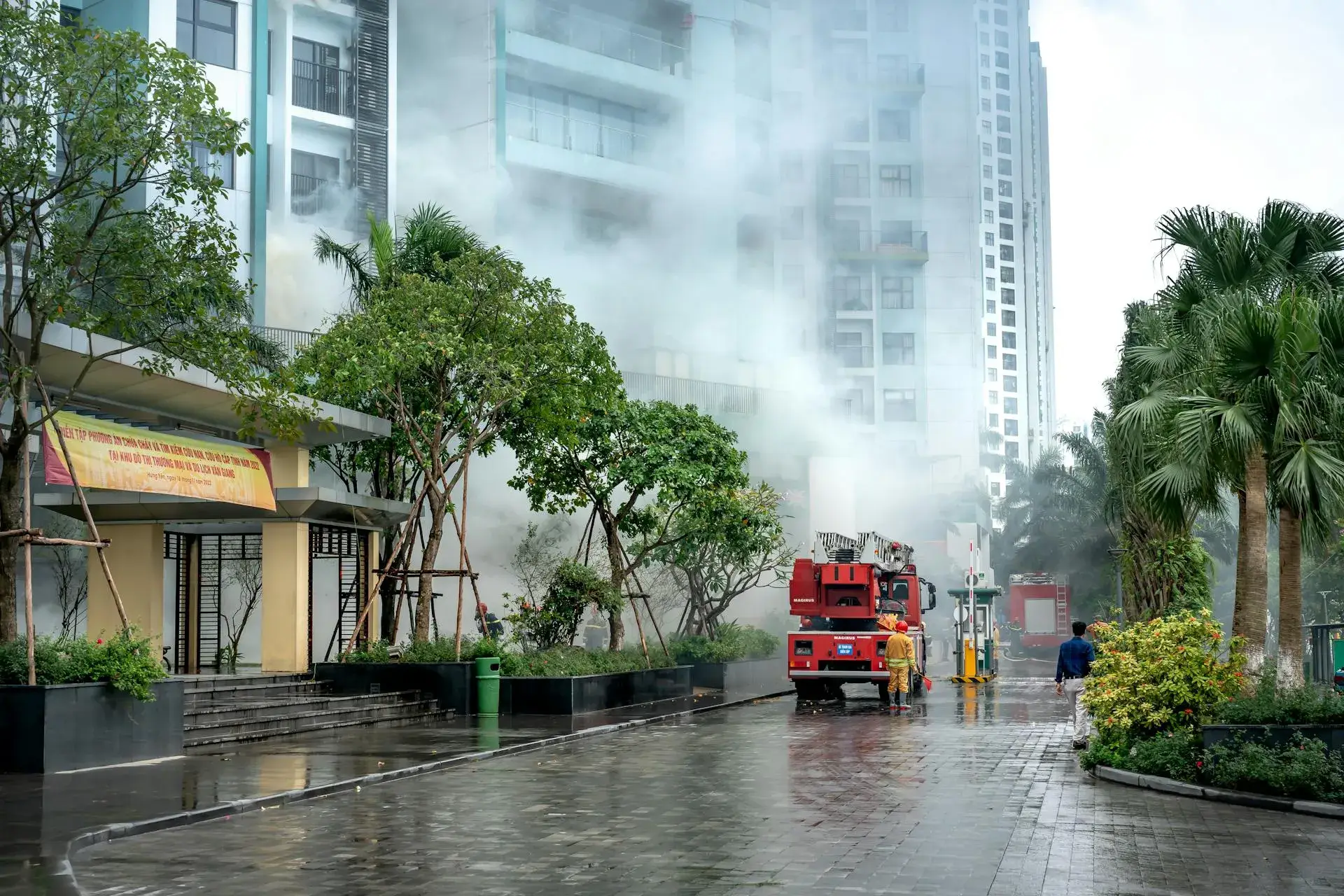
Smoke Damage Restoration in Carmel, IN
Smoke residue corrodes surfaces and bonds to materials within hours. Our local team responds to Carmel emergencies within 60 minutes to stop the damage from setting permanently.
What Happens When You Call
A real person answers, not a call center. We assess the smoke source, affected areas, and urgency, then begin coordinating your response immediately.
Your dedicated restoration team is dispatched from our local base serving Carmel and the surrounding Hamilton County communities.
Team arrives with air quality testing equipment, HEPA filtration, and professional cleaning systems. Containment and initial cleaning begin immediately.
Contamination contained, HVAC isolated, cleaning plan documented. You know exactly what comes next and what your insurance needs.
Smoke damage is deceptive. The fire may be out or the source may be gone, but the contamination is active and spreading through your home right now. Soot corrodes metal, stains surfaces permanently, and fills your HVAC system with particulate that recirculates every time the blower runs. You need professional intervention before the damage sets. X Response exists for exactly this moment. When you reach out, your restoration team is mobilized within minutes and on site within the hour. Call now. Your team is standing by.
Why Carmel Homes Are Vulnerable to Smoke Damage
Carmel is a city of approximately 103,600 residents in Hamilton County, Indiana, that experienced sustained poor air quality during the June 2023 Canadian wildfire smoke events alongside the entire Indianapolis metro. The Indiana Department of Environmental Management issued statewide Air Quality Action Days on June 7-9 and again on June 27-28, 2023, after Canadian wildfire smoke pushed fine particulate levels into the unhealthy range across all Indiana counties. The Knozone Action Day program for the Indianapolis metro declared nine separate action days during the summer of 2023, reflecting repeated episodes where fine particulates and ground-level ozone reached unhealthy concentrations. For Carmel residents, these events were not merely outdoor air quality advisories. They were indoor contamination events that deposited fine particulate on surfaces, inside HVAC ductwork, and throughout soft goods in every home that had windows open, fresh air intakes running, or aging weatherstripping on doors and windows.
Beyond wildfire infiltration, Carmel's dense downtown Arts and Design District creates a unique smoke exposure profile. The June 2025 basement fire at Goodness Gracious Kitchen and Indiana Artisan Gifts in downtown Carmel required multiple fire departments and produced smoke that affected the shared building and surrounding structures in the city center. A May 2024 strip mall fire on Rangeline Road generated a heavy smoke plume affecting downwind residential and commercial properties. In a city where mixed-use buildings, restaurants, and residential units share walls and proximity, smoke from any single commercial fire event can contaminate multiple addresses simultaneously. The combination of regional wildfire smoke infiltration and localized structure fire exposure gives Carmel a broader smoke damage risk profile than communities with solely residential construction.
Canadian Wildfire Smoke Infiltration Events
The June 2023 Canadian wildfire smoke episodes proved that Carmel homes are vulnerable to smoke contamination from sources hundreds of miles away. IDEM issued Air Quality Action Days covering all Indiana counties on June 7-9 and June 27-28, 2023, and the Knozone Action Day program for the Indianapolis metro declared nine action days that summer. During these events, PM2.5 particulate at 2.5 microns and smaller infiltrated homes through building envelope gaps, open windows, and fresh air intakes, then was distributed by HVAC systems to every room. Standard residential MERV 8 filters capture only a fraction of these fine particles. A multi-day smoke event deposits enough particulate to produce a visible haze on surfaces, discolor light-colored furnishings, contaminate ductwork interiors, and degrade indoor air quality for weeks after outdoor conditions normalize. Carmel's large homes with extensive ductwork running through attic spaces provide more surface area for smoke accumulation and more volume for the HVAC system to contaminate.
Downtown Mixed-Use and Commercial Fire Proximity
Carmel's Arts and Design District, Midtown, and City Center combine restaurants, retail, and residential units in close proximity. The June 2025 downtown basement fire at shared commercial buildings and the May 2024 strip mall fire on Rangeline Road both produced smoke plumes that affected neighboring properties. Restaurant kitchen fires generate greasy, protein-based smoke that is particularly pungent and difficult to remove. Retail fires involving synthetic materials produce acrid, corrosive soot. When these fires occur in buildings that share walls with residential condominiums or townhomes, or in commercial strips adjacent to residential neighborhoods, the smoke migrates through structural connections, HVAC systems, and the outdoor air into neighboring homes. Residents may not know their home was affected until they notice a persistent odor or find soot residue on surfaces days after the fire.
Furnace Puffbacks and Heating System Malfunctions
Carmel's cold winters drive continuous furnace operation from November through March. Furnace puffbacks occur when unburned fuel accumulates in the combustion chamber and ignites all at once, sending a burst of oily soot backward through the heat exchanger and into the ductwork and living space. The soot exits every supply register simultaneously, coating walls, ceilings, countertops, and furnishings throughout the home within seconds. Puffback residue is petroleum-based and oily, requiring solvent-based cleaning rather than standard methods. Carmel's older homes near the city center and Monon corridor, with furnaces that have operated for 20 or more years, are most susceptible. But even newer high-efficiency furnaces can puffback if ignition systems malfunction or if the system experiences delayed ignition from a dirty burner or faulty gas valve.
Multi-Zone HVAC and Whole-Home Distribution
Carmel's larger homes frequently feature two to four separate HVAC zones serving different areas of the house: main floor, upper floor, basement, and sometimes a dedicated system for a bonus room or master suite. When smoke enters the home from any source, each running HVAC system becomes both a distribution mechanism and a contamination reservoir. The blower pulls smoke-laden air through the return, deposits particulate on the evaporator coil and inside ductwork, then pushes contaminated air through every supply register served by that zone. In homes with multiple systems, contamination can be uneven: the zone that was running during the event may be heavily affected while a dormant zone remains relatively clean. Each system must be evaluated and decontaminated independently, which increases both the complexity and cost of restoration compared to single-system homes.
High-Value Content and Specialty Surfaces
Carmel homes frequently contain high-value content including original artwork, custom upholstery, designer furnishings, wine collections, and specialty surfaces like natural stone countertops, hand-scraped hardwood, and custom cabinetry. Smoke damage to these items requires specialized restoration techniques beyond standard residential cleaning. Artwork requires conservation-grade treatment. Natural stone etches if acidic soot residue is not removed before it sets. Custom wood finishes can be permanently damaged by aggressive cleaning methods intended for painted surfaces. Wine collections exposed to smoke contamination through permeable corks may be total losses. For Carmel homeowners, the content restoration component of a smoke damage event can equal or exceed the cost of structural cleaning.
Smoke damage in Carmel comes from multiple sources that produce different contamination types. Wildfire smoke deposits fine, widespread particulate across every surface. Commercial fires in the dense downtown generate heavy soot plumes affecting adjacent residences. Furnace puffbacks produce oily, system-distributed residue throughout the home. In every case, the forced-air HVAC system, often multiple zones in Carmel's larger homes, turns a localized event into whole-home contamination. Effective restoration requires identifying the smoke type, matching cleaning techniques to each surface and material, decontaminating every HVAC zone, and eliminating embedded odor rather than masking it.
What Happens to Your Home While You Wait
Within 1 Hour
Soot particles settle on all exposed surfaces. Acidic residues begin etching metal hardware, stainless steel appliances, and chrome fixtures. The HVAC system, if running, distributes contamination to every room through supply registers. Smoke odor begins absorbing into upholstery, bedding, clothing, carpet, and drapes. In Carmel homes with natural stone surfaces, acidic soot begins reacting with the stone immediately.
1–24 Hours
Soot permanently discolors porous surfaces including grout, natural stone, and unfinished wood. Acidic compounds continue corroding metal surfaces. Smoke odor chemically bonds to painted walls and penetrates wall cavities. In Hamilton County's humid conditions, moisture in the air helps smoke molecules penetrate deeper into porous materials. Custom wood finishes begin showing permanent marks where soot has settled.
24–72 Hours
Plastic fixtures, switch plates, and bathroom accessories yellow permanently. Upholstered furniture absorbs smoke deep into foam padding beyond the reach of surface cleaning. HVAC ductwork accumulates enough residue to produce visible discoloration and sustained odor with every cycle. Wine corks and other permeable closures absorb smoke compounds, potentially compromising stored collections.
72 Hours to One Week
Smoke odor fully saturates insulation in attic and wall cavities. Metal surfaces show permanent corrosion pitting. Restoration scope increases as more materials require replacement rather than cleaning. The contamination has moved from surface-level to embedded, requiring thermal fogging and advanced deodorization.
One Week and Beyond
Surfaces and content that could have been saved with early intervention now require replacement. The home smells indefinitely because odor sources are embedded in structural materials and HVAC components. Insurance claims grow contested as carriers question whether timely intervention could have reduced scope.
Professional smoke damage restoration within the first 24 hours can save surfaces, fixtures, and content that become permanent losses after 72 hours. Contact X Response now. Our Carmel team responds within 60 minutes.
How We Restore Smoke-Damaged Carmel Homes
Smoke damage restoration is precise, technical work that follows a specific sequence. Cleaning in the wrong order or with the wrong technique can permanently set stains and odors rather than removing them. Here is how the process works.
Source Identification and Contamination Mapping
Different smoke sources produce different residue types requiring different cleaning approaches. Our team identifies whether the contamination came from a structure fire, wildfire infiltration, a furnace puffback, or a kitchen event. We map contamination boundaries using UV light, particle counters, and visual inspection. In Carmel homes with multiple HVAC zones, each zone is evaluated separately to determine which systems distributed contamination and which remained clean. The output is a precise scope defining what requires cleaning, what requires intensive treatment, and what is unaffected.
HVAC Isolation and Air Quality Control
Before cleaning begins, all HVAC systems are isolated to prevent redistribution during restoration. HEPA air scrubbers are deployed throughout the affected zone to capture airborne particulate that cleaning dislodges. In Carmel homes with multiple zones, systems are shut down and sealed individually. Negative air pressure may be established to prevent contamination from migrating into unaffected areas. This containment step prevents aggressive cleaning from simply moving soot from surfaces into the air and back onto surfaces.
Surface Cleaning and Soot Removal
Surfaces are cleaned using techniques matched to the residue type and surface material. Dry sponging removes loose particulate from painted walls without smearing. Wet alkaline cleaning addresses heavy combustion soot on hard surfaces. Solvent-based cleaning handles oily puffback residue. For Carmel homes with specialty surfaces, natural stone is cleaned with pH-neutral products to prevent etching, custom wood finishes receive appropriate treatment to preserve the finish, and high-end appliances are cleaned to manufacturer specifications. The sequence proceeds top to bottom, ceilings first, so dislodged particles fall onto surfaces not yet cleaned.
HVAC Decontamination
Each contaminated HVAC system receives dedicated decontamination: supply and return ductwork cleaned from register to plenum, evaporator coil accessed and cleaned, blower assembly decontaminated, and system sanitized. In Carmel homes with two to four zones, each system is treated individually. New MERV 13 or higher filters are installed. Leaving any system contaminated means it recirculates residue and odor indefinitely, recontaminating cleaned areas with every cycle. This step is not optional regardless of the smoke source.
Odor Elimination
Visible soot removal does not eliminate smoke odor. Odor molecules are absorbed into painted surfaces, wall cavities, structural wood, insulation, and soft goods at a molecular level. We deploy thermal fogging equipment that produces penetrating deodorizing vapor capable of reaching the same cavities and materials the smoke reached. Hydroxyl generators oxidize odor molecules in occupied spaces safely. For severe contamination, sealed ozone treatment of individual rooms targets deeply embedded odor. The job is complete when instrumentation and sensory inspection confirm odor is eliminated, not masked.
Content Cleaning and Restoration
Personal belongings, clothing, electronics, artwork, and household items are inventoried, documented for insurance, and cleaned using appropriate methods. In Carmel homes with high-value content, artwork receives conservation-grade assessment, electronics are inspected for particulate infiltration, and specialty items are treated individually rather than batch-processed. Clothing goes through specialized ozone treatment or professional laundering. Items that cannot be restored are documented as losses. Every item is tracked through our system so nothing is lost during the process.
The X Response Difference
When you contact X Response for smoke damage in Carmel, you get a team that understands smoke contamination as a system-wide problem requiring treatment of every surface, cavity, HVAC zone, and piece of content in the home.
Insurance Claim Guidance for Carmel Homeowners
Smoke damage insurance coverage in Indiana depends on the source. Smoke from a fire in your home or a neighbor's property is typically covered under your standard homeowner's policy. Smoke from commercial fires in adjacent buildings may also be covered depending on your policy. Furnace puffbacks are generally covered as sudden equipment failure. However, gradual smoke damage from a poorly maintained system, chronic fireplace backdrafting, or ongoing cooking residue is typically excluded. The distinction between sudden and gradual matters enormously, and proper documentation of the event timeline is critical.
How X Response Helps
- Document the smoke source and timeline to establish the event as sudden and accidental
- Photograph all affected areas, surfaces, and content items before any cleaning begins
- Inventory damaged content with replacement values, particularly high-value items in Carmel homes
- Separate smoke damage from any pre-existing conditions
- Document HVAC contamination specifically, as multi-zone decontamination is a legitimate restoration cost
X Response does not file claims on your behalf, adjust claims, or make coverage determinations. We provide documentation and guidance to help you make informed decisions about your property and your policy. Coverage decisions are made solely by your insurance carrier.
Certified Restoration Specialists Serving Carmel
When you contact X Response for smoke damage in Carmel, your restoration team is drawn from certified professionals who work across Hamilton County and understand smoke behavior in the construction types and conditions specific to this area. They know how multiple HVAC zones in Carmel's larger homes distribute contamination unevenly, how downtown mixed-use fires affect adjacent residential units, how Hamilton County's humid summers cause smoke molecules to bond aggressively to surfaces, and how high-value content in custom homes requires specialized restoration techniques. They have cleaned wildfire infiltration from the 2023 Canadian smoke events, puffback residue from aging furnaces, heavy soot from commercial fires in the Arts and Design District, and protein-based deposits from kitchen events across every neighborhood.
Every technician holds current IICRC certification in fire and smoke restoration. Equipment includes particle counters for contamination mapping, commercial HEPA air scrubbers, professional-grade thermal fogging and hydroxyl generation systems, specialized content restoration tools, and cleaning products matched to specialty surfaces including natural stone, custom wood, and high-end finishes. When your team arrives, they bring everything needed to begin containment and cleaning immediately.
In Carmel, X Response works with The Cleaning Source, an independent local restoration partner serving Hamilton County.
Smoke Damage Restoration FAQ for Carmel Homeowners
Other Emergency Services in Carmel
Water Damage Restoration
Burst pipes, storm flooding, standing water. We extract, dry, and restore before mold sets in.
Learn more
Fire Damage Restoration
Structural damage, soot, debris. We stabilize, clean, and rebuild what fire destroyed.
Learn more
Mold Remediation
Testing, containment, removal, prevention. We find the source, eliminate the growth, and stop it from returning.
Learn more
Sewage Cleanup
Sewer backups, contaminated water, biohazard. We extract, sanitize, and restore safely.
Learn moreNearby Service Areas
Also serving nearby: