
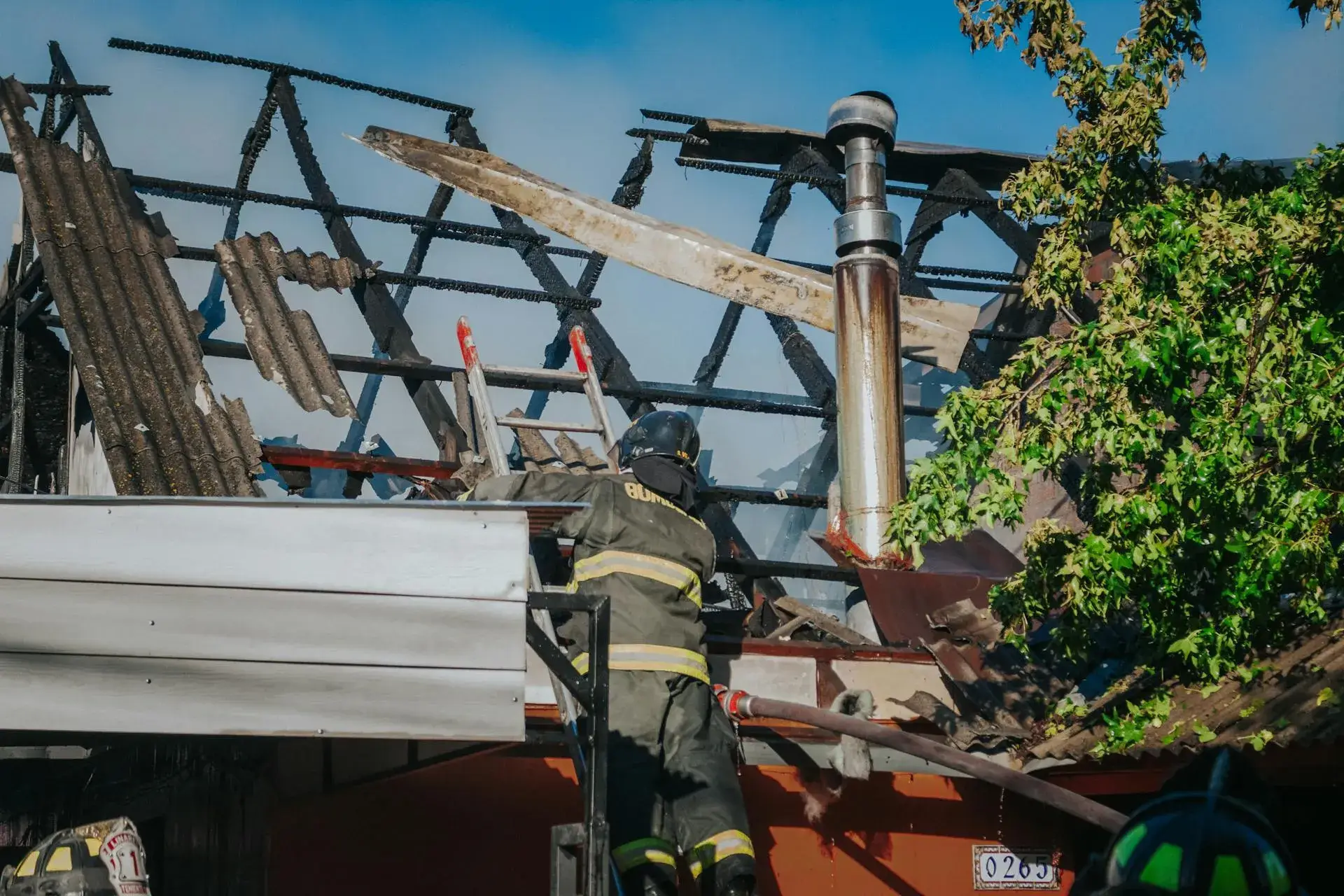
Fire Damage Restoration in Wheaton, IL
Fire damage worsens every hour as soot corrodes surfaces and smoke penetrates deeper into your home's structure. Our local team responds to Wheaton emergencies within 60 minutes.
What Happens When You Call
A real person answers, not a call center. We assess your situation, ask the right questions, and begin coordinating your response immediately.
Your dedicated restoration team is dispatched from our local base serving Wheaton and the surrounding DuPage County communities.
Team arrives with board-up materials, HEPA filtration, soot removal equipment, and structural assessment tools. Emergency stabilization begins immediately.
Property secured, immediate threats addressed, restoration plan documented. You know exactly what comes next.
A fire just tore through part of your home and you need someone who knows what to do next. Not a claims hotline, not a callback queue. X Response exists for exactly this moment. When you reach out, your restoration team is mobilized within minutes and on site within the hour. From that point forward, one team manages everything: stabilization, smoke removal, structural repair, and insurance documentation. You are never left guessing about the next step. Call now. Your team is standing by.
Why Wheaton Homes Are Vulnerable to Fire Damage
Wheaton is a city of 53,970 residents and the county seat of DuPage County, Illinois, located approximately 25 miles west of downtown Chicago. The Wheaton Fire Department, established in 1883, provides fire suppression, emergency medical services, and technical rescue across the city's 11.25 square miles from multiple fire stations. The department serves a dense mix of residential neighborhoods ranging from pre-war bungalows near downtown to mid-century ranch homes in established subdivisions to newer construction on the city's periphery. The WFD participates in the Mutual Aid Box Alarm System (MABAS), ensuring that confirmed working structure fires automatically bring additional resources from neighboring departments in Glen Ellyn, Carol Stream, Winfield, Warrenville, and West Chicago. In 2023, Illinois reported residential structure fire casualties of 6.1 deaths and 27.4 injuries per 1,000 fires, both above the national averages of 5.8 deaths and 19.7 injuries per 1,000 fires, according to the U.S. Fire Administration's National Fire Incident Reporting System data.
On April 17, 2025, the Wheaton Fire Department responded to a lightning-strike fire in the 1400 block of Wendover Lane, finding heavy fire on the roof of the home. Crews contained the blaze to the attic and brought it under control within 20 minutes, but the home sustained significant fire and water damage and was left uninhabitable. The incident was the second lightning-caused house fire in the western suburbs that week. Just weeks later, on May 6, 2025, the WFD responded to a structure fire in the 600 block of Polo Drive where heavy fire and smoke were pushing from the attached garage and attic, with smoke visible at the eaves on the second floor. Firefighters brought that fire under control in approximately 30 minutes, but one firefighter was treated for a minor injury. These incidents illustrate the reality of structure fire risk in Wheaton: fires start from causes residents cannot prevent, like lightning strikes during severe thunderstorms, and the damage extends far beyond the flame origin as fire suppression water, smoke, and soot penetrate throughout the structure.
Lightning Strikes and Severe Thunderstorm Fire Risk
DuPage County sits in the heart of the Midwest thunderstorm corridor, experiencing an average of 35 to 45 thunderstorm days per year, many producing cloud-to-ground lightning. Wheaton's residential neighborhoods consist predominantly of single-family homes with asphalt shingle roofs, wood-frame attic structures, and mature tree canopies that attract lightning strikes. When lightning hits a residential roof, the electrical discharge travels through metal components, wiring, and moisture paths in the roof structure, generating enough heat to ignite wood sheathing, insulation, or roofing materials. The fire often starts in the attic space, hidden above the ceiling, where it can grow for minutes before producing visible smoke or triggering smoke detectors positioned lower in the home. The April 2025 Wendover Lane fire demonstrated this pattern: heavy fire was already established on the roof when crews arrived, and despite containment to the attic within 20 minutes, the home was rendered uninhabitable from combined fire, smoke, and suppression water damage. Lightning-caused fires present particular restoration challenges because the fire often damages roof structure and sheathing that requires full replacement, while suppression water cascades downward through ceilings and walls, creating secondary water damage throughout the home that must be addressed simultaneously.
Wheaton's Mixed-Era Housing Stock and Fire Behavior
Wheaton's residential neighborhoods span nearly a century of construction methods, from 1920s and 1930s bungalows near the downtown core to mid-century ranch homes in the 1950s and 1960s subdivisions to newer construction on the city's western and southern edges. Each era presents different fire behavior characteristics. Pre-war homes feature plaster-and-lath walls that resist flame spread better than drywall but trap smoke within the wall cavity where it deposits soot on hidden surfaces. Mid-century homes often have balloon-frame construction where wall studs run continuously from the foundation to the roof without fire stops between floors, creating vertical channels that allow fire to travel rapidly from basement to attic. Homes built from the 1970s onward use platform framing with fire stops at each floor level, but their engineered-wood trusses and oriented-strand-board sheathing ignite more readily and fail faster under fire load than the dimensional lumber and plank sheathing in older construction. The median construction year in Wheaton is approximately 1975, placing the majority of homes in the era where construction used a mix of dimensional lumber framing with early engineered products, combining moderate fire resistance with materials that produce heavy smoke when they burn.
Attached Garages and Fire Spread to Living Spaces
The majority of Wheaton homes built since the 1960s feature attached garages that share a common wall with the living space. Garages concentrate ignition sources, including vehicles with fuel systems, stored gasoline and chemicals, electrical panels, water heaters, and power tools with lithium-ion batteries, in a space often lacking the smoke detection required in living areas. The fire separation between an attached garage and the living space, typically a single layer of fire-rated drywall on the garage side, depends on that barrier remaining intact and continuous. Over decades, homeowners modify garage walls by running wiring, adding shelving anchors, cutting access doors, or finishing the space without maintaining the fire-rated assembly. When a fire originates in the garage, it can breach the compromised separation and enter the home's living space before occupants are aware. The May 2025 Polo Drive fire in Wheaton demonstrated this risk pattern: heavy fire and smoke were pushing from the attached garage and attic when crews arrived, indicating fire had traveled from the garage into the attic space above the home. Garage-origin fires produce particularly aggressive smoke and soot contamination because burning vehicles, tires, plastics, and chemicals generate complex hydrocarbon residues that penetrate deeply into building materials and are difficult to remove without professional chemical cleaning.
Electrical System Aging in 1960s and 1970s Homes
A significant portion of Wheaton's housing stock was built during the 1960s and 1970s when electrical codes were less stringent than current standards. These homes were wired for the electrical demands of that era: a few lighting circuits, a limited number of outlet circuits, and service panels sized for 100 or 150 amps. Over 50 to 60 years, homeowners have added air conditioning, kitchen renovations with high-draw appliances, home offices, entertainment systems, electric vehicle chargers, and other loads that push these systems beyond their original design capacity. Arc-fault circuit interrupter breakers, which detect dangerous arcing in wiring before it reaches ignition temperature, were not required by the National Electrical Code until 1999 for bedroom circuits and 2014 for most others. The majority of Wheaton homes predate both requirements. Original wiring connections loosen over decades of thermal cycling, creating high-resistance points that generate heat. Aluminum wiring, used in some homes during the early 1970s copper shortage, oxidizes at connection points and creates additional fire risk at every outlet, switch, and junction box where aluminum meets copper or brass terminals. The electrical system in a 50-year-old Wheaton home is the single component most likely to fail in a way that starts a fire, particularly in circuits that have been loaded beyond their original rating.
Cooking Fires and Open Floor Plan Consequences
The National Fire Protection Association consistently identifies cooking as the leading cause of residential structure fires nationally, and Wheaton's housing market has followed the trend of remodeling older homes to create open floor plans that remove walls between kitchens and living spaces. When a kitchen fire escapes the cooktop, whether from an unattended pan, a grease ignition on a gas range, or a malfunctioning appliance, the open layout provides no barrier between the fire and connected living areas. In homes where a first-floor renovation created an open kitchen, dining, and family room, smoke from a single cooking fire deposits soot on every surface in the connected space within minutes. Homes with two-story great rooms or open staircases allow smoke to rise to second-floor hallways and bedrooms before occupants upstairs are aware of the fire below. Even small cooking fires that are quickly extinguished by the homeowner or self-extinguish when the fuel is consumed produce enough smoke and soot in an open-concept home to create a whole-house odor and contamination event requiring professional cleaning of walls, ceilings, cabinetry, soft goods, and HVAC ductwork throughout the structure.
These factors create a city where residential fire damage frequently extends well beyond the ignition point. Lightning strikes ignite concealed attic fires during severe thunderstorms. Mixed-era construction means fire behavior varies by neighborhood and building decade. Attached garages concentrate ignition sources behind fire separations that may have been compromised over decades. Aging electrical systems in the majority of homes operate without modern arc-fault protection. And the open floor plans created by remodeling older homes allow smoke and soot to travel throughout the structure from even a localized kitchen fire. Effective fire damage restoration in Wheaton requires a team that understands how different construction eras behave during and after a fire, where hidden smoke and soot accumulate in each building type, and how to restore a property where damage extends through HVAC systems, wall cavities, attic spaces, and connected rooms far from the flame origin.
What Happens to Your Home While You Wait
Within 1 Hour
Soot begins settling on every horizontal surface throughout the home, including rooms distant from the fire origin. In Wheaton homes with forced-air HVAC systems, the air handler circulates smoke and soot particles through the ductwork to every register in the house within minutes of the fire. Acidic combustion byproducts from burned plastics, synthetic materials, and treated wood begin corroding metal surfaces: chrome fixtures, copper wiring, appliance exteriors, and jewelry. Suppression water from firefighting operations drains downward through ceiling cavities and wall interiors, pooling in basements and saturating insulation, drywall, and flooring on lower levels. Smoke odor penetrates porous materials including upholstered furniture, clothing, bedding, and curtains that were exposed to even brief smoke contact.
1–24 Hours
Soot etches into painted surfaces, stone countertops, and glass as acidic compounds react with the underlying material. What could be cleaned with professional methods in the first hours becomes permanently stained as the chemical reaction progresses. Metal surfaces develop visible tarnish and discoloration. Suppression water that pooled in basements and wall cavities begins creating secondary water damage: drywall wicks moisture upward, wood framing swells, and carpet padding traps water against subfloors. In Wheaton's climate, where indoor humidity in summer already runs high, the added moisture from suppression water creates conditions for mold colonization to begin within this same timeframe. The boundary between salvageable and unsalvageable contents shifts every hour as soot sets deeper into fabrics, finishes, and porous materials.
24–72 Hours
Permanent staining occurs on surfaces that appeared salvageable in the first hours. Nickel and chrome plating on bathroom fixtures, kitchen hardware, and appliances develops irreversible pitting. Painted walls and ceilings that could have been professionally cleaned now require repainting or replacement as soot bonds with the paint film. Wood furniture and cabinetry absorb smoke compounds through their finish into the wood grain beneath, making simple surface cleaning ineffective. Mold begins colonizing in areas where suppression water saturated drywall and insulation, particularly in concealed wall cavities where moisture is trapped and cannot evaporate. The restoration scope expands significantly from where it stood in the first hours.
One Week and Beyond
Smoke odor permeates structural materials, including framing lumber, concrete, and subfloor sheathing, making odor removal increasingly difficult and expensive. Secondary water damage from firefighting operations has created mold colonies in wall cavities, attic insulation, and any area where moisture was trapped without ventilation. Metal ductwork throughout the HVAC system retains soot deposits that continue to circulate contamination every time the system runs. The restoration project has evolved from smoke cleaning and targeted repairs into comprehensive demolition of affected materials, structural drying, mold remediation, and full rebuild of damaged areas. Insurance claims filed at this stage are more complex and contested because the carrier may argue that timely mitigation could have preserved materials that now require replacement.
Every hour of delay after a fire allows soot to set deeper, acids to corrode further, and suppression water to create secondary damage. Contact X Response now. Our Wheaton team responds within 60 minutes to begin stabilization and prevent avoidable losses.
How We Restore Fire-Damaged Wheaton Homes
From the moment our team arrives, every step is documented, measured, and verified. Here is exactly what the fire damage restoration process involves for Wheaton properties.
Emergency Stabilization and Security
Our team arrives to secure the property against further damage and unauthorized entry. In Wheaton, where structure fires often leave homes with compromised roofs from attic fires or breached walls from suppression operations, emergency board-up of openings prevents weather intrusion, animal entry, and security threats. We install tarps over roof penetrations to prevent rain from entering the attic and cascading through ceilings. Broken windows and doors breached by firefighters are boarded with plywood and secured. If the fire created structural instability, we install temporary shoring to prevent collapse during the restoration process. This stabilization phase happens immediately on arrival, before assessment begins, because an unsecured fire-damaged property deteriorates rapidly from weather exposure and is a liability for the homeowner.
Damage Assessment and Scope Documentation
Once the property is secured, our team performs a systematic room-by-room assessment documenting the extent of fire, smoke, soot, and water damage throughout the structure. In Wheaton homes with attic-origin fires from lightning strikes, this means inspecting the entire roof structure for charring and compromised sheathing, checking ceilings throughout the home for suppression water damage, evaluating walls for smoke penetration through electrical and plumbing penetrations, and mapping soot deposition patterns that reveal how smoke traveled through the home. For homes with garage-origin fires, assessment focuses on the fire separation wall, the attic space above both the garage and living areas, and the path smoke took through shared wall and ceiling cavities. We use thermal imaging to identify hidden hot spots that could reignite and moisture meters to map suppression water damage. The result is a comprehensive scope of work with photos, measurements, and damage classifications that your insurance adjuster needs to process your claim.
Smoke and Soot Removal
Soot and smoke residue removal is the most technically demanding phase of fire restoration. Different fire types produce different residue: protein residues from kitchen fires create an invisible film with extreme odor; synthetic residues from burning plastics, carpets, and electronics produce a sticky, black soot that smears if improperly cleaned; wood-smoke residue from structural fires is dry and powdery but penetrates deeply into porous materials. Our technicians identify the residue type and apply the correct cleaning chemistry and technique for each surface. Hard surfaces are cleaned with progressively stronger methods: dry sponging first, then chemical cleaning, then sealing if necessary. Soft goods are evaluated for salvageability: some can be professionally laundered or ozone-treated, while heavily saturated items require disposal. HEPA air scrubbers run continuously during cleaning to capture airborne particles dislodged during the process.
Structural Repair and Reconstruction
Once smoke and soot are removed and water damage from suppression operations is addressed, structural repair begins. In Wheaton's attic-fire scenarios, this typically means replacing charred roof sheathing, damaged trusses or rafters, ceiling drywall throughout affected rooms, and insulation that absorbed smoke or water. For fire that entered wall cavities, affected framing is inspected and replaced where charring has reduced its structural capacity. Electrical wiring in fire-affected areas is replaced entirely, as heat damage to wire insulation creates future failure risk even if the copper conductor appears intact. The reconstruction follows current building codes, which means fire-affected areas may receive upgrades including arc-fault circuit interrupter breakers, updated insulation, and improved fire separation where garages adjoin living spaces.
Odor Elimination and Final Verification
Smoke odor molecules penetrate deeply into structural materials and persist long after visible soot is removed. We use a combination of thermal fogging, hydroxyl generation, and ozone treatment to neutralize odor at the molecular level in affected areas. Thermal fogging uses heated deodorizer that penetrates the same pathways smoke traveled, reaching into wall cavities, behind trim, and into porous materials where surface cleaning cannot reach. Hydroxyl generators break down odor molecules continuously during the restoration process. Once odor treatment is complete, a final inspection verifies that all affected areas are clean, structurally sound, and odor-free. Documentation packages are assembled for your insurance claim, including before-and-after photos, moisture readings from suppression water areas, and detailed records of all work performed.
The X Response Difference
When you contact X Response after a fire, you get a team that manages the entire restoration from emergency board-up through final odor verification. Fire and water damage addressed together, documented together, and resolved together.
Insurance Claim Guidance for Wheaton Homeowners
Fire damage claims in Illinois are typically covered under standard homeowner's policies because fire is a named peril on virtually every policy. However, claim complexity arises from the interaction between fire damage, smoke damage extending beyond the fire origin, water damage from suppression operations, and additional living expenses while the home is uninhabitable. Illinois policies generally cover the dwelling structure, other structures like detached garages, personal property (contents), and loss of use (additional living expenses for temporary housing while repairs are completed). The key variables that affect your specific claim are your policy limits, your deductible, the distinction between repair and replacement of contents, and whether depreciation applies to your settlement. For Wheaton homes left uninhabitable by fire, like the April 2025 Wendover Lane lightning strike, additional living expenses become a significant component of the total claim as families need housing during months of reconstruction.
How X Response Helps
- Document all damage comprehensively: fire, smoke, soot, and suppression water, with photos and measurements throughout the entire structure
- Identify damage extending beyond the visible fire origin, including smoke in HVAC systems, soot in adjacent rooms, and water damage from suppression on lower floors
- Create detailed inventories of damaged contents with replacement values for insurance purposes
- Prepare scope of work documentation that addresses structural repair, smoke cleaning, water damage, and odor elimination as an integrated project
- Coordinate with your adjuster on scope changes as hidden damage is discovered during restoration, keeping your claim current throughout the project
X Response does not file claims on your behalf, adjust claims, or make coverage determinations. We provide documentation and guidance to help you make informed decisions about your property and your policy. Coverage decisions are made solely by your insurance carrier.
Certified Restoration Specialists Serving Wheaton
When you contact X Response after a fire in Wheaton, your restoration team is drawn from certified professionals who work across DuPage County and understand the specific challenges of restoring properties in this community. They know how Wheaton's mixed-era housing stock behaves during and after a fire: where balloon-frame construction in older homes creates hidden fire travel paths, how mid-century attic insulation traps smoke and odor, where suppression water pools in the specific foundation and basement configurations common to each building era, and how modern open-concept renovations in older homes allow smoke to travel through the entire structure from a single-room fire. They have restored homes after attic fires from lightning strikes, garage fires that breached the common wall, kitchen fires in remodeled open-concept spaces, and electrical fires in aging 1960s and 1970s wiring. This is not a crew dispatched from hours away with no knowledge of your home's construction. It is a local team with local expertise.
Every technician on your team holds current IICRC certification in fire and smoke restoration (FSRT) and carries the appropriate Illinois state licensing for the work being performed. Equipment includes HEPA air scrubbers, thermal foggers, hydroxyl generators, ozone chambers for contents, commercial dehumidifiers for suppression water management, and the full range of cleaning chemistry required for protein, synthetic, and wood-smoke residues. When your team arrives, they bring everything needed to begin stabilization and assessment immediately, so there is no second trip required before meaningful work begins.
In Wheaton, X Response works with Scene Cleaners, an independent local restoration partner serving DuPage County.
Fire Damage Restoration FAQ for Wheaton Homeowners
Other Emergency Services in Wheaton

Water Damage Restoration
Burst pipes, storm flooding, standing water. We extract, dry, and restore before mold sets in.
Learn more
Smoke Damage Restoration
Soot residue, chemical odors, HVAC contamination. We decontaminate surfaces, eliminate odors, and restore air quality.
Learn more
Mold Remediation
Testing, containment, removal, prevention. We find the source, eliminate the growth, and stop it from returning.
Learn more
Sewage Cleanup
Sewer backups, contaminated water, biohazard. We extract, sanitize, and restore safely.
Learn more