
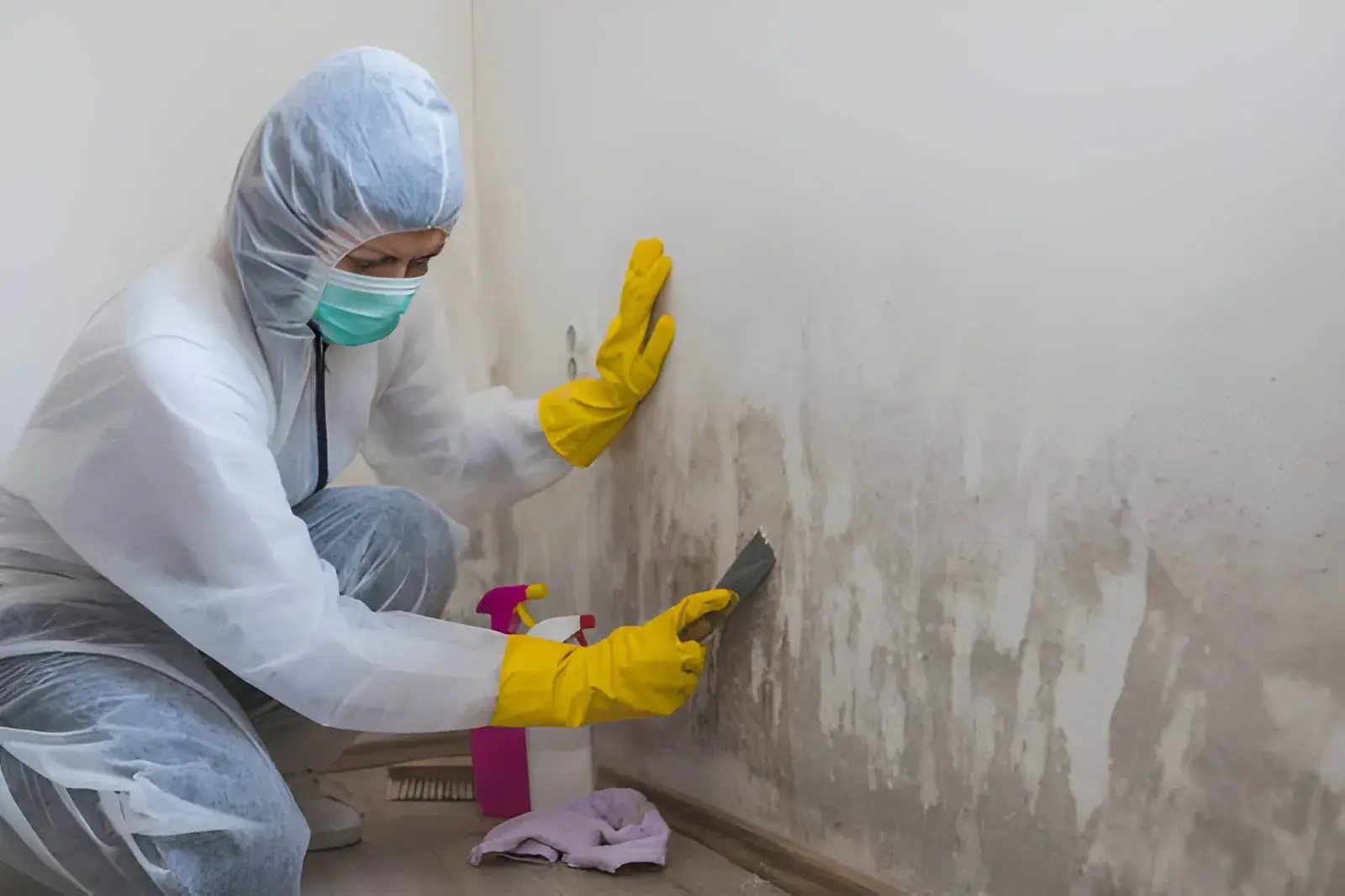
Mold Remediation in Hoffman Estates, IL
Mold spreads aggressively in humid conditions and can colonize hidden spaces within 24 to 48 hours of water intrusion. Our local team responds to Hoffman Estates mold emergencies within 60 minutes.
What Happens When You Call
A real person answers, not a call center. We assess your situation, ask the right questions, and begin coordinating your response immediately.
Your dedicated remediation team is dispatched from our local base serving Hoffman Estates and the surrounding northwest Cook County communities.
Team arrives with moisture detection equipment, HEPA filtration, containment materials, and testing supplies. Assessment begins immediately.
Moisture source identified, contamination extent mapped, remediation plan documented. You know exactly what comes next and what it involves.
You have found mold in your home. Maybe it is visible on a basement wall. Maybe you smell it but cannot see it. Maybe a home inspector flagged it during a transaction. Regardless of how you discovered it, mold in Hoffman Estates homes is rarely a surface problem. The visible growth you see is the visible portion of a colony fed by moisture you may not see, and that moisture source must be identified and resolved before remediation can succeed permanently. X Response exists for exactly this moment. When you reach out, your remediation team is mobilized within minutes and on site within the hour. From that point forward, one team manages everything: inspection, containment, removal, moisture resolution, and verification. Call now. Your team is standing by.
Why Hoffman Estates Homes Are Vulnerable to Mold
Hoffman Estates is a village of approximately 52,530 residents in northwest Cook County, Illinois, with residential construction spanning six decades from the early 1960s through the 2010s. The community sits in a humid continental climate zone where average relative humidity peaks during winter months and summer dew points routinely run high, creating conditions that support mold growth in any space where moisture is present and ventilation is insufficient. The village's housing stock presents mold vulnerability at multiple levels. Older homes from the 1960s and 1970s have basements with concrete block walls, original waterproofing that has deteriorated over 50 to 60 years, and perimeter drain tile systems that may be clogged or collapsed. Apartment and condominium complexes from the 1970s and 1980s have ground-floor units that sit at grade or partially below grade, with moisture pathways through slab edges and foundation-to-framing transitions. Newer construction has tighter building envelopes that reduce outside air infiltration but can trap interior moisture in wall cavities if vapor barriers are improperly placed or HVAC systems are undersized for dehumidification.
In 2024, the Village of Hoffman Estates bid out a Storm Sewer Rehabilitation Project to repair and replace deteriorated segments of the stormwater system that is more than 50 years old in many neighborhoods. This infrastructure acknowledgment matters for mold because the same aging storm sewers that cannot handle modern runoff volumes during rain events also contribute to chronic moisture conditions around residential foundations between storms. When storm sewers leak, backfill soil remains saturated longer than it should. When catch basins fail, surface water pools near foundations rather than draining away. When pipe joints separate, groundwater migrates along the pipe exterior toward homes downstream. These chronic, low-level moisture inputs create the sustained elevated humidity that mold requires to establish colonies in basements, crawl spaces, and wall cavities, even in homes that have never experienced a dramatic flooding event. The stormwater infrastructure problems identified by the Village's rehabilitation project are, for many Hoffman Estates homes, the upstream explanation for persistent basement mold that appears unrelated to any specific storm.
Aging Basements and Foundation Moisture
The earliest residential development in Hoffman Estates dates to the late 1950s and 1960s, with the majority of single-family homes built between 1960 and 1985. Basements in homes from this era were constructed with concrete block walls, a technology that is inherently permeable to moisture. Water and water vapor pass through the mortar joints and the porous block material itself, particularly when hydrostatic pressure from saturated soil pushes against the exterior face. Original waterproofing on these foundations consisted of asphalt damp-proofing applied to the exterior, a coating with a service life of 15 to 25 years that in most Hoffman Estates homes deteriorated decades ago. Perimeter drain tiles, if installed, were often clay tiles laid without connections, relying on gravity and the gaps between tile segments to collect and convey water to a sump pit. After 50 to 60 years, these systems are commonly clogged with soil infiltration, root intrusion, and mineral deposits, reducing their capacity to a fraction of original design. The result is basements where moisture enters chronically through the walls and floor slab, maintaining relative humidity above the 60% threshold where mold can colonize indefinitely.
Cook County Climate and Seasonal Moisture Cycles
Hoffman Estates sits in a humid continental climate where mold-favorable conditions persist across multiple seasons. Summer months bring dew points that routinely run high, meaning outdoor air contains enough moisture to support condensation on any surface cooler than the dew point. Basement walls and floors, which remain at relatively stable temperatures year-round, act as condensing surfaces during summer when warm, humid air contacts their cooler mass. This condensation supplements any moisture entering through the foundation, adding to the overall humidity load in below-grade spaces. Winter presents a different mechanism: the temperature differential between heated interior air and cold exterior conditions drives moisture vapor toward the cold side of wall assemblies, where it can condense within the wall cavity on sheathing or framing members that never reach temperatures warm enough to evaporate the moisture before the next vapor-drive cycle delivers more. Spring snowmelt and heavy spring rains saturate soils around foundations that are still cool from winter, combining hydrostatic pressure with the beginning of the humid season in a pattern that peaks mold growth potential precisely when occupied homes begin opening windows and reducing mechanical ventilation.
Multi-Family Buildings and Shared Moisture Pathways
Hoffman Estates contains a substantial inventory of apartment complexes and condominium buildings constructed between the late 1960s and 1990s. These multi-family structures present mold challenges distinct from single-family homes. Ground-floor units that sit at or partially below grade experience the same foundation moisture issues as single-family basements, but with the added complexity of shared walls and common mechanical spaces that can distribute moisture and mold between units. A moisture problem in one ground-floor unit, whether from a slab leak, a condensation issue, or water intrusion through the foundation, can migrate through shared wall cavities and floor assemblies into adjacent units before either occupant detects it. Upper-floor units face different moisture sources: condensation from HVAC systems, water intrusion from roof or exterior wall defects that travel through wall cavities before appearing at an interior surface, and plumbing leaks within shared wall assemblies. In many of these buildings, the fire-separation assemblies between units are not vapor barriers, allowing moisture and mold spores to migrate between units through the same pathways smoke uses during fire events.
Post-Flood Mold Development
Hoffman Estates' documented stormwater challenges mean that water intrusion events, whether from storm sewer surcharge, Salt Creek tributary flooding, or sump pump overwhelm, are a recurring trigger for mold growth. Mold can begin colonizing wet materials within 24 to 48 hours under Cook County's humidity conditions. A basement that floods during a heavy rain event and is pumped dry but not mechanically dried with dehumidification will retain enough moisture in concrete block walls, carpet padding, stored belongings, and framing members to support active mold growth within two days. The village's aging stormwater infrastructure makes these events more frequent in certain neighborhoods than the residents may realize, because the flooding need not be dramatic to produce mold-favorable conditions. Even a few inches of water that enters through a floor drain during a storm sewer surcharge and recedes within hours leaves enough moisture in porous materials to initiate colonization if mechanical drying does not follow promptly.
Tight Construction and Vapor Trapping in Newer Homes
Newer homes in Hoffman Estates, particularly those built from the 1990s onward, present a different mold risk profile than the older housing stock. These homes have tighter building envelopes with better insulation, house wraps, and sealed duct systems that reduce air infiltration. While this improves energy efficiency, it also reduces the natural air exchange that historically helped dry wall cavities and attic spaces passively. If an HVAC system is undersized for dehumidification, if bathroom exhaust fans are not ducted to the exterior, or if a construction defect allows bulk water into a wall cavity, the tighter envelope traps that moisture rather than allowing it to dissipate through the drafty pathways that older homes provide. Mold in newer Hoffman Estates homes often develops within wall cavities around window flanges, at roof-to-wall transitions, behind synthetic stucco or composite siding systems, and in attic spaces where bathroom fans exhaust into the attic rather than through the roof. These concealed locations mean the colony can grow for months or years before it is detected, often only discovered during a remodel, an energy audit, or a real estate inspection.
These factors create a community where mold risk is structural and ongoing rather than event-driven and temporary. The aging basements admit moisture chronically through deteriorated waterproofing. The climate delivers humidity year-round through different seasonal mechanisms. The multi-family housing stock distributes moisture through shared pathways. Flood events from overtaxed stormwater infrastructure deliver the acute moisture that triggers rapid colonization. And newer homes trap moisture that older, draftier construction would have passively released. Effective mold remediation in Hoffman Estates means addressing the moisture source, not just the visible growth, because removing mold without resolving the water pathway that fed it guarantees recurrence.
What Happens to Your Home While You Wait
Within 24 Hours of Moisture Event
Mold spores, which are always present in ambient air, begin germinating on wet surfaces. In Hoffman Estates' humid climate, the combination of material moisture and ambient humidity above 60% creates ideal colonization conditions. At this stage, no visible growth exists, but the biological clock has started. Porous materials like drywall, carpet backing, wood framing, and stored cardboard absorb moisture and provide both the water and the nutrient source mold requires. Prompt mechanical drying within this window can prevent colonization entirely.
24–48 Hours
Initial mold colonies establish on wet porous surfaces. Growth may not yet be visible to the eye, but microscopic hyphae are penetrating into material fibers. In basement spaces where block walls and concrete floors maintain elevated humidity even after standing water is removed, colonization begins at floor-to-wall transitions, behind baseboards, and on the backside of stored furniture touching walls. The warm, still air in enclosed spaces below grade provides ideal growth conditions with no air movement to slow the process.
48 Hours to One Week
Visible mold appears on surfaces where colonization began earliest. In Hoffman Estates basements, this typically manifests first at the base of block walls where mortar joints admit moisture, behind furniture pushed against foundation walls, and on the underside of shelving or stored items resting on the floor. Simultaneously, concealed growth develops behind drywall, within wall cavities, and beneath flooring systems where moisture persists without detection. Musty odors intensify as the colony produces volatile organic compounds. Occupants may begin experiencing allergic symptoms or respiratory irritation.
1–4 Weeks
Colonies mature and spread across connected surfaces. Growth that began at the floor-to-wall transition climbs upward through drywall wicking and surface spread. In wall cavities, colonies that started near the moisture source spread along framing members, insulation faces, and the backside of drywall that forms the interior surface of finished rooms. Spore production increases as colonies mature, degrading indoor air quality throughout the home as the HVAC system distributes spores to every room. The affected area grows daily, expanding remediation scope and cost with each passing week.
One Month and Beyond
Extensive colonization throughout connected wall cavities, floor systems, and concealed spaces. Structural wood shows discoloration and early fiber degradation from sustained fungal activity. Indoor air quality measurements show elevated spore counts throughout the home, not just near the visible growth. The HVAC system harbors and distributes spores to every room. Remediation at this stage requires extensive containment, removal of significant material, and thorough post-remediation verification. What could have been prevented with prompt drying after the initial moisture event, or remediated with localized treatment in the first week, now requires a full-scope professional project.
Every day between moisture intrusion and professional intervention allows mold to spread further, affect more material, and increase both health impact and remediation cost. Contact X Response now. Our Hoffman Estates team responds within 60 minutes.
How We Restore Mold-Affected Hoffman Estates Homes
From the moment our team arrives, every step is documented, measured, and verified. Here is exactly what the mold remediation process involves for Hoffman Estates properties.
Inspection and Moisture Source Identification
Our team arrives with professional moisture meters, thermal imaging cameras, and air sampling equipment to identify both the extent of mold contamination and, critically, the moisture source feeding it. In Hoffman Estates homes, moisture sources vary by construction era: older homes with block basements often have foundation moisture from deteriorated waterproofing and failed drain tile systems; mid-era homes may have condensation issues from inadequate insulation or ventilation; newer homes can trap moisture from construction defects or undersized HVAC dehumidification. We trace the moisture pathway from where it enters the structure to where mold is growing, because remediation that removes mold without resolving the water source fails within weeks. Air samples establish baseline spore counts for comparison to post-remediation verification. Everything is documented with photos, moisture readings, and mapped findings.
Containment and HEPA Filtration
Before any mold-affected material is disturbed, we isolate the contaminated area with physical containment barriers (polyethylene sheeting sealed floor-to-ceiling) and establish negative air pressure using HEPA-filtered air machines that exhaust to the exterior. This prevents spore release from spreading contamination to unaffected areas of the home during the removal process. In Hoffman Estates basements where mold covers wall surfaces and concealed spaces behind finished walls, containment typically encompasses the entire below-grade level. In multi-family buildings where mold is present in shared wall cavities, containment must address both units simultaneously. The HVAC system serving the contaminated zone is shut down and sealed to prevent distribution of disturbed spores through the duct system.
Mold Removal and Material Extraction
Contaminated materials are removed following strict protocols: porous materials with established mold growth, including drywall, insulation, carpet, and carpet padding, are cut out, bagged in sealed polyethylene, and removed from the structure without passing through uncontaminated areas. Non-porous surfaces like concrete block, structural wood framing, and floor joists are cleaned with appropriate biocides and mechanically agitated to remove surface growth while the underlying material is preserved. For Hoffman Estates homes with block basements, we remove affected drywall and insulation from basement finishing systems, clean the block wall surface and mortar joints directly, and treat with antimicrobial coatings designed to resist recolonization. In concealed wall cavities, we open the wall sufficiently to access all contaminated framing and sheathing, clean or replace depending on the depth of penetration, and document every step.
Moisture Resolution and Prevention
This step distinguishes professional remediation from cosmetic mold removal. We address the moisture source that created the mold condition in the first place. For Hoffman Estates basements with chronic foundation moisture, that may mean recommending interior waterproofing systems, sump pump upgrades, or dehumidifier installation to maintain humidity below the 60% colonization threshold year-round. For condensation-driven mold in wall cavities, we identify the vapor drive direction and recommend insulation or ventilation corrections. For flood-triggered mold resulting from storm sewer surcharge events, we ensure proper drying was completed and recommend mitigation measures, such as check valves on floor drains, that reduce future intrusion risk. The goal is a dry condition that prevents mold from returning after our work is complete.
Post-Remediation Verification and Clearance
After removal is complete and the workspace is dry, we conduct post-remediation verification: visual inspection confirming no remaining visible growth, moisture readings confirming the structure has returned to acceptable levels, and air sampling confirming that spore counts in the remediated area have returned to levels consistent with or lower than the outdoor baseline and unaffected areas of the home. This clearance testing provides objective proof that remediation was successful, not just a visual impression. The results are documented in a clearance report that serves both your records and any insurance or real estate transaction requirements. If any measurement does not meet clearance standards, we continue work until it does. There is no partial clearance.
The X Response Difference
When you contact X Response for mold remediation in Hoffman Estates, you get a team that treats the moisture source and the mold colony as inseparable problems. One team manages inspection through verified clearance. No shortcuts, no cosmetic treatments, no declaring success without testing to prove it.
Insurance Claim Guidance for Hoffman Estates Homeowners
Mold insurance coverage in Illinois is complex and varies significantly between carriers and policy types. Standard homeowner's policies typically exclude mold as a standalone peril, meaning they will not cover mold that results from chronic moisture conditions like foundation seepage, poor ventilation, or high humidity. However, if mold develops as a direct result of a covered water damage event, such as a sudden pipe burst or appliance failure that was reported and mitigated promptly, the resulting mold remediation may be covered as part of the water damage claim. Many Illinois carriers offer optional mold endorsements with specific dollar caps, often between $5,000 and $25,000, that provide limited coverage regardless of cause. For Hoffman Estates residents whose mold results from chronic basement moisture through aging foundation walls, coverage is unlikely under standard policies. For mold that developed after a documented sudden water event, coverage depends on whether mitigation was timely and whether the mold is demonstrably linked to the covered event.
How X Response Helps
- Document the moisture source and its connection to any covered water damage event with professional assessment and timeline evidence
- Provide mold testing results, including species identification and spore counts, that establish the scope and severity of contamination
- Demonstrate through documentation that mold development was a consequence of a specific covered event, not pre-existing or chronic conditions
- Prepare cost estimates that align with insurance remediation standards and clearly separate mold removal from moisture source correction
- Explain your policy's mold coverage provisions, including any sub-limits or endorsements, before work begins so you understand your financial exposure
X Response does not file claims on your behalf, adjust claims, or make coverage determinations. We provide documentation and guidance to help you make informed decisions about your property and your policy. Coverage decisions are made solely by your insurance carrier.
Certified Restoration Specialists Serving Hoffman Estates
When you contact X Response for mold remediation in Hoffman Estates, your team is drawn from certified professionals who work across northwest Cook County and understand the moisture conditions and building types that drive mold growth in this community. They know the block-wall basements in the 1960s and 1970s homes where deteriorated waterproofing admits chronic moisture. They know the ground-floor condo units where slab-edge moisture and shared-wall pathways distribute mold between adjacent spaces. They know the newer homes where tight construction traps moisture from minor defects that would dissipate in older, draftier buildings. They have remediated basement colonies fed by failed drain tiles, wall-cavity growth driven by vapor condensation, flood-triggered mold in homes along the stormwater-challenged Route 72 corridor, and concealed growth discovered during renovation and real estate transactions. This is not a general cleaning crew attempting mold work. It is a remediation team trained in containment, removal protocols, moisture science, and clearance verification.
Every technician on your team holds current IICRC certification in mold remediation and carries the appropriate Illinois licensing for the work being performed. Equipment includes professional moisture meters and thermal imaging for non-destructive assessment, HEPA-filtered negative air machines for containment, air sampling cassettes for pre- and post-remediation testing, and the biocides, cleaning tools, and protective equipment required for safe, effective mold removal. When your team arrives, they bring the science and the tools to resolve the problem permanently rather than temporarily.
In Hoffman Estates, X Response works with Scene Cleaners, an independent local restoration partner serving Cook County.
Mold Remediation FAQ for Hoffman Estates Homeowners
Other Emergency Services in Hoffman Estates

Water Damage Restoration
Burst pipes, storm flooding, standing water. We extract, dry, and restore before mold sets in.
Learn more
Fire Damage Restoration
Structural damage, soot, debris. We stabilize, clean, and rebuild what fire destroyed.
Learn more
Smoke Damage Restoration
Soot residue, chemical odors, HVAC contamination. We decontaminate surfaces, eliminate odors, and restore air quality.
Learn more
Sewage Cleanup
Sewer backups, contaminated water, biohazard. We extract, sanitize, and restore safely.
Learn moreNearby Service Areas
Also serving nearby: