
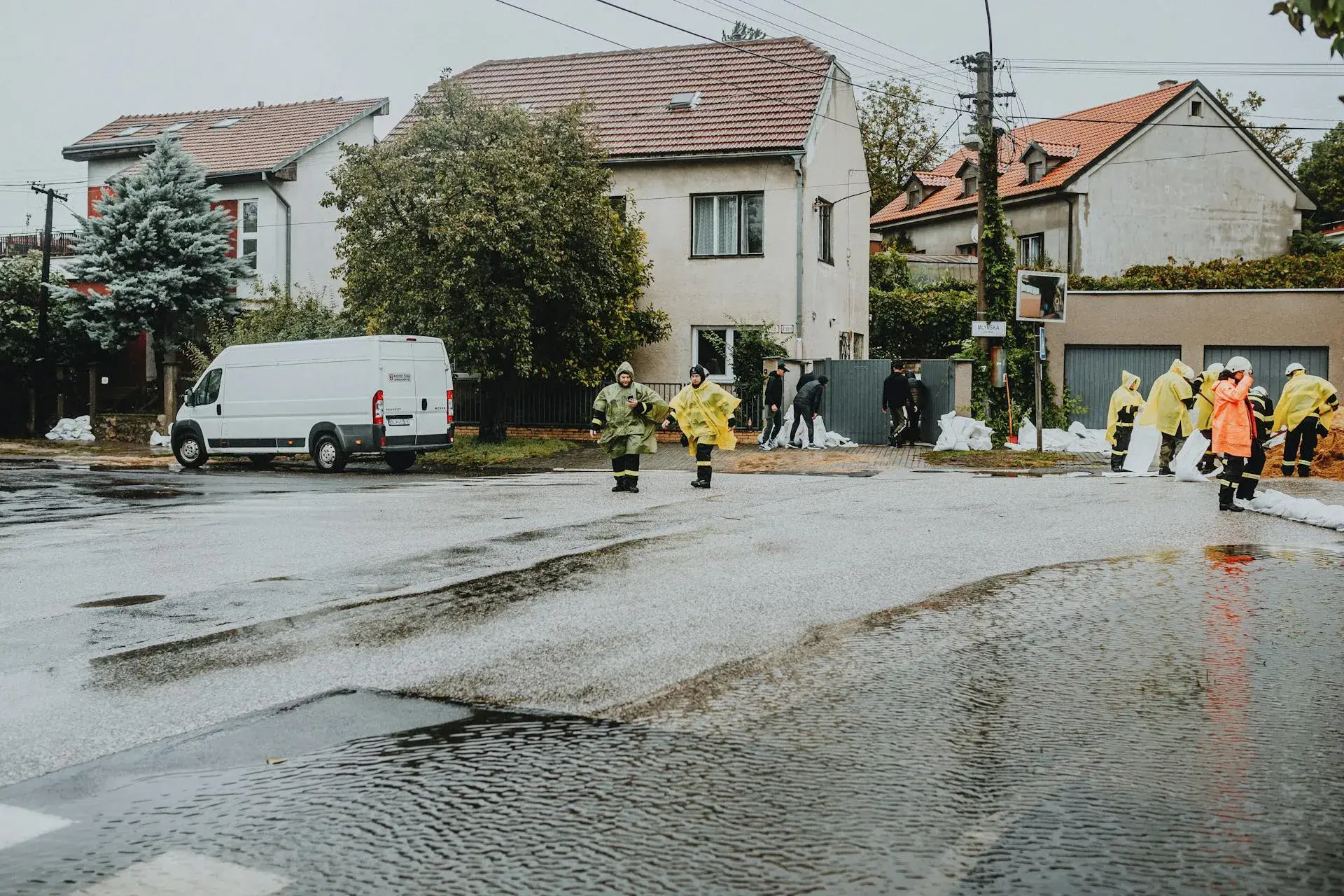
Sewage Cleanup in Vinings, GA
Sewage contamination is a biological hazard that worsens every hour. Bacteria multiply, odor intensifies, and materials absorb contaminants deeper with every passing minute. Our local team responds to Vinings emergencies within 60 minutes.
What Happens When You Call
A real person answers, not a call center. We assess your situation, ask the right questions about the sewage source and extent, and begin coordinating your response immediately.
Your dedicated decontamination team is dispatched from our local base serving Vinings and the surrounding southeast Cobb County communities.
Team arrives with extraction equipment, antimicrobial agents, personal protective equipment, and containment materials. Emergency mitigation begins immediately.
Sewage extracted, affected area contained and treated, restoration plan documented. You know exactly what comes next and your family is safe.
Sewage in your property is not just property damage. It is a biological hazard that demands immediate professional response. Raw sewage contains bacteria, viruses, parasites, and chemical contaminants that pose direct health risks to anyone in the affected space. Every hour of contact increases contamination depth, expands the affected area, and makes restoration more expensive and complex. X Response exists for exactly this moment. When you reach out, your decontamination team is mobilized within minutes and on site within the hour. Call now. Your team is standing by.
Why Vinings Homes Are Vulnerable to Sewage
Vinings' sewage risk operates through two distinct mechanisms tied directly to the community's position on the Chattahoochee River. The first is the municipal wastewater collection system that serves the area, operated by the Cobb County Water System under a CMOM (Capacity, Management, Operations, and Maintenance) consent agreement with the Georgia Environmental Protection Division. That agreement exists because the EPD adopted a Zero Tolerance Policy mandating enforcement action for any sanitary sewer overflow into waters of the Chattahoochee River Basin within the metropolitan Atlanta area, including all of Cobb County. In January 2025, the EPD penalized an apartment complex for discharging pollutants into Rottenwood Creek, the tributary that flows through Vinings into the Chattahoochee. That enforcement action confirmed that the Rottenwood Creek corridor, which runs directly through the heart of the Vinings community, remains an active pathway for sewage contamination events. The second mechanism is the Chattahoochee River itself: during major flood events like September 2009, overwhelmed sewage infrastructure upstream discharges into the river, and the floodwater that enters Vinings properties carries that contamination with it.
The Cobb County Water System serves approximately 160,000 sewer customers who produce roughly 63 million gallons of wastewater daily. That volume moves through a gravity-fed collection system of pipes, manholes, and lift stations that follow the natural drainage toward the county's water reclamation facilities. In Vinings, where the terrain descends toward the Chattahoochee River and Rottenwood Creek, the collection system follows the same gravity gradient that surface water follows. During heavy rainfall, the system experiences inflow and infiltration as stormwater enters through cracked manholes, deteriorated pipe joints, and failed seals, adding volume to a system already carrying its full daily sewage load. When capacity is exceeded, the combined volume backs up through the lowest available exit point: residential lateral connections that discharge through floor drains, toilet connections, and shower drains at the lowest elevation in a building. For Vinings properties in the lower-lying areas near the river, the same topography that makes them vulnerable to surface flooding also makes them the first to experience sewer backups when the collection system exceeds capacity.
Georgia EPD Zero Tolerance Policy and the Rottenwood Creek Enforcement
The Georgia Board of Natural Resources adopted a resolution in January 1998 directing that enforcement action be taken for any sanitary sewer overflow into waters of the Chattahoochee River Basin within the metropolitan Atlanta area. That Zero Tolerance Policy covers all of Cobb County and every waterway in the community, including Rottenwood Creek which flows through the center of Vinings. In January 2025, the Georgia Environmental Protection Division penalized an apartment complex for discharging pollutants into Rottenwood Creek in the southern part of Cobb County, demonstrating that the regulatory framework actively penalizes sewer contamination events in the Vinings area. The Cobb County Water System itself operates under a formal CMOM consent agreement with the EPD, signed under the authority of the same Zero Tolerance Policy, requiring the county to maintain its collection system to prevent overflows into the Chattahoochee Basin. That consent agreement acknowledges the system's vulnerability and imposes ongoing maintenance, reporting, and improvement requirements. For Vinings property owners, the existence of both the Zero Tolerance Policy and the county's consent agreement confirms that sewage overflow into local waterways is not a theoretical risk but a documented, regulated, and actively enforced reality in this specific geographic area.
Storm-Driven Sewer Backups During Heavy Rain
The Cobb County wastewater collection system experiences inflow and infiltration during heavy rain, a problem common to aging gravity-fed sewer systems throughout metro Atlanta. Stormwater enters the sanitary system through cracked manholes, deteriorated pipe joints, root-damaged lateral connections, and failed seals throughout the network. When the combined volume of wastewater plus infiltrated stormwater exceeds the system's capacity, it backs up through the lowest available exit: residential plumbing fixtures at the lowest elevation in a building. In Vinings, where topography descends toward the Chattahoochee River, properties at lower elevations are most vulnerable because they sit deepest in the gravity system and experience hydrostatic backpressure first when the system fills beyond capacity. The same intense rainfall events that produce Rottenwood Creek flash flooding and Chattahoochee River rises simultaneously stress the sewer system with infiltrated volume, meaning that Vinings property owners in the lower areas can face triple exposure: surface flooding from the creek, river flooding from the Chattahoochee, and sewer backup from below, all during the same storm event. Each source introduces Category 3 contamination requiring decontamination protocols.
Aging Residential Sewer Laterals
The pipe connecting a home to the county sewer main, called the lateral, is the homeowner's responsibility to maintain in Cobb County. In Vinings' older residential areas developed from the 1960s through 1980s, these laterals were installed using materials that deteriorate predictably over time. Clay pipe, used extensively in this era, cracks at joints as the surrounding soil shifts and settles, creating gaps where tree roots penetrate and where groundwater infiltrates during wet weather. Cast iron pipe, also common in this vintage, corrodes internally over decades, developing scale that reduces diameter and creates catch points where solids accumulate and blockages form. The mature landscaping in Vinings' established neighborhoods, particularly the large hardwoods along the river corridor, sends root systems aggressively toward the moisture and nutrients in sewer laterals. Roots penetrate cracked joints, expand inside the pipe, and eventually block flow entirely. A partially blocked lateral handles normal household flows without incident but backs up during peak usage (morning routines when multiple fixtures discharge simultaneously) or during rain events that add groundwater infiltration to the pipe's load. The resulting backup discharges sewage into the home through the lowest fixtures: basement floor drains, ground-level toilets, or shower drains.
Chattahoochee River Flood Contamination
When the Chattahoochee River floods in Vinings, as it did catastrophically in September 2009 and significantly during Hurricane Ivan in 2004, the water that enters homes is not clean rainwater. River flood water collects everything in its path: sediment, organic debris, petroleum from roads, agricultural runoff from upstream, animal waste, and crucially, sewage from overwhelmed manholes, lift stations, and treatment infrastructure throughout the upstream watershed. The May 2026 incident where 5.94 million gallons of combined sewer overflow from Atlanta's system entered the Chattahoochee via Peachtree Creek, killing an estimated 44,500 fish through Cobb County waters, demonstrated the volume of sewage contamination the river can carry past Vinings during rainfall events. The IICRC classifies all river flood water as Category 3, the most contaminated category, requiring the most aggressive decontamination protocols regardless of whether a direct sewer backup occurred at the property. For Vinings properties that flooded in 2009, every surface the river water contacted required Category 3 decontamination treatment, not because a sewer backed up in their home specifically, but because the river itself carried sewage-level contamination.
Cobb County CMOM Program and Documented Overflow Events
The Cobb County Water System operates under a CMOM program that requires public reporting of sanitary sewer overflows, including location, estimated volume, and receiving waterway. The program exists because Cobb County signed a consent agreement with the Georgia EPD under the Chattahoochee Basin Zero Tolerance Policy, acknowledging that its collection system produces overflows that contaminate state waters. Recent CMOM press releases document wastewater overflows into tributaries throughout southeast Cobb County, including events in December 2025 and January 2026 affecting waterways in Smyrna and adjacent areas. The system that serves Vinings, carrying approximately 63 million gallons daily across roughly 160,000 customers, uses gravity-fed pipes that follow the same terrain contours as the surface waterways. Manholes, lift stations, and junction points throughout the system represent potential failure locations where overflow can escape during wet weather or equipment failure. For Vinings property owners, the CMOM reports confirm that the wastewater infrastructure serving their community is a system under documented stress, actively regulated for its overflow history, and continuing to experience events that require public disclosure and regulatory scrutiny.
These factors define sewage risk in Vinings: a collection system operating under a consent agreement with Georgia EPD because of its documented overflow history in the Chattahoochee Basin, the January 2025 Rottenwood Creek enforcement confirming active contamination events in the waterway that flows through the community, storm-driven backups during the same heavy rain events that produce surface flooding, aging residential laterals vulnerable to root intrusion and material failure, river flooding that carries upstream sewage contamination into homes regardless of local system performance, and ongoing documented overflows under the CMOM program. Effective sewage cleanup in Vinings means treating every intrusion as a Category 3 biological hazard from the first moment, because the pathogen load from any of these sources poses the same health risk whether the volume is one gallon or one hundred.
What Happens to Your Home While You Wait
Within 1 Hour
Sewage contaminants begin absorbing into porous materials: carpet, pad, drywall paper, unsealed wood, grout, and concrete. Bacteria from fecal matter begin multiplying in the warm, nutrient-rich environment that sewage creates on contact with organic building materials. In Vinings' warm climate, bacterial doubling times are accelerated compared to cooler environments. The immediate health hazard is established: E. coli, coliform bacteria, and other pathogens are present on every surface the sewage contacted. Occupants should evacuate the affected area immediately without walking through contaminated zones.
1–24 Hours
Bacteria multiply exponentially in the warm, moist, nutrient-rich conditions. Odor intensifies as anaerobic decomposition begins in areas where sewage has pooled or soaked into materials. Drywall absorbs contamination upward through capillary action, expanding the affected zone above the visible water line. In Vinings homes with crawl spaces near the Chattahoochee corridor, sewage backup that reaches the crawl space soaks into exposed earth and floor joists from below, creating a contamination reservoir beneath the living space. The affected area expands as contaminated moisture wicks into adjacent materials that were never in direct contact with the original sewage.
24–48 Hours
Mold colonization begins on sewage-contaminated organic materials, compounding the bacterial contamination with fungal growth. The combination of sewage pathogens and mold creates a complex biological hazard requiring both decontamination and remediation protocols. Carpet and pad that absorbed sewage cannot be decontaminated and must be removed. Drywall contaminated above the visible sewage line requires removal because bacteria have wicked upward through the paper facing into the gypsum core. Wood materials begin absorbing sewage compounds that cannot be removed through surface cleaning, potentially requiring removal if contamination has penetrated beyond surface treatment depth.
48–72 Hours
Structural materials that absorbed sewage begin deteriorating from both bacterial decomposition and moisture saturation. Particleboard subfloor exposed to sewage swells and loses structural capacity. Untreated sewage in crawl spaces produces hydrogen sulfide gas as anaerobic decomposition progresses, creating a health hazard in addition to the original contamination. In Vinings' warm, humid climate, mold growth on contaminated materials accelerates rapidly and spreads into adjacent areas through HVAC distribution. The scope of removal and decontamination expands significantly beyond what would have been required with same-day intervention.
One Week and Beyond
Extensive biological contamination throughout affected materials and potentially into structural members. Hydrogen sulfide levels from decomposing sewage may reach concentrations requiring ventilation before workers can enter the space. Mold from the moisture component of the sewage has spread beyond the original contamination footprint. Wood structural members that absorbed sewage may require assessment for replacement rather than treatment if decomposition has compromised their load-bearing capacity. What began as a sewage extraction and decontamination job becomes demolition, structural assessment, mold remediation, and rebuild. Insurance claims become significantly more complex and costly than they would have been with immediate professional response.
Sewage contamination is a biological hazard where every hour of delay increases health risk and restoration cost. Contact X Response now. Our Vinings team responds within 60 minutes in full protective equipment.
How We Restore Sewage-Damaged Vinings Homes
From the moment our team arrives in full PPE, every step is designed to eliminate biological hazards and restore your property to a safe, habitable condition. Here is exactly what the sewage cleanup process involves for Vinings properties.
Hazard Assessment and Containment
Our team arrives in full personal protective equipment and immediately assesses the contamination extent, entry pathway, and affected materials. In Vinings, where sewage can enter from sewer backup through plumbing fixtures, Rottenwood Creek flooding carrying upstream sewage contamination, or Chattahoochee River overflow with Category 3 biological load, we determine the source to guide protocol aggressiveness. Containment barriers isolate the affected area from clean spaces to prevent cross-contamination from foot traffic, airborne particulate, or drainage spread. Air monitoring establishes whether hydrogen sulfide or other hazardous gases are present at levels requiring enhanced ventilation before work proceeds.
Sewage Extraction and Debris Removal
All contaminated water and solid debris are extracted using specialized equipment designed for biological waste. Truck-mounted extractors remove standing sewage from the lowest points. Contaminated carpet, pad, insulation, and any porous material that absorbed sewage are removed, bagged, and disposed of as biohazardous waste. For Vinings homes with crawl spaces, extraction includes pumping contaminated water from beneath the floor system and removing any saturated insulation hanging from the floor joists above. Hardwood flooring, particleboard subfloor, and drywall that absorbed sewage beyond surface treatment depth are removed. Every contaminated material that leaves the containment zone is sealed to prevent exposure during transport.
Antimicrobial Decontamination
After all contaminated materials are removed, every remaining surface within the affected area receives EPA-registered antimicrobial treatment. We apply hospital-grade disinfectants rated for the specific pathogens present in sewage: E. coli, coliform bacteria, hepatitis A virus, and parasitic organisms. Treatment covers floors, wall cavities exposed by drywall removal, structural framing, concrete or masonry surfaces, and any item that cannot be removed but contacted contaminated water. For Vinings homes where sewer backup reached the crawl space, antimicrobial treatment covers all accessible crawl space surfaces including floor joists, sill plates, and foundation walls. Multiple applications may be required to achieve verified kill rates on porous materials.
Structural Drying
After decontamination, the structure must be dried to prevent mold growth from the moisture component of the sewage intrusion. Commercial dehumidifiers and air movers are positioned throughout the affected area to drive moisture from structural materials. In Vinings' warm, humid climate, mechanical drying is essential because ambient conditions will not produce adequate evaporation. We monitor moisture readings daily, repositioning equipment as needed until structural materials reach their dry standard. For crawl spaces where sewage pooled on the ground, the soil surface may require treatment and a sealed vapor barrier to prevent ongoing moisture migration into the dried framing above.
Verification and Clearance
Before the space is cleared for occupancy, a final inspection verifies that all contaminated materials have been removed, antimicrobial treatment has been applied to all affected surfaces, moisture readings have returned to acceptable levels, and no residual odor remains. Air quality testing confirms that biological aerosol levels have returned to safe concentrations. We provide completion documentation including extraction records, antimicrobial application logs, final moisture readings, and clearance test results. That documentation supports your insurance claim and provides evidence that the space has been restored to a safe, habitable condition.
The X Response Difference
When you contact X Response for sewage in Vinings, you get a team in full PPE that treats the situation as the biological hazard it is from the first moment. Extraction, decontamination, drying, and verified clearance. One team, one process, one standard: the space is not done until testing confirms it is safe.
Insurance Claim Guidance for Vinings Homeowners
Sewage cleanup insurance coverage in Georgia depends on the entry mechanism. Standard homeowner's policies typically exclude sewer backup damage unless you have purchased a specific sewer backup endorsement or rider. If sewage entered through surface flooding (river or creek overflow carrying contamination), that falls under flood insurance rather than the sewer endorsement. The distinction matters: a sewer backup through your floor drain from the municipal system is one coverage pathway, while Chattahoochee River floodwater carrying upstream sewage contamination into your home through doors and windows is a different policy entirely. Many Vinings homeowners have one coverage but not the other, and the entry mechanism determines which applies. We document the entry pathway clearly to support whichever coverage is relevant.
How X Response Helps
- Document the sewage entry pathway with photos and narrative so the carrier can determine which coverage applies
- Identify whether contamination entered through plumbing fixtures (sewer backup endorsement) or surface flooding (flood insurance)
- Photograph all contaminated materials before removal so the carrier can verify the scope of demolition was necessary
- Provide antimicrobial application records and clearance testing to prove decontamination was performed to professional standards
- Document structural drying with daily moisture readings to demonstrate prompt mitigation that prevented secondary mold damage
X Response does not file claims on your behalf, adjust claims, or make coverage determinations. We provide documentation and guidance to help you make informed decisions about your property and your policy. Coverage decisions are made solely by your insurance carrier.
Certified Restoration Specialists Serving Vinings
When you contact X Response for sewage in Vinings, your decontamination team is drawn from certified professionals who work across southeast Cobb County and understand the specific sewage hazards this community faces. They know how the Cobb County collection system behaves during heavy rain when inflow and infiltration exceed capacity, how Rottenwood Creek carries upstream contamination through the community during overbank events, how the Chattahoochee River flood water that devastated Vinings in 2009 carried Category 3 biological contamination, and how the low-elevation properties along the river corridor face the highest risk from both backup and flooding simultaneously. This is not a crew that treats every sewage call identically. It is a local team that assesses the source, determines the contamination category, and applies the protocol that matches the actual hazard.
Every technician on your team holds current IICRC certification in water damage restoration with specific training in Category 3 biohazard protocols, and carries the appropriate Georgia state licensing for the work being performed. Equipment includes truck-mounted extraction systems, submersible pumps, hospital-grade antimicrobial compounds, air monitoring instruments for hydrogen sulfide and biological aerosols, full PPE including powered air-purifying respirators for enclosed-space work, and commercial drying equipment. When your team arrives, they are equipped for the worst-case scenario from the first moment.
In Vinings, X Response works with Atlanta's Best Restoration, an independent local restoration partner serving Cobb County.
Sewage Cleanup FAQ for Vinings Homeowners
Other Emergency Services in Vinings

Water Damage Restoration
Burst pipes, storm flooding, standing water. We extract, dry, and restore before mold sets in.
Learn more
Fire Damage Restoration
Structural damage, soot, debris. We stabilize, clean, and rebuild what fire destroyed.
Learn more
Smoke Damage Restoration
Soot residue, chemical odors, HVAC contamination. We decontaminate surfaces, eliminate odors, and restore air quality.
Learn more
Mold Remediation
Testing, containment, removal, prevention. We find the source, eliminate the growth, and stop it from returning.
Learn more