
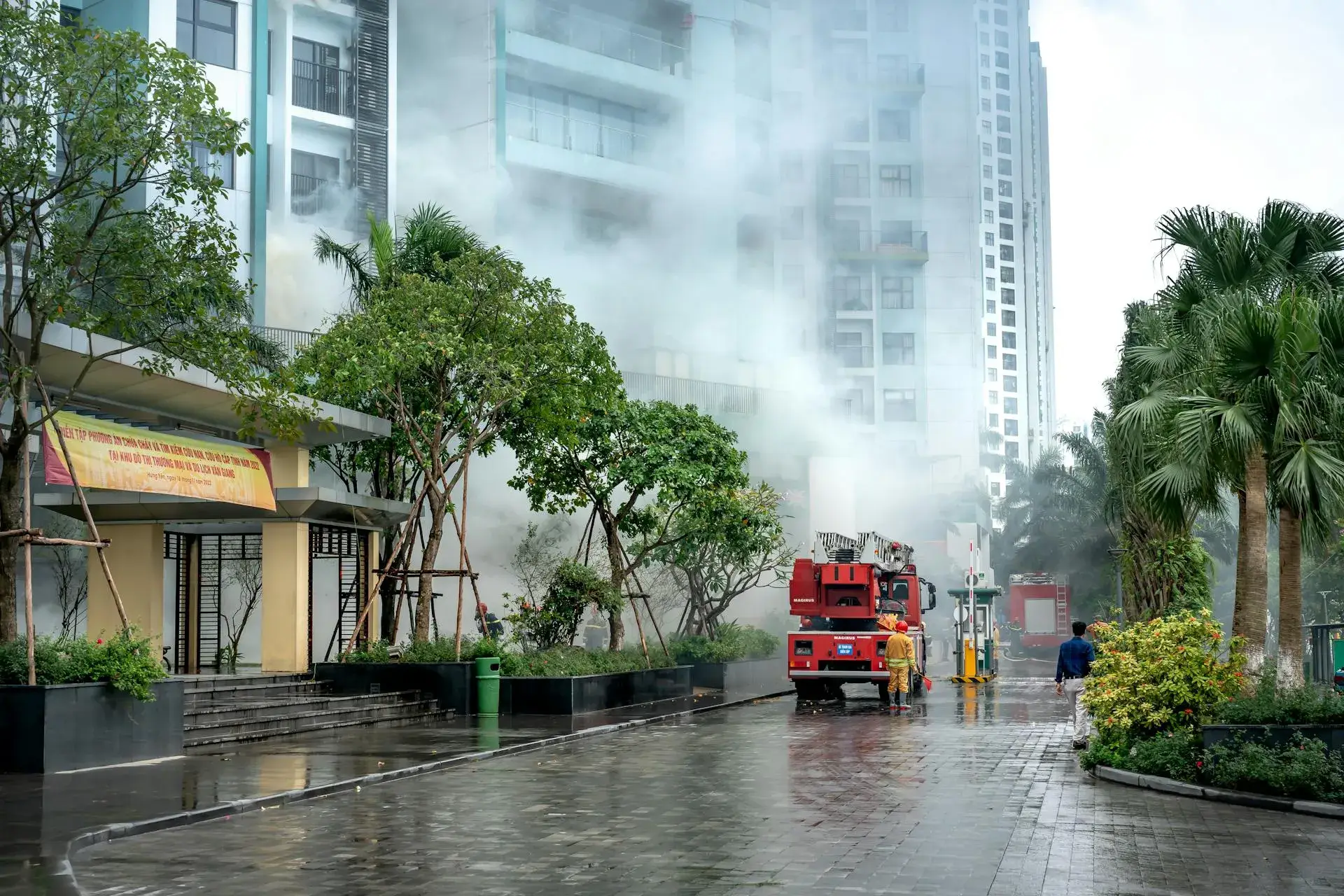
Smoke Damage Restoration in Fort Myers Beach, FL
Smoke residue bonds permanently to surfaces within hours in Fort Myers Beach's salt air and humidity. Our local team responds to Estero Island emergencies within 60 minutes to stop secondary damage before it becomes irreversible.
What Happens When You Call
A real person answers, not a call center. We assess your situation, determine the smoke source and severity, and dispatch your restoration team immediately.
Your dedicated team is dispatched from our local base serving Fort Myers Beach and Lee County's barrier islands.
Team arrives with air quality testing equipment, soot removal tools, and industrial deodorization systems. Assessment and mitigation begin immediately.
Smoke damage mapped, cleaning protocol established, and restoration timeline documented. You know exactly what comes next.
Smoke does not respect property lines, and on a barrier island barely 2,000 feet wide, it has nowhere to dissipate. When a fire occurs on Fort Myers Beach, smoke migrates through shared walls, HVAC systems, and the narrow corridors between closely spaced buildings along Estero Boulevard. You may not have had a fire, but smoke found your home anyway. X Response exists for exactly this situation. One call, one dedicated crew, one standard of work from assessment through final clearance. Call now. Your team is standing by.
Why Fort Myers Beach Homes Are Vulnerable to Smoke Damage
Fort Myers Beach occupies Estero Island, a barrier island roughly seven miles long but rarely more than 2,500 feet wide in Lee County, Florida. This narrow geography concentrates structures close together along Estero Boulevard, the island's single main road, with minimal space between buildings for smoke to dissipate during a fire event. When the Bay to Beach condominium at 740 Estero Boulevard caught fire in April 2023, smoke from the blaze drifted across neighboring structures along the densely built corridor. The Fort Myers Beach Fire Control District's chief of operations noted the fire was contained to the roof area of the building, but smoke affected surrounding properties. On an island this narrow, a single structure fire can deposit soot and smoke residue across dozens of neighboring buildings in the time it takes suppression units to cross the Matanzas Pass Bridge and reach the scene. Properties with no fire damage at all can sustain significant smoke damage simply because of proximity on a confined barrier island.
Beyond the acute risk of structural fires, Fort Myers Beach faces ongoing smoke exposure from prescribed burns and wildfires in the mainland vegetation east of Estero Bay. The Corkscrew Watershed and pine flatwoods along Corkscrew Road in Estero undergo regular prescribed burns managed by the Florida Forest Service, and when westerly or southwesterly winds carry that smoke across Estero Bay, it settles over the barrier island with nowhere to go. In May 2023, a 300-acre brush fire along Corkscrew Road sent smoke across the broader Fort Myers Beach area. The island's year-round use of air conditioning means exterior smoke is drawn into buildings through fresh-air intakes and infiltration points, depositing particulate matter throughout HVAC systems and onto interior surfaces. In the post-hurricane reconstruction environment, many buildings have open construction gaps, missing exterior cladding, or incomplete HVAC systems that provide direct pathways for exterior smoke to enter living spaces.
Barrier Island Smoke Confinement and Proximity
Fort Myers Beach's narrow island geography means structures are packed close together along Estero Boulevard with minimal separation. A fire at one property sends smoke directly into neighboring buildings because there is no open distance for it to dilute before reaching the next structure. The island is surrounded by water on both sides, and prevailing onshore winds push smoke inland from Gulf-side fires or trap it against the bayside when fires occur on the east side of the island. Unlike mainland communities where smoke can rise and dissipate over open land, smoke on this barrier island is confined within the narrow corridor of development and lingers until wind patterns shift to carry it offshore. Neighboring property owners who had no fire on their own property can experience extensive soot deposition, smoke odor penetration, and HVAC contamination simply because the fire occurred nearby on the same confined island.
Salt-Air Accelerated Smoke Damage
Smoke damage on Fort Myers Beach progresses faster and becomes permanent sooner than at inland locations because of the salt-laden marine environment. Acidic soot particles that land on metal surfaces react with the salt already deposited by Gulf air to form corrosive compounds that pit and etch metals within 24 to 48 hours. On the mainland, the same soot might sit on a surface for several days before causing permanent damage. On this barrier island, the chemical reaction between soot acids and salt creates an accelerated corrosion timeline that makes rapid response essential. Glass, chrome, stainless steel, and aluminum surfaces all show evidence of this accelerated damage. Porous materials like textured walls, concrete block, and natural stone absorb both the salt and the soot, creating a compound contamination that requires specialized cleaning approaches beyond standard smoke restoration protocols.
HVAC Systems as Smoke Distribution Networks
Fort Myers Beach homes run air conditioning year-round, typically 10 to 12 months of continuous operation in the subtropical climate. When smoke enters a building, the HVAC system becomes a distribution network, pulling smoke-laden air from affected areas and depositing it throughout every room connected to the ductwork. Soot accumulates on evaporator coils, inside supply and return ducts, and on the blower assembly. Even after the visible smoke event ends, the contaminated HVAC system continues releasing odor and particulate into the living space every time the system cycles. On Fort Myers Beach, where buildings run AC continuously, the contamination spreads further and faster than in climates where systems operate intermittently. Complete smoke restoration on the island almost always includes HVAC decontamination or component replacement, because the system that was supposed to maintain air quality instead became the primary smoke distribution mechanism.
Mainland Wildfire and Prescribed Burn Smoke
East of Estero Bay, the mainland vegetation includes thousands of acres of fire-adapted pine flatwoods, saw palmetto, and cypress wetlands managed through prescribed burning by the Florida Forest Service and conservation agencies. These burns are ecologically necessary but produce significant smoke that travels on prevailing winds. When easterly winds shift to westerly or southwesterly during burn events, smoke crosses Estero Bay and settles over Fort Myers Beach. The island's low elevation and the marine boundary layer trap this smoke close to the ground rather than allowing it to rise and disperse. Residents experience reduced visibility, strong burning odor, and particulate deposition that coats exterior surfaces and infiltrates buildings through any opening. The post-Ian reconstruction environment, with many buildings having incomplete exterior envelopes, amplifies this infiltration. Properties under renovation lack the sealed building envelope that would normally prevent exterior smoke from reaching interior spaces.
Post-Fire Odor Persistence in Humid Coastal Air
Smoke odor on Fort Myers Beach persists longer and penetrates deeper than in drier climates because humidity carries odor molecules deeper into porous materials. In air with high relative humidity, smoke compounds dissolve into the moisture film that coats every surface and penetrate into materials that would resist them in dry conditions. Concrete block walls, stucco exteriors, terrazzo flooring, and textured ceilings common in Fort Myers Beach construction all absorb smoke odor when humidity is high. The odor then re-releases when conditions change, creating a cycle where the property seems clear one day and smells of smoke the next as humidity fluctuates. Effective odor elimination in this environment requires thermal fogging, ozone treatment, or hydroxyl generator protocols that reach into the materials where odor has embedded, not just surface cleaning that addresses what the nose detects immediately.
These factors create smoke damage conditions on Fort Myers Beach that mainland communities rarely face. The narrow barrier island concentrates smoke from any fire across neighboring structures. Salt air accelerates the chemical damage timeline from days to hours. Year-round AC operation distributes smoke throughout buildings via HVAC systems. Mainland burn events cross Estero Bay and settle over the island with poor dispersion. And the humid environment drives smoke odor deep into porous materials where it persists for weeks without professional intervention. Effective smoke damage restoration on Estero Island requires understanding this compressed timeline, the salt-air chemistry, the HVAC distribution problem, and the humidity-driven odor persistence that defines the barrier island environment.
What Happens to Your Home While You Wait
Within 1 Hour
Soot settles onto surfaces throughout the structure. On Fort Myers Beach, salt already deposited by Gulf air begins reacting with acidic soot compounds, initiating corrosion on metal surfaces. Smoke odor begins penetrating soft furnishings, fabrics, and upholstered surfaces. HVAC systems operating at the time of smoke exposure begin distributing particulate through ductwork to every connected room.
1–24 Hours
Soot-salt chemical reactions advance on metal surfaces from discoloration to active pitting. Smoke residue bonds with the moisture film on walls, floors, and ceilings in the humid air, making subsequent removal more difficult. HVAC ductwork accumulates soot on interior surfaces and the evaporator coil. Odor penetrates into drywall, wood framing, and concrete block through the moisture pathways that high humidity provides.
24–48 Hours
Permanent etching develops on unprotected metal surfaces, appliances, and fixtures. Soot residue becomes chemically bonded to porous surfaces and cannot be removed without aggressive cleaning that may damage the substrate. Smoke odor embeds at a molecular level into materials throughout the structure. Fabrics, carpets, and upholstered items that could have been cleaned with prompt response may now require replacement.
48–72 Hours
Corrosion advances into structural metal components, fasteners, and mechanical systems. HVAC contamination spreads through the full duct network and into the air handler. Odor becomes self-sustaining as embedded compounds off-gas continuously in the subtropical heat. The scope of restoration expands significantly as salvageable items become total losses and cleaning becomes replacement.
One Week and Beyond
Widespread permanent damage to surfaces, finishes, and mechanical systems. Odor embedded in structural materials requires intensive treatment protocols rather than surface cleaning. HVAC system may require full duct replacement rather than cleaning. What started as a smoke cleaning job becomes partial demolition and rebuild. Insurance claim complexity and cost increase substantially as delay-related damage exceeds the original smoke exposure.
Fort Myers Beach's salt air and humidity compress the smoke damage salvage window to hours rather than the days you might have on the mainland. Contact X Response now. Our team responds within 60 minutes to stop permanent damage before it sets.
How We Restore Smoke-Damaged Fort Myers Beach Homes
From the moment our team arrives on Estero Island, every step is documented, measured, and verified. Here is exactly what the smoke damage restoration process involves.
Air Quality Assessment and Source Identification
Our team arrives with particulate monitoring equipment and visual inspection tools to determine the source, type, and extent of smoke contamination. On Fort Myers Beach, we differentiate between structural fire smoke from nearby buildings, wildfire or prescribed burn smoke from the mainland, and construction-related smoke from ongoing renovation work across the island. Each source produces different residue types requiring different cleaning protocols. We map the smoke migration path through the building, identify HVAC contamination levels, and test surfaces for soot type and bonding state. This assessment determines whether surfaces can be cleaned in place or require more intensive intervention.
Emergency Surface Stabilization
Before full cleaning begins, we stabilize surfaces where soot is actively reacting with salt deposits in the coastal air. Metal surfaces receive a protective treatment that stops the corrosion reaction. High-value finishes and electronics are isolated from continued exposure. HVAC systems are shut down to stop further smoke distribution through ductwork. On Fort Myers Beach, this stabilization step is more urgent than on the mainland because the salt-air reaction gives us hours rather than days before damage becomes permanent. Stabilization buys time for the thorough cleaning that follows without allowing the chemical clock to continue running.
Soot and Residue Removal
We remove soot from all affected surfaces using techniques appropriate to the surface type and the residue characteristics. Dry sponging removes loose particulate without smearing. HEPA vacuuming captures fine particles from textured surfaces and crevices. Chemical cleaning removes bonded residue from hard surfaces. On Fort Myers Beach, where the combination of soot and salt creates compound contamination, we use cleaning agents that address both the carbon-based soot and the mineral salt deposits simultaneously. Contents are evaluated, cleaned on-site where possible, or packed for off-site restoration in a controlled, dehumidified environment away from the barrier island's salt air.
HVAC Decontamination
We clean or replace contaminated HVAC components depending on the severity of smoke exposure. On Fort Myers Beach, where AC runs year-round and likely operated during the smoke event, duct systems contain significant soot accumulation. We inspect ductwork with cameras, clean accessible sections with HEPA-rated equipment, replace filters and contaminated insulation, and treat the evaporator coil and blower assembly. If contamination exceeds what cleaning can resolve, we coordinate duct replacement. The HVAC system must be verified clean before it can resume operation, otherwise it continues releasing smoke particulate into the restored space.
Odor Elimination and Verification
Surface cleaning alone does not eliminate smoke odor in Fort Myers Beach's humid environment because the odor has penetrated into porous materials beyond surface reach. We deploy thermal fogging that reproduces smoke's penetration path in reverse, carrying deodorizing agents into the same materials the smoke entered. Ozone generators or hydroxyl generators treat enclosed spaces to neutralize odor compounds at a molecular level. The subtropical humidity actually assists these treatments by keeping material pores open for agent penetration. After treatment, we verify with air quality testing and occupant comfort assessment. If any residual odor is detected, we retreat specific areas until the space tests clear under normal occupancy conditions.
The X Response Difference
When you contact X Response for smoke damage on Fort Myers Beach, you get a team that understands the compressed timelines, salt-air chemistry, and HVAC challenges that define smoke restoration on a barrier island. One team, one standard of work, from emergency stabilization through verified odor elimination.
Insurance Claim Guidance for Fort Myers Beach Homeowners
Smoke damage insurance claims on Fort Myers Beach often involve properties that did not experience the fire directly but sustained smoke damage from a neighboring structure or a community-wide event. Standard homeowner's policies generally cover smoke damage whether it originated from your own property or from a nearby fire. For properties in condominium or multi-unit buildings, the HOA master policy and your individual HO-6 policy may both apply depending on whether the damage is to common elements or your unit's interior. During the post-Ian reconstruction period, properties with open construction gaps that allowed smoke infiltration may face questions about whether the damage was preventable. Clear documentation of the smoke source, the migration path, and the condition of your property before the event strengthens any claim.
How X Response Helps
- Document the smoke source and your property's relationship to it, including distance and wind direction
- Photograph all affected surfaces, contents, and HVAC components with detailed notes on smoke type and severity
- Preserve samples of soot residue for analysis if the damage source or type is disputed
- Align restoration scope with standard smoke damage coverage categories so your adjuster can process the claim efficiently
- Identify whether condo association master policies or neighboring property liability applies in multi-unit situations
X Response does not file claims on your behalf, adjust claims, or make coverage determinations. We provide documentation and guidance to help you make informed decisions about your property and your policy. Coverage decisions are made solely by your insurance carrier.
Certified Restoration Specialists Serving Fort Myers Beach
When you contact X Response for smoke damage on Fort Myers Beach, your restoration team is drawn from certified professionals who work across Lee County's barrier islands and understand how smoke behaves differently in the coastal salt-air environment. They know that the corrosion timeline on Estero Island is measured in hours rather than days, that HVAC systems on the island run continuously and distribute smoke throughout structures rapidly, and that the humid subtropical air drives odor compounds deep into porous materials where surface cleaning cannot reach them. They have restored smoke-damaged properties adjacent to construction fires, properties affected by mainland brush fire smoke crossing Estero Bay, and units in multi-story buildings where smoke migrated through shared HVAC systems and wall penetrations.
Every technician on your team holds current IICRC certification in fire and smoke restoration and carries the appropriate Florida state licensing for the work performed. Equipment includes industrial air scrubbers with HEPA filtration, ozone generators, thermal foggers, hydroxyl generators for occupied-space treatment, HVAC inspection cameras, and the surface-specific cleaning tools required to address the compound soot-and-salt contamination unique to barrier island smoke events. When your team arrives, they bring everything needed to stabilize, clean, deodorize, and verify in the demanding conditions that define this coastal environment.
In Fort Myers Beach, X Response works with Florida Restoration and Platinum Air Mold Inspection, independent local restoration partners serving Lee County.
Smoke Damage Restoration FAQ for Fort Myers Beach Homeowners
Other Emergency Services in Fort Myers Beach

Water Damage Restoration
Burst pipes, storm flooding, standing water. We extract, dry, and restore before mold sets in.
Learn more
Fire Damage Restoration
Structural damage, soot, debris. We stabilize, clean, and rebuild what fire destroyed.
Learn more
Mold Remediation
Testing, containment, removal, prevention. We find the source, eliminate the growth, and stop it from returning.
Learn more
Sewage Cleanup
Sewer backups, contaminated water, biohazard. We extract, sanitize, and restore safely.
Learn more