
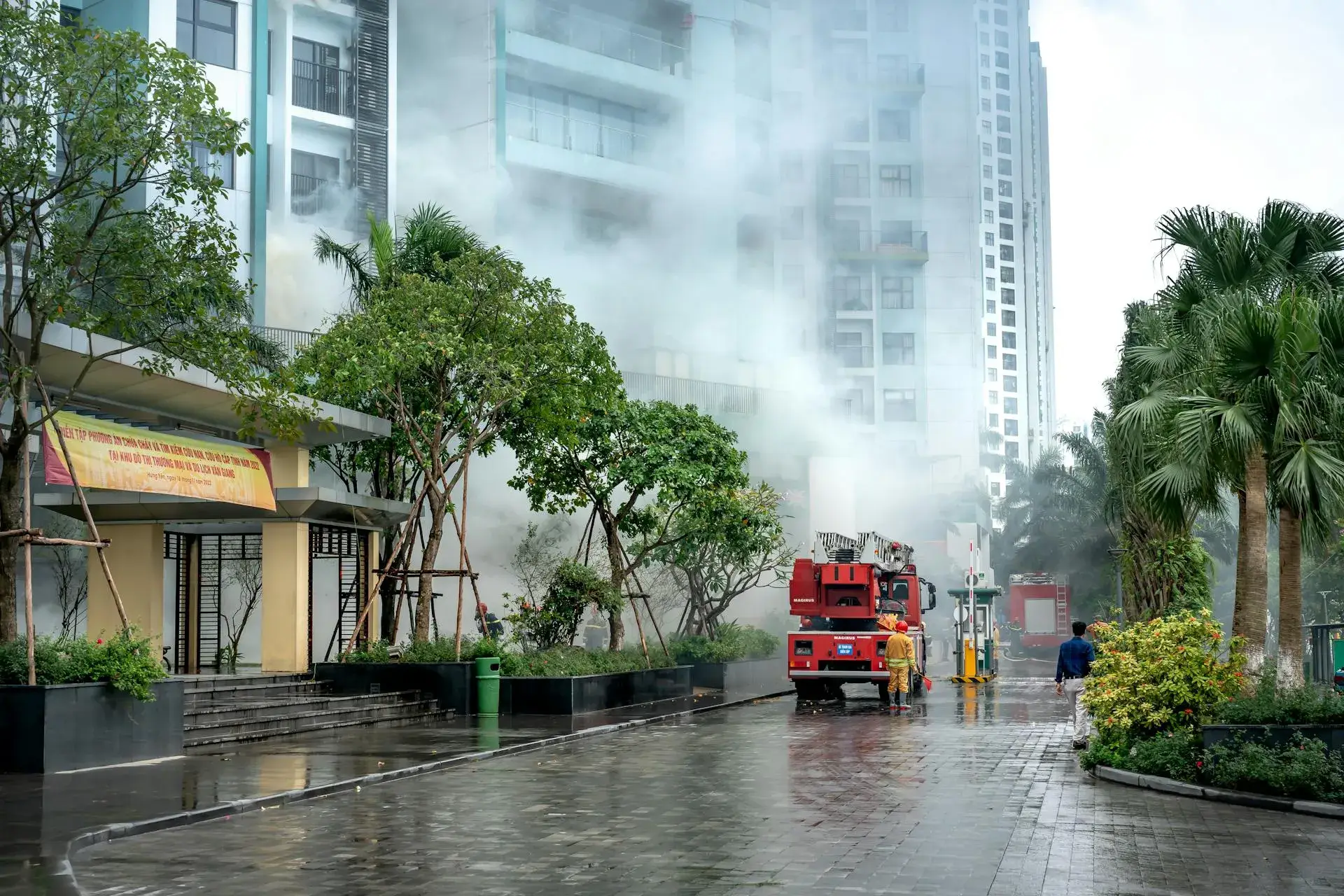
Smoke Damage Restoration in Fort Myers, FL
Smoke residue bonds to surfaces within hours and becomes permanently embedded if untreated. In Fort Myers' humidity, that process accelerates. Our local team responds within 60 minutes to begin professional smoke damage restoration.
What Happens When You Call
A real person answers, not a call center. We assess your smoke damage situation, identify the source type, and begin coordinating your response immediately.
Your dedicated smoke restoration team is dispatched from our local base serving Fort Myers and the surrounding Lee County communities.
Team arrives with air quality monitoring equipment, HEPA air scrubbers, and professional cleaning systems. Assessment and initial air filtration begin immediately.
Contamination scope mapped, cleaning plan documented, air scrubbers running. You know exactly what comes next.
Smoke does not stop causing damage when the fire goes out or when the haze clears. The particles and acids in smoke residue continue reacting with your home's surfaces, and in Southwest Florida's humidity, they do so faster than in drier climates. X Response exists for exactly this moment. When you reach out, your smoke damage restoration team is mobilized within minutes and on site within the hour. From that point forward, one team manages everything: assessment, cleaning, deodorization, air quality restoration, and insurance documentation. You are never left guessing about the next step. Call now. Your team is standing by.
Why Fort Myers Homes Are Vulnerable to Smoke Damage
Fort Myers sits at the western edge of a vast expanse of undeveloped land stretching east through Lehigh Acres, Hendry County, and into the Everglades, and it borders the Gulf of Mexico to the west. This geography means the city receives smoke from multiple directions depending on season and wind patterns. During Florida's dry season, roughly November through May, the Florida Forest Service and private landowners conduct prescribed burns on thousands of acres of palmetto, pine flatwoods, and agricultural land east and south of the metro area. A single 1,600-acre prescribed burn east of the city has sent dense smoke directly into Fort Myers and neighboring communities when wind direction shifts, triggering air quality advisories across Lee County. In 2023, more than 2,600 wildfire incidents across Florida burned over 101,000 acres, fueled by La Nina-induced dryness and vegetation damage left by Hurricane Ian, and Lee County commissioners enacted a burn ban for all of unincorporated Lee County due to increasingly dry conditions. That burn ban itself confirmed how immediate the wildfire and smoke threat had become for the developed areas of the county.
Smoke in Fort Myers does not just come from distant wildfires. Structure fires within the city produce localized smoke plumes that contaminate neighboring homes and businesses through HVAC systems, open windows, and building envelope gaps. The September 2024 and July 2023 apartment fires sent smoke through shared attic spaces and wall cavities into units that were never touched by flame. And the prescribed burns that the Forest Service conducts for ecological management are sometimes close enough to residential development that smoke infiltration into homes is measurable. The result is that Fort Myers residents face smoke exposure from wildfire, prescribed burns, and structure fires, each producing different types of residue that require different restoration approaches. Wildfire smoke from burning vegetation carries different chemical compounds than the synthetic-laden smoke from a structure fire, and prescribed burn smoke from palmetto and pine differs from both. Each requires its own assessment and cleaning protocol.
Prescribed Burns and Seasonal Wildfire Smoke
Southwest Florida depends on prescribed fire to manage the palmetto, pine flatwoods, and sawgrass ecosystems that surround the developed areas of Lee County. The Florida Forest Service conducts these burns during the dry season when conditions allow controlled fire behavior, but smoke from burns of 1,000 to 2,000 acres does not stay on the burn site. Wind direction determines where it goes, and when an easterly or southeasterly wind carries smoke from burns in eastern Lee County, Hendry County, or Collier County into the Fort Myers metro, residents experience reduced visibility, irritated airways, and measurable particulate infiltration into their homes. In June 2024, a 90-acre wildfire off Green Meadow Road in east Lee County sent smoke and soot south across the metro, and in June 2026, multiple wildfires in adjacent counties produced smoke plumes that affected air quality across all of Southwest Florida for days.
Post-Hurricane Ian Wildfire Fuel Load
Hurricane Ian in September 2022 killed and damaged millions of trees across Lee and neighboring counties. Dead vegetation dried out over the following months and created an unusually heavy fuel load that increased both the frequency and intensity of wildfires in subsequent dry seasons. The 2023 wildfire season saw over 101,000 acres burned statewide, with Southwest Florida experiencing elevated fire activity partly because of this hurricane-deposited fuel. When these larger, more intense fires burn, they produce denser smoke plumes that travel farther and carry higher concentrations of fine particulate matter. Homes downwind of these fires, including in Fort Myers' eastern and southern neighborhoods that border undeveloped land, receive heavier smoke loading than they would from a typical dry-season burn.
Structure Fire Smoke and Multi-Unit Contamination
When a fire occurs in a Fort Myers apartment complex or multi-family building, smoke migrates through shared attic spaces, HVAC plenums, electrical and plumbing chases, and the building envelope into units that the flames never reached. Residents of neighboring units may not see fire damage but return to find soot on surfaces, smoke odor permeating fabrics, and discolored walls where residue has settled. The July 2023 Boardwalk Apartments fire and the September 2024 Winkler complex fire both produced this pattern: localized fire damage in one or two units with smoke contamination affecting several more. Restoration in the non-fire units requires full smoke cleaning and deodorization even though no structural repair is needed, and the work must happen quickly before the residue permanently bonds to surfaces in the humid environment.
HVAC Systems as Smoke Distribution Networks
Fort Myers homes run air conditioning virtually year-round, and most use central forced-air systems with ductwork running through attic spaces or between floors. When smoke enters a home through any pathway, the HVAC system distributes it throughout the structure within minutes. Fine smoke particles deposit inside ductwork, on the evaporator coil, in the air handler cabinet, and on the return-side filter housing. Even after the ambient smoke clears, the system continues recirculating contaminated air every time it cycles. Cleaning only the visible surfaces while leaving contaminated ductwork in place means the home continues to smell of smoke and residents continue breathing particulate every time the AC runs. Effective smoke restoration in Fort Myers must include the HVAC system as a primary contamination pathway, not an afterthought.
Humidity-Accelerated Residue Bonding
Smoke residue is not a dry powder that simply sits on surfaces waiting to be wiped away. It contains oils, acids, and fine particulate that bond chemically to materials, and atmospheric moisture accelerates that bonding. In Fort Myers, where relative humidity stays high year-round, smoke residue bonds to surfaces faster and more permanently than in drier climates. A surface that could be cleaned with a dry sponge in an arid environment may require chemical cleaning or even replacement in Fort Myers if treatment is delayed more than 24 to 48 hours. This is why speed of response matters for smoke damage in Southwest Florida: the same residue that is removable today becomes a permanent stain or embedded odor source tomorrow, and the humid climate determines that timeline.
These factors combine to make smoke damage in Fort Myers both more common and more aggressive than in many other regions. The city receives smoke from prescribed burns, seasonal wildfires intensified by post-hurricane fuel loads, and structure fires in dense multi-family housing. Fort Myers' HVAC-dependent lifestyle distributes smoke through entire homes within minutes, and the year-round humidity bonds residue to surfaces faster and more permanently than drier climates. Effective smoke damage restoration here requires rapid response, source-specific cleaning protocols, HVAC decontamination as standard practice, and the chemical deodorization methods that actually eliminate smoke molecules rather than masking them.
What Happens to Your Home While You Wait
Within 1 Hour
Smoke residue settles on every exposed surface in the home. In Fort Myers' high humidity, the oils and acids in soot begin bonding to glass, metal, and painted surfaces immediately. Fine particulate enters the HVAC system and begins distributing throughout the ductwork. At this stage, most surfaces can still be cleaned with professional dry-sponge and chemical methods if treated promptly.
1–24 Hours
Residue begins permanently staining porous surfaces: grout, unsealed tile, natural stone countertops, and fabric upholstery. Metal fixtures tarnish and begin pitting as acids react with the moisture in the air. The HVAC system has now cycled contaminated air into every room in the home, depositing residue on surfaces the smoke never reached directly. The window for simple surface cleaning begins to close.
24–48 Hours
Smoke odor embeds deeply into soft materials: carpet padding, mattresses, upholstered furniture, drapery, and clothing stored in closets and drawers. The chemical bond between residue and hard surfaces strengthens in the humid environment. Cleaning becomes more labor-intensive and chemical-dependent. Items that could have been saved at 12 hours may become total losses at 48.
48–72 Hours
Permanent etching on glass surfaces and chrome fixtures. Yellow-brown discoloration on walls, ceilings, and trim that cannot be removed with surface cleaning and requires repainting or replacement. Odor compounds penetrate into drywall, insulation, and framing materials where they become extremely difficult to reach with standard deodorization methods.
One Week and Beyond
Smoke odor becomes embedded in the structure itself: framing, subfloor, concrete slab, and the interior of wall cavities. Surface cleaning and repainting no longer addresses the problem because the odor source is inside the materials. Restoration shifts from cleaning to demolition and replacement of affected materials, dramatically increasing cost and timeline. HVAC ductwork that has circulated contaminated air for a week may require complete replacement rather than cleaning.
In Fort Myers' humid subtropical climate, smoke residue bonds permanently to surfaces in half the time it takes in drier regions. Every hour of delay narrows your restoration options and increases cost. Contact X Response now. Our Fort Myers team responds within 60 minutes.
How We Restore Smoke-Damaged Fort Myers Homes
From the moment our team arrives, every step is documented, measured, and verified. Here is exactly what the smoke damage restoration process involves.
Air Quality Assessment and Source Identification
Our team arrives with particulate monitoring equipment to measure the contamination level throughout your home and identify the smoke source type. Wildfire smoke from burning vegetation requires different treatment than synthetic smoke from a structure fire or mixed smoke from a prescribed burn. We map which areas have the heaviest deposits, test HVAC system contamination, and establish a baseline air quality reading that will be compared against post-treatment testing. In Fort Myers, we also check whether the HVAC system is actively recirculating contaminated air and shut it down or install emergency filtration immediately if it is.
Containment and Air Filtration
HEPA air scrubbers are deployed throughout the affected areas to begin removing airborne particulate immediately. If the smoke source is still present, such as an ongoing wildfire or a neighboring unit fire still producing smoke, we establish containment to prevent continued infiltration. For apartment and condominium smoke intrusion, we seal the pathways through which smoke entered: shared walls, ceiling penetrations, HVAC connections, and building envelope gaps. Negative air pressure in affected areas prevents cross-contamination to unaffected spaces during the cleaning process.
Surface Cleaning and Residue Removal
Every surface in the contaminated area is cleaned using methods matched to the material and the type of smoke residue present. Dry-chemical sponges remove light residue from walls and ceilings without spreading it. Wet chemical cleaning addresses heavier deposits on hard surfaces. Ultrasonic cleaning restores small items, electronics components, and delicate objects. For Fort Myers homes, we pay particular attention to surfaces where humidity has already begun bonding the residue: window glass, chrome fixtures, polished stone, and any surface with a semi-porous finish. Timing determines whether we clean or replace, and our assessment tells you which applies to each element of your home.
HVAC Decontamination
In Fort Myers, HVAC cleaning is not optional during smoke restoration. The system has been distributing contaminated air from the moment the smoke entered the home, and residue coats the interior of supply and return ductwork, the evaporator coil, the blower housing, and the filter compartment. We clean ductwork using agitation and vacuum methods that remove deposited residue without pushing it further into the system. The evaporator coil is chemically cleaned to remove oily smoke residue that traps odor. New filtration is installed and the system is tested to confirm it is circulating clean air. In severe cases where cleaning cannot remove embedded residue from older ductwork, we recommend replacement and coordinate with your HVAC contractor.
Odor Elimination and Verification
Smoke odor cannot be masked with air fresheners or surface sprays. We use thermal fogging to penetrate the same gaps and cavities the smoke originally entered, hydroxyl generators that break down odor molecules at the chemical level safely in occupied spaces, and ozone treatment in sealed, unoccupied areas for severe contamination. In Fort Myers' climate, we also address the moisture component by dehumidifying during treatment to prevent the humid air from reactivating odor compounds in treated materials. Post-treatment air quality testing verifies that particulate levels have returned to acceptable ranges and odor elimination is complete throughout the structure, not just in the rooms that received direct treatment.
The X Response Difference
When you contact X Response for smoke damage in Fort Myers, you get a team that addresses the contamination comprehensively: surfaces, HVAC, contents, and air quality, verified with post-treatment testing. One team, one standard, complete restoration.
Insurance Claim Guidance for Fort Myers Homeowners
Smoke damage insurance coverage in Florida depends on the source of the smoke. If smoke entered your home from a covered peril, such as a fire in your own home, a fire in a neighboring property, or a vehicle fire on adjacent land, your homeowner's policy typically covers the cleaning, restoration, and any replacement of damaged materials. Smoke from wildfires that produces measurable property damage is generally covered as well. However, some policies exclude or limit coverage for smoke damage from agricultural burns, prescribed burns conducted on public or private land, or ongoing ambient smoke conditions that develop gradually rather than from a single identifiable event. Understanding whether your specific smoke exposure qualifies as a covered peril under your policy is the first step toward a successful claim.
How X Response Helps
- Document smoke contamination with professional photos, air quality readings, and a detailed scope identifying affected surfaces and systems
- Identify the smoke source clearly, as coverage may differ between structure fire smoke, wildfire smoke, and prescribed burn smoke
- Record the date and duration of smoke exposure to establish it as a sudden event rather than a gradual condition
- Inventory all damaged contents with pre-loss values, including soft goods, electronics, and items requiring professional cleaning
- Preserve samples of residue and contaminated materials for adjuster inspection before any cleaning begins
X Response does not file claims on your behalf, adjust claims, or make coverage determinations. We provide documentation and guidance to help you make informed decisions about your property and your policy. Coverage decisions are made solely by your insurance carrier.
Certified Restoration Specialists Serving Fort Myers
When you contact X Response for smoke damage in Fort Myers, your restoration team is drawn from certified professionals who work across Lee County and understand the specific challenges of smoke restoration in a subtropical coastal environment. They know the difference between palmetto wildfire residue, synthetic structure fire soot, and the mixed agricultural smoke that drifts in from prescribed burns east of the metro. They understand how Fort Myers' year-round humidity accelerates residue bonding and why HVAC decontamination is essential rather than optional in a climate where systems run 10 to 12 months per year. They have restored homes after wildfire smoke intrusion from east Lee County burns, multi-unit apartment smoke migration, and the localized smoke events that affect neighboring properties after a single-structure fire.
Every technician on your team holds current IICRC certification in fire and smoke restoration and carries appropriate Florida state licensing for the work being performed. Equipment includes professional air quality monitoring instruments, HEPA filtration systems, thermal foggers, hydroxyl generators, ultrasonic cleaning systems, and the duct-cleaning equipment required to decontaminate the HVAC systems that distribute smoke through Fort Myers homes. When your team arrives, they bring everything needed to begin assessment and air filtration immediately, stopping the contamination from deepening while the full restoration plan is developed.
In Fort Myers, X Response works with Florida Restoration and Platinum Air Mold Inspection, independent local restoration partners serving Lee County.
Smoke Damage Restoration FAQ for Fort Myers Homeowners
Other Emergency Services in Fort Myers

Water Damage Restoration
Burst pipes, storm flooding, standing water. We extract, dry, and restore before mold sets in.
Learn more
Fire Damage Restoration
Structural damage, soot, debris. We stabilize, clean, and rebuild what fire destroyed.
Learn more
Mold Remediation
Testing, containment, removal, prevention. We find the source, eliminate the growth, and stop it from returning.
Learn more
Sewage Cleanup
Sewer backups, contaminated water, biohazard. We extract, sanitize, and restore safely.
Learn moreNearby Service Areas
Also serving nearby: