
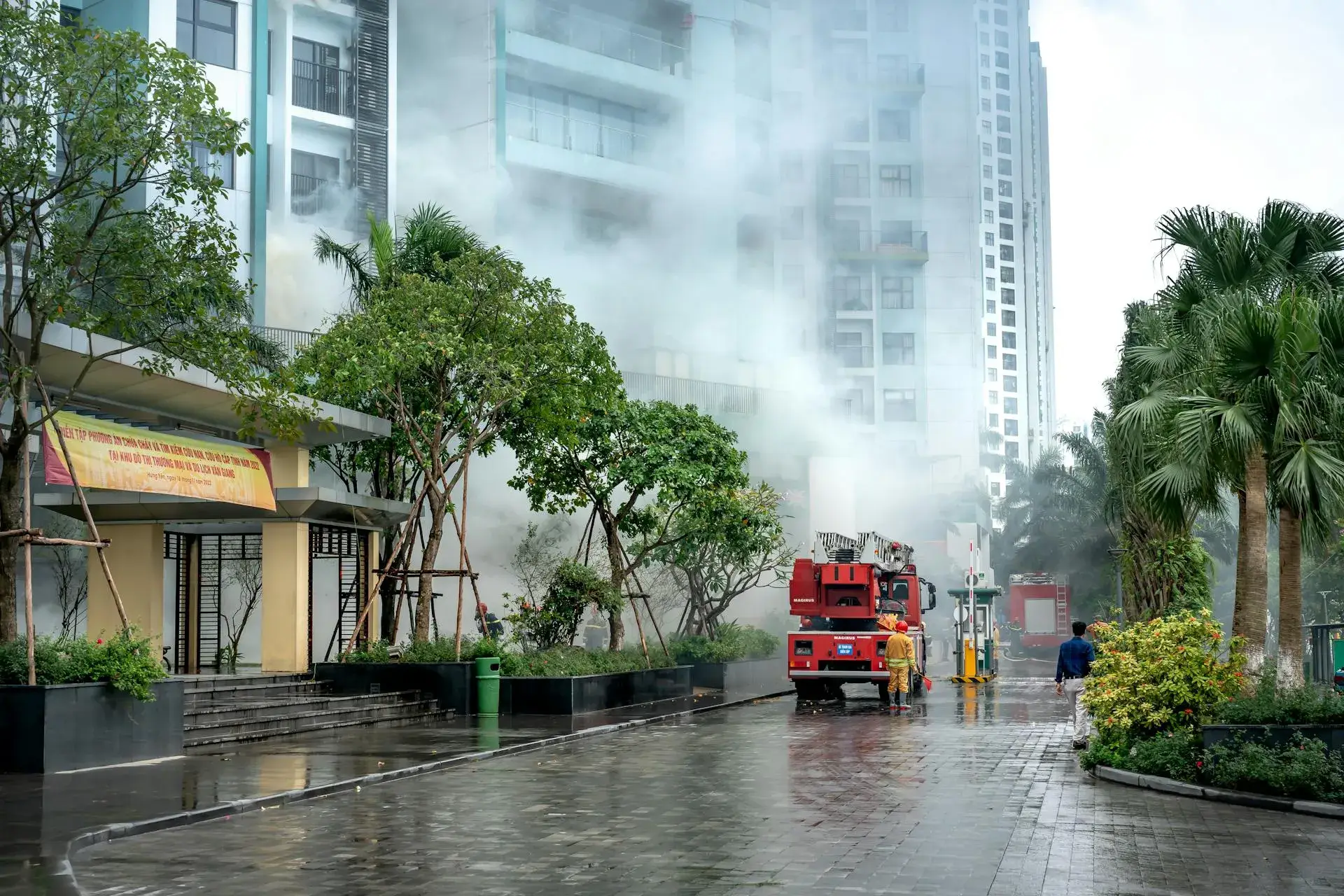
Smoke Damage Restoration in North Fort Myers, FL
Smoke infiltration compounds with every hour in North Fort Myers' humidity, bonding permanently with surfaces and circulating through HVAC systems. Our local team responds within 60 minutes to assess, contain, and begin professional smoke remediation.
What Happens When You Call
A real person answers, not a call center. We assess the smoke source, extent of infiltration, and immediate containment needs.
Your dedicated restoration team is dispatched from our local base serving North Fort Myers and Lee County.
Team arrives with air quality testing equipment, HEPA filtration, and specialized smoke cleaning tools. Assessment and containment begin immediately.
Infiltration pathways identified, HVAC isolated, initial air scrubbing deployed, and restoration plan documented. You know exactly what your home needs.
Smoke does not need to come from your own property to cause serious damage inside your home. In North Fort Myers, prescribed burns from nearby conservation lands, brush fires along the I-75 corridor, and structure fires in neighboring properties send smoke into homes through HVAC intakes, open windows, door gaps, and building envelope penetrations. Once inside, smoke residue bonds with every surface it touches, and in subtropical humidity, that bonding accelerates rapidly. You need professional intervention before the damage becomes permanent. Call now. Your team is standing by.
Why North Fort Myers Homes Are Vulnerable to Smoke Damage
North Fort Myers occupies a position in Lee County that makes it uniquely susceptible to smoke infiltration from external sources. The community is bordered to the north and east by thousands of acres of conservation land, pine flatwoods, and wildlife management areas that require periodic prescribed burning for ecological health. The Fred C. Babcock/Cecil M. Webb Wildlife Management Area lies just north across the Charlotte County line, and its regular burn schedule sends smoke plumes south into North Fort Myers depending on wind direction. In early 2025, a 1,600-acre prescribed burn in conservation land adjacent to Lee County sent heavy smoke drifting into the Fort Myers metro including North Fort Myers, reducing visibility and air quality across the community. In March 2023, Lee County's own Florida Forest Service operations included a 163-acre prescribed burn that produced noticeable smoke across populated areas. These are not rare events. The Florida Forest Service conducts hundreds of prescribed burns annually in Southwest Florida, and North Fort Myers' position downwind of large conservation parcels means regular smoke exposure throughout the dry season from November through May.
Beyond prescribed burns, North Fort Myers faces smoke from brush fires that ignite along its semi-rural eastern boundary and from structure fires within its dense mobile home communities. The March 2023 brush fire off Slater Road near I-75 produced smoke that billowed across the interstate and drifted into residential neighborhoods. Structure fires in closely spaced mobile home parks generate heavy smoke that affects dozens of neighboring units even when the fire itself is contained to one or two structures. North Fort Myers' older mobile homes and site-built houses often have compromised building envelopes, deteriorated weather seals, aging windows, and HVAC systems that draw unfiltered outside air. When smoke events occur, these homes inhale contaminated air for hours or days, depositing soot and smoke residue on every interior surface and throughout the ductwork. By the time the air clears outside, significant indoor damage has already occurred. Residents often do not realize the extent of smoke infiltration until they notice persistent odor, discolored surfaces, or respiratory symptoms days after the event.
Prescribed Burn Proximity and Frequency
North Fort Myers sits immediately south of extensive conservation lands managed through prescribed fire. The Babcock/Webb Wildlife Management Area, encompassing over 80,000 acres across the Charlotte and Lee County border, conducts regular burns to maintain pine flatwoods and prairie ecosystems. The CREW Land and Water Trust manages additional thousands of acres east of Interstate 75 with similar burn requirements. When burn managers ignite these parcels, smoke production is unavoidable even with careful planning around wind conditions. Burns of 1,000 to 2,000 acres produce smoke columns visible for miles and deposit particulate matter across downwind communities for hours. North Fort Myers' geographic position means it receives smoke from burns conducted to the north (Babcock/Webb) when winds come from the north or northeast, and from burns to the east (CREW lands) when winds shift to the east. During the peak burn season between January and April, smoke events can occur multiple times per month.
Wildfire and Brush Fire Smoke
Unlike prescribed burns, which are planned around weather conditions to minimize community impact, wildfires and escaped brush fires produce smoke without regard to wind direction or population exposure. North Fort Myers' eastern boundary along I-75 borders undeveloped parcels of pine flatwoods and saw palmetto that dry rapidly during winter months and ignite from lightning, power line failures, equipment sparks, and unauthorized burning. The 2023 wildfire season produced over 2,600 fires burning more than 101,000 acres across Florida, with Hurricane Ian's vegetation damage from the previous year providing additional fuel in Lee County. Wildfires burn hotter and produce denser smoke than prescribed burns because they consume accumulated fuel loads rather than carefully managed lighter fuels. When wildfires ignite east of North Fort Myers and westerly wind shifts push smoke toward the coast, the entire community can be blanketed in dense smoke for extended periods.
HVAC Systems as Smoke Distribution Networks
In North Fort Myers, air conditioning runs year-round because summer temperatures and humidity make natural ventilation impractical. Most residential HVAC systems draw return air from inside the home, but they also pull air through building envelope leaks, ductwork connections in unconditioned spaces, and fresh-air intakes. When outdoor smoke events occur, these systems pull smoke-laden air into the home and distribute it through every room connected to the duct system. The ductwork itself becomes contaminated, with smoke residue depositing on interior surfaces throughout the supply and return system. Once smoke enters ductwork, the HVAC system continues redistributing residue particles every time it cycles, even days or weeks after the original smoke event has cleared. Older systems common in North Fort Myers' housing stock have minimal filtration, often using basic fiberglass filters that capture virtually no smoke particulate. The system effectively converts a temporary outdoor smoke event into a persistent indoor air quality problem.
Humidity-Accelerated Smoke Bonding
Smoke residue behaves differently in North Fort Myers' subtropical humidity compared to drier climates. Smoke particles are hygroscopic, meaning they absorb moisture from the surrounding air. In an environment where indoor relative humidity routinely exceeds 60 percent even in air-conditioned homes, smoke residue absorbs atmospheric moisture and forms a sticky, acidic film on surfaces it contacts. This film bonds with paint, fabric, wood, and metal far more aggressively than dry smoke residue would. Surfaces that could be cleaned with dry methods in an arid climate require chemical cleaning or replacement in Southwest Florida because the humidity-activated residue has penetrated the surface material. The bonding process accelerates with time, meaning that smoke residue left untreated for 48 to 72 hours in this climate causes permanent damage that would take a week or more in drier conditions.
Mobile Home Infiltration Vulnerability
North Fort Myers' large mobile home population faces elevated smoke infiltration risk because manufactured homes have more building envelope penetrations and less airtight construction than site-built homes. Seams between wall panels, gaps around windows and doors, deteriorated skirting, plumbing and electrical penetrations through the floor system, and roof-mounted HVAC equipment all provide pathways for smoke to enter during outdoor events. Older mobile homes built before current manufactured housing standards may have no effective air barrier at all between the interior and exterior environment. During a multi-hour smoke event from a nearby prescribed burn or brush fire, these homes continuously inhale contaminated air with no mechanical filtration. The resulting interior smoke exposure can be severe enough to require professional restoration even when the smoke source is miles away and the home itself never experienced a fire.
Smoke damage in North Fort Myers is not limited to homes that experience fire. The community's position adjacent to regularly burned conservation lands, its exposure to brush fires along the I-75 corridor, and its housing stock with compromised building envelopes mean that external smoke events regularly cause interior damage requiring professional restoration. The subtropical humidity accelerates smoke bonding with surfaces, HVAC systems distribute contamination throughout entire homes, and older construction offers minimal protection against infiltration. Effective smoke restoration here means addressing the full pathway from infiltration source through distribution system to every affected surface, not just cleaning what is visibly discolored.
What Happens to Your Home While You Wait
Within 1 Hour
Smoke residue begins depositing on all surfaces within the home, including those in rooms that appear unaffected. Fine particulate settles on countertops, electronics, fabrics, and food preparation surfaces. In North Fort Myers' humid air, residue immediately begins absorbing atmospheric moisture, forming the sticky acidic film that bonds with surfaces. HVAC systems pull contaminated air through ductwork, spreading residue to every room in the home.
1–24 Hours
Smoke residue bonds with painted surfaces, fabric fibers, and porous materials as humidity-activated bonding progresses. Metal fixtures begin showing discoloration as acidic residue reacts with moisture on their surfaces. Odor permeates soft furnishings, bedding, clothing in closets, and upholstered furniture. HVAC ductwork accumulates residue that will continue recirculating even after outdoor air clears. The window for simple surface cleaning begins closing as penetration deepens.
24–48 Hours
Permanent staining develops on light-colored surfaces, grout, and natural stone as acidic residue etches into the material. Smoke odor fully bonds with wall paint, carpet fibers, and window treatments. Professional cleaning methods become necessary as DIY surface wiping no longer removes embedded residue. Electronics and appliance interiors accumulate particulate that affects performance and lifespan. The restoration scope expands from surface cleaning to include material replacement.
48–72 Hours
In North Fort Myers' humidity, smoke residue has fully penetrated porous surfaces and cannot be removed without aggressive chemical treatment or material replacement. Painted walls require stripping and recoating rather than surface cleaning. Carpet and pad must be replaced rather than cleaned. HVAC ductwork requires professional cleaning or section replacement. Corrosion advances on metal components. What began as an air quality and cleaning issue becomes a material replacement and reconstruction project.
One Week and Beyond
Without professional intervention, smoke residue permanently discolors walls, destroys soft furnishings, corrodes electronics and metal fixtures, and creates persistent odor embedded in every porous material in the home. The HVAC system continues redistributing residue with every cycle, recontaminating cleaned surfaces. Health symptoms from ongoing particulate exposure may develop. Complete restoration now requires extensive material removal, surface treatment, ductwork replacement, and odor elimination through the entire structure.
North Fort Myers' humidity turns smoke residue into a permanently bonded contaminant faster than most residents expect. Contact X Response now. Our team responds within 60 minutes to contain, clean, and eliminate smoke damage before it becomes permanent.
How We Restore Smoke-Damaged North Fort Myers Homes
From the moment our team arrives, every step is documented, measured, and verified. Here is exactly what the smoke damage restoration process involves.
Source Identification and Containment
Our team arrives to determine the smoke source, identify infiltration pathways, and contain further exposure. For ongoing external smoke events like prescribed burns or brush fires, we seal building envelope penetrations, isolate the HVAC system to prevent further distribution, and deploy HEPA air scrubbers to begin filtering indoor air. For post-fire smoke damage, we identify which areas received direct smoke exposure versus secondary distribution through ductwork. We use air quality monitoring to measure particulate levels in each room and establish a baseline for restoration verification. This assessment determines whether the damage requires surface cleaning, deep cleaning, material replacement, or a combination approach.
HVAC Isolation and Ductwork Assessment
In North Fort Myers homes where HVAC runs continuously, the duct system is almost always contaminated during smoke events. We isolate the system immediately to prevent further distribution and inspect ductwork for residue accumulation. Depending on the severity, ductwork may require professional cleaning using agitation and HEPA vacuum extraction, or sections may need replacement. The air handler, evaporator coil, and blower assembly are inspected and cleaned because smoke residue accumulating on these components affects system efficiency and continues releasing particles into airflow. Filters are replaced and we assess whether the existing filtration rating is adequate to capture residual particulate during and after restoration.
Surface Cleaning and Soot Removal
Smoke residue removal requires different techniques depending on the surface material and the degree of bonding. In North Fort Myers' humidity-accelerated environment, we use chemical sponges for light residue on painted surfaces, alkaline cleaners for protein-based smoke residue, and solvent-based cleaners for petroleum-based soot from synthetic materials. We work from the least affected areas toward the most contaminated to prevent cross-contamination. Hard surfaces are cleaned and sealed. Soft furnishings are evaluated for salvageability, and items that cannot be cleaned to pre-loss condition are documented for insurance purposes. We clean walls, ceilings, trim, cabinetry, and all horizontal surfaces where particulate has settled.
Odor Elimination
Surface cleaning removes visible residue but does not eliminate embedded smoke odor. We use a multi-method approach tailored to the materials affected and the severity of penetration. Thermal fogging generates a heated deodorizer that penetrates the same pathways smoke used to enter materials, neutralizing odor at the molecular level. Ozone treatment oxidizes odor-causing compounds in enclosed spaces. Hydroxyl generators provide continuous deodorization in occupied areas without requiring evacuation. For severe cases, we apply odor-blocking primers to structural surfaces before repainting. In North Fort Myers' sealed, air-conditioned homes, we treat the HVAC system separately because ductwork odor recirculates continuously if not addressed.
Air Quality Verification and Completion
Before we consider the job complete, air quality testing confirms that particulate levels have returned to acceptable standards and odor has been eliminated. We run air scrubbers with HEPA filtration throughout the project and verify final readings in each room. The HVAC system is tested after cleaning to confirm it is no longer distributing residue. All work is documented with before-and-after photos, air quality readings, and a written summary of methods used. This documentation supports your insurance claim and provides a clear record of what was done. If any area does not meet our quality standard on final inspection, work continues until it does.
The X Response Difference
When you contact X Response for smoke damage in North Fort Myers, you get a team that understands smoke infiltration as a system-wide problem requiring system-wide solutions. One team manages assessment, HVAC decontamination, surface restoration, and odor elimination as a unified project.
Insurance Claim Guidance for North Fort Myers Homeowners
Smoke damage insurance coverage depends on the source of the smoke and the type of policy you hold. Most homeowner's policies cover smoke damage from a sudden event such as a house fire, neighboring structure fire, or wildfire that directly threatens your property. Coverage for smoke infiltration from prescribed burns or distant brush fires is less straightforward and depends on your policy language and the insurer's assessment of the event. Mobile home policies have their own coverage terms. Understanding how your specific smoke event relates to your policy language is essential before filing a claim.
How X Response Helps
- Document all smoke damage with professional photos, air quality readings, and a detailed scope of work from day one
- Identify the smoke source clearly, as coverage may differ between fire-related smoke and environmental smoke from prescribed burns
- Inventory damaged contents room by room with photographs and pre-loss condition documentation
- Maintain air quality test results as objective evidence of contamination levels before and after restoration
- Document HVAC contamination separately as it may fall under equipment damage or property damage categories depending on your policy
X Response does not file claims on your behalf, adjust claims, or make coverage determinations. We provide documentation and guidance to help you make informed decisions about your property and your policy. Coverage decisions are made solely by your insurance carrier.
Certified Restoration Specialists Serving North Fort Myers
When you contact X Response for smoke damage in North Fort Myers, your restoration team is drawn from certified professionals who work across Lee County and understand the specific smoke challenges this community faces. They have restored homes after prescribed burn infiltration from the Babcock/Webb conservation lands, brush fire smoke events along the I-75 corridor, structure fire smoke spread through mobile home parks, and interior smoke damage from kitchen and electrical fires. They understand how North Fort Myers' humidity accelerates smoke bonding with surfaces, how older mobile homes and site-built homes each infiltrate differently, and how HVAC systems in continuously air-conditioned Florida homes become persistent redistribution networks for smoke residue.
Every technician on your team holds current IICRC certification in fire and smoke restoration and carries the appropriate Florida state licensing for the work performed. Equipment includes professional air quality monitoring, HEPA air scrubbers, thermal fogging systems, ozone generators, hydroxyl treatment units, and the full range of chemical cleaning agents required for different smoke residue types on different surface materials. When your team arrives, they bring everything needed to assess, contain, clean, and verify the restoration without waiting for additional equipment or separate contractors.
In North Fort Myers, X Response works with Florida Restoration and Platinum Air Mold Inspection, independent local restoration partners serving Lee County.
Smoke Damage Restoration FAQ for North Fort Myers Homeowners
Other Emergency Services in North Fort Myers
Water Damage Restoration
Burst pipes, storm flooding, standing water. We extract, dry, and restore before mold sets in.
Learn more
Fire Damage Restoration
Structural damage, soot, debris. We stabilize, clean, and rebuild what fire destroyed.
Learn more
Mold Remediation
Testing, containment, removal, prevention. We find the source, eliminate the growth, and stop it from returning.
Learn more
Sewage Cleanup
Sewer backups, contaminated water, biohazard. We extract, sanitize, and restore safely.
Learn moreNearby Service Areas
Also serving nearby: