
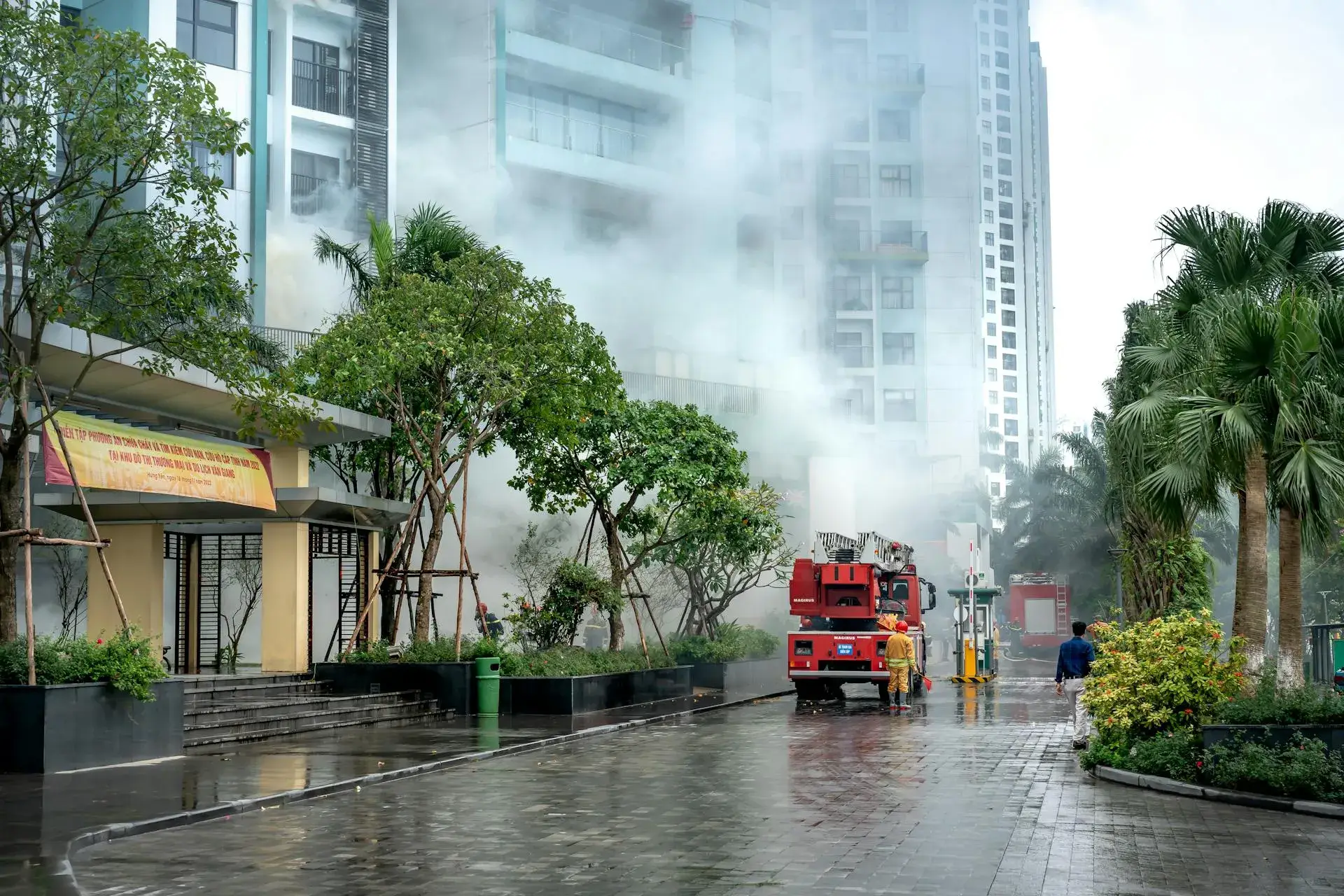
Smoke Damage Restoration in Palm Harbor, FL
Every hour that smoke residue sits on surfaces in Palm Harbor's coastal humidity, acidic compounds bond deeper and odor molecules penetrate further into your home's structure. Our local team responds within 60 minutes.
What Happens When You Call
A real person answers. We assess your smoke damage, identify the residue type and source, and coordinate your response immediately.
Your dedicated restoration team is dispatched from our Clearwater-area base serving Palm Harbor and northern Pinellas County.
Team arrives with HEPA air scrubbers, professional cleaning equipment, thermal foggers, and hydroxyl generators. Assessment and air quality stabilization begin immediately.
Damage scope mapped, cleaning protocol matched to residue type, plan documented. You know the timeline and what each phase involves.
Smoke damage does not stop when the visible haze clears. Residue keeps reacting. Odor compounds keep migrating into materials. Fine particulate keeps settling inside HVAC systems where it recirculates with every cooling cycle. X Response exists for exactly this situation. When you reach out, your restoration team is mobilized within minutes and on site within the hour. One team manages everything: surface cleaning, odor elimination, air quality restoration, and contents recovery. Call now. Your team is standing by.
Why Palm Harbor Homes Are Vulnerable to Smoke Damage
Palm Harbor is an unincorporated community of over 61,000 residents in northern Pinellas County, Florida, where smoke damage enters homes from three distinct sources: structure fires caused by the area's frequent lightning strikes, wildfire smoke from atmospheric events that infiltrate through HVAC systems, and neighbor-structure fires in the community's condominium and townhome developments where shared attic spaces allow smoke to migrate across building assemblies. On October 3, 2023, the Environmental Protection Commission of Hillsborough County issued an Air Pollution Advisory due to elevated fine particulate matter from Canadian wildfire smoke, with unhealthy air quality levels for sensitive groups reaching across the Tampa Bay area including Pinellas County. Palm Harbor's homes run central air conditioning throughout the warm months, and during this event HVAC systems throughout the community pulled contaminated outdoor air through return intakes, drawing the fine wildfire particulate into ductwork and distributing it to every room the system served. Standard residential HVAC filters cannot capture particles below 2.5 micrometers, allowing wildfire smoke to pass through and deposit on evaporator coils, duct walls, and room surfaces.
Structure fire smoke is the more severe contamination category in Palm Harbor. The August 2025 lightning-struck condo fire and the March 2024 Haviland Court apartment fire that spread from the first floor to the attic each generated smoke that migrated through connected building assemblies. In Palm Harbor's 1980s and 1990s condominium buildings, shared attic spaces above ceiling planes create horizontal pathways for smoke to distribute across entire building footprints. Residents in units where no fire occurred may discover smoke contamination days or weeks later when odors emerge from wall cavities as temperatures rise and volatile organic compounds that were deposited inside the building assembly begin offgassing. Kitchen fires in Palm Harbor's single-family homes distribute protein-based smoke through HVAC systems immediately as the continuous AC operation pulls the distinctive oily residue into return ducts and redistributes it throughout the home. In Palm Harbor's coastal environment, all of these smoke types interact with salt-laden air to produce residue that remains chemically active longer than the same residue in an inland location.
Lightning-Strike Smoke Characteristics
Lightning-caused fires in Palm Harbor produce a specific smoke profile determined by what the lightning ignites. Attic fires from lightning strikes burn roof decking, framing lumber, insulation, and roofing materials, generating a wood and petroleum-based smoke with volatile organic compounds that penetrate deeply into porous building materials. When lightning strikes an electrical system or appliance, the resulting fire produces acrid chemical smoke from burning wire insulation, junction box materials, and circuit components. Both types of residue behave differently from kitchen fires or combustion-heating puffbacks, requiring assessment to determine the appropriate cleaning chemistry. Lightning-strike fires also tend to occur during the summer storm season when Palm Harbor's humidity is at its peak, which means smoke residue deposited on surfaces remains reactive and continues damaging materials longer than it would in drier conditions.
Shared Attic Smoke Migration in Condo Buildings
Palm Harbor's condominium and townhome communities, built primarily during the 1980s and 1990s, feature connected attic spaces that run above ceiling assemblies across entire building lengths. During the March 2024 Haviland Court fire and the August 2025 lightning-struck condo fire, smoke entering the attic space from the fire unit or from a lightning strike on the roofline spread through the shared attic above connected units before penetrating ceiling surfaces. Units at opposite ends of a building may receive smoke contamination through the shared attic from a fire they were not directly aware of. This migration pathway deposits smoke primarily on ceiling surfaces and in the upper portions of wall cavities near the ceiling plane, creating a contamination pattern that differs from the uniform distribution of HVAC-distributed smoke. Professional assessment after any multi-unit fire must inspect the shared attic condition to identify affected units beyond those immediately adjacent to the fire.
Continuous AC Operation and Systemic Distribution
Palm Harbor's climate supports continuous central air conditioning operation for approximately nine months annually. The HVAC system cycles all indoor air through return ducts, across the evaporator coil, and out through supply registers multiple times per hour. Any smoke event immediately engages this distribution system. Wildfire particulate from the October 2023 atmospheric event, protein smoke from a kitchen fire, and lightning-strike fire smoke from an adjacent unit are all pulled into the return air stream and deposited throughout the home within minutes. The evaporator coil and supply ductwork become secondary storage for smoke compounds that then release back into room air with every system cycle. In Palm Harbor's climate, HVAC decontamination is an essential component of every smoke restoration project because the duct system operates as both the distribution pathway during the event and the ongoing contamination source afterward.
Coastal Humidity and Persistent Residue
Palm Harbor's position along St. Joseph Sound and the Gulf of Mexico means ambient relative humidity regularly exceeds 75%. In this environment, deposited smoke residue absorbs atmospheric moisture and remains chemically active on surfaces longer than in drier inland locations. Soot acids continue reacting with metal surfaces, etching glass, and penetrating porous materials rather than drying into an inert deposit. The practical effect is that the cleaning window in Palm Harbor, measured from the time of deposition to the point where residue bonds permanently to many surface types, is compressed compared to inland Florida locations. Materials that could be professionally cleaned within two or three days after a fire in an air-conditioned interior environment may be permanently stained within 24 to 48 hours in Palm Harbor's humid coastal conditions if the structure has lost its climate control.
Mobile Home Smoke Vulnerability
Palm Harbor and unincorporated northern Pinellas County contain numerous manufactured housing communities. Smoke damage in mobile homes requires different assessment and restoration approaches than site-built construction. The relatively thin wall assemblies, lower-density insulation materials, and compact construction of manufactured housing allow smoke to penetrate wall, floor, and ceiling assemblies more quickly than standard framing. HVAC systems in manufactured housing are typically smaller units with less ductwork, but their compact design means smoke infiltration reaches every room of the home within minutes of any smoke event. The synthetic materials common in manufactured housing, including vinyl siding, plastic trim, and synthetic carpeting, respond differently to smoke residue than wood and drywall, requiring specific cleaning agents and techniques. Odor penetration into the structural materials of manufactured housing, particularly the floor assembly and wall panels, can be especially persistent.
These smoke damage sources create indoor air quality threats in Palm Harbor from lightning-caused structure fires that produce specific residue types, shared attic migration in the older condo stock, continuous AC distribution that spreads contamination systematically, coastal humidity that keeps residue chemically active longer, and the distinct vulnerabilities of the manufactured housing communities throughout northern Pinellas County. Each demands a source-specific approach, but all require HVAC decontamination to prevent ongoing redistribution after surfaces are cleaned.
What Happens to Your Home While You Wait
Within 1 Hour
Smoke particles settle on all surfaces. Acidic soot begins reacting with metals. In Palm Harbor's coastal air, this reaction is more persistent than in inland locations. The HVAC system pulls particles into return ducts and distributes them throughout the home. Fine wildfire particulate passes through standard filters and deposits throughout the duct system and on room surfaces.
1–24 Hours
Soot acids etch chrome, brass, and stainless steel. Residue absorbs into drywall, ceiling texture, and carpet. Odor compounds bond to soft furnishings. Coastal humidity maintains residue chemical activity, extending surface damage beyond what dry climates experience. HVAC continues redistributing contamination with every cycle.
24–48 Hours
Smoke residue becomes increasingly permanent on porous surfaces. Coastal humidity keeps soot acids reactive, continuing to damage surfaces that would have dried into stability in a drier environment. Odor compounds migrate into wall cavities and structural materials. Fabrics that were cleanable on day one may require replacement.
48–72 Hours
Surface damage transitions from cleanable to permanent on many materials. HVAC contamination is systemic. Natural stone, grout, and unfinished wood absorb smoke compounds at depths surface cleaning cannot address. Professional restoration scope and cost increase substantially.
One Week and Beyond
Smoke odor permeates the building envelope. Structural materials hold embedded compounds. Contents that could have been cleaned now require replacement. Comprehensive restoration with demolition components is required. The HVAC system needs decontamination or component replacement.
Smoke damage in Palm Harbor persists longer in the coastal humidity because acidic residue stays reactive. Contact X Response now. The earlier we begin, the more we can save.
How We Restore Smoke-Damaged Palm Harbor Homes
Smoke damage restoration follows a systematic protocol tailored to residue type and distribution pattern.
Source Identification and Damage Assessment
Our team identifies the smoke source and residue type. Lightning-strike fire smoke, wildfire atmospheric particulate, kitchen protein smoke, and manufactured housing synthetic material smoke each require different chemistry. We inspect the HVAC system for internal contamination, assess shared attic spaces in condominium buildings for migration extent, and document full scope. For mobile homes, we assess structural panels and floor assemblies separately.
Air Quality Stabilization
HEPA air scrubbers deploy immediately. The HVAC system shuts down to stop redistribution. Negative pressure in contaminated areas prevents migration to clean spaces. In Palm Harbor's climate where AC is essential, temporary cooling is positioned while the contaminated central system stays offline throughout the project.
Surface Cleaning and Soot Removal
Residue-specific chemistry applied to every contaminated surface. Dry soot removed first with chemical sponges and HEPA vacuuming before any wet methods to prevent smearing. Lightning-strike fire soot from burning wood and roofing materials uses different chemistry from electrical smoke. For condominium attic smoke migration, contaminated ceiling surfaces and upper wall areas receive dedicated treatment. We work ceiling to floor, systematically through every room the smoke reached.
HVAC Decontamination
Ductwork is camera-inspected, then mechanically cleaned or replaced based on contamination level. Evaporator coil is cleaned with approved solvents. Blower and air handler housing are decontaminated. New high-efficiency filtration is installed. For mobile homes with compact AC units, the entire system is accessed and treated. The system does not restart until all interior surfaces are clean.
Odor Elimination and Verification
Hydroxyl generators break down odor molecules through oxidation. Thermal fogging with odor counteractants penetrates material pores. Treatment continues until verification across multiple days under Palm Harbor's varying humidity conditions confirms permanent elimination. We test under conditions that stress-test results before sign-off.
The X Response Difference
When you contact X Response for smoke damage in Palm Harbor, you get a team addressing every contamination pathway with the coastal-specific approach this environment requires.
Insurance Claim Guidance for Palm Harbor Homeowners
Smoke damage insurance in Palm Harbor depends on the source. Smoke from a structure fire on your property is covered under standard homeowner's policies. Smoke from a neighbor's fire that migrated through shared condo attic spaces is typically covered as fire-related damage. Lightning-caused fire smoke is covered as a named peril. Wildfire smoke infiltration from atmospheric events may fall under different coverage provisions. For manufactured housing, coverage terms and valuation methods often differ from standard homeowner's policies, particularly regarding actual cash value versus replacement cost for smoke-affected contents and structural elements.
How X Response Helps
- Document the smoke source and date with evidence establishing when contamination occurred
- For condo shared-attic migration, document the pathway connecting the fire unit to your affected unit
- For lightning-caused fire smoke, confirm Palm Harbor Fire Rescue documentation of lightning as the suspected ignition source
- Map distribution through the property including HVAC contamination and shared attic exposure
- Provide air quality testing establishing contamination level and post-restoration improvement for claim support
X Response does not file claims on your behalf, adjust claims, or make coverage determinations. Coverage decisions are made solely by your insurance carrier.
Certified Restoration Specialists Serving Palm Harbor
When you contact X Response for smoke damage in Palm Harbor, your team brings expertise in lightning-strike fire smoke restoration, shared attic migration assessment in northern Pinellas County's condo stock, and the coastal humidity factors that compress the salvage timeline for smoke-affected materials. They understand how Palm Harbor's continuous AC operation makes HVAC decontamination mandatory for lasting results and how manufactured housing requires assessment approaches different from site-built construction.
Every technician holds current IICRC fire and smoke restoration certification. Equipment includes commercial HEPA air scrubbers, hydroxyl generators, thermal foggers, duct inspection cameras, and the full range of cleaning chemistry for every residue type encountered in Palm Harbor's varied housing stock. One team manages assessment through final odor verification.
In Palm Harbor, X Response works with Dry Out Daddy Restoration, an independent local restoration partner serving Pinellas County.
Smoke Damage Restoration FAQ for Palm Harbor Homeowners
Other Emergency Services in Palm Harbor

Water Damage Restoration
Burst pipes, storm flooding, standing water. We extract, dry, and restore before mold sets in.
Learn more
Fire Damage Restoration
Structural damage, soot, debris. We stabilize, clean, and rebuild what fire destroyed.
Learn more
Mold Remediation
Testing, containment, removal, prevention. We find the source, eliminate the growth, and stop it from returning.
Learn more
Sewage Cleanup
Sewer backups, contaminated water, biohazard. We extract, sanitize, and restore safely.
Learn more