
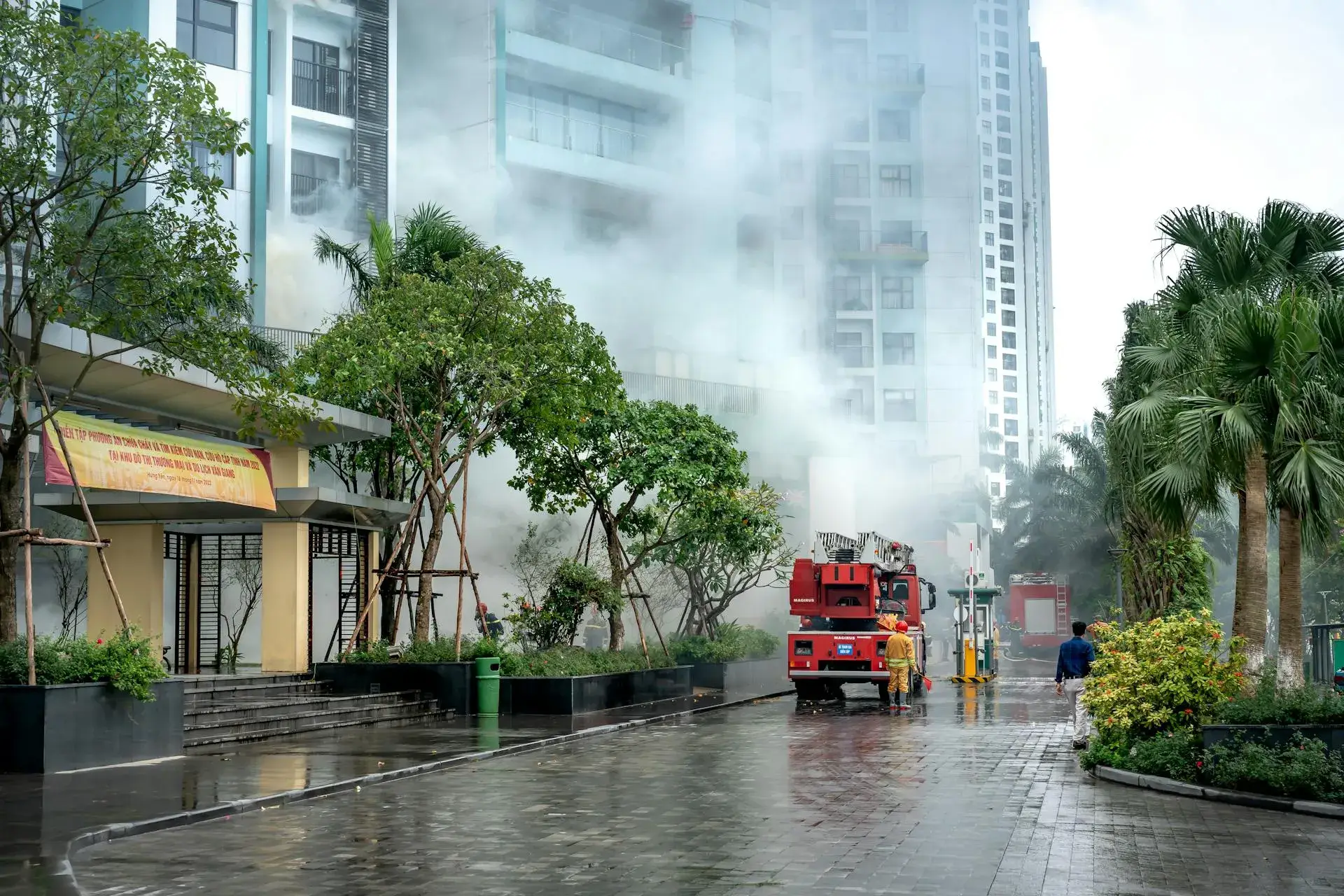
Smoke Damage Restoration in Evanston, IL
Smoke residue continues damaging surfaces and embedding odor every hour it remains untreated. Our local team provides professional smoke cleanup and HVAC decontamination for Evanston homes.
What Happens When You Call
A real person answers. We ask about the smoke source, when it occurred, and what you are experiencing. We begin coordinating your assessment immediately.
Our team arrives to test air quality, identify the smoke type, evaluate HVAC contamination, and map the extent of residue throughout the home including the basement.
HVAC system shut down to stop redistributing particles. Air scrubbers deployed. Building envelope sealed if the smoke source is external. Contamination contained to prevent further spread.
Surface cleaning, deodorization, and HVAC decontamination begin. Restoration plan documented with scope of work and insurance documentation prepared from day one.
You can smell smoke in your home and it is not going away. Maybe a fire broke out in the apartment next door. Maybe wildfire haze settled into your HVAC system during a bad air quality day. Maybe your furnace or boiler misfired and sent oily soot through the house. Whatever the source, the smell is getting worse and surface cleaning is not working. X Response exists for exactly this situation. We identify the smoke type, find where it has penetrated, and eliminate it at the source. Call now. We can help.
Why Evanston Homes Are Vulnerable to Smoke Damage
Smoke damage is distinct from fire damage because it can happen without any fire on your property. A fire in the apartment next door pushes smoke through shared walls and stairwells. Canadian wildfire haze settles over the lakefront for days. A furnace or boiler puffback sends oily soot through the house. In each case, the homeowner ends up with smoke contamination throughout the home without a single flame ever touching their structure. That distinction matters for insurance, for the restoration approach, and for understanding why the damage is often worse than it looks.
Evanston's housing stock makes smoke damage particularly hard to address. This is a dense, mature lakefront city where century-old single-family homes sit beside two-flats, vintage courtyard apartment buildings, and high-rises, and where finished plaster, lath, and original woodwork hold odor far longer than modern drywall. Many homes distribute smoke through forced-air ducts; many older ones spread it through open balloon-frame wall cavities and grand staircases instead. On top of that, the Chicago lakefront has absorbed several severe wildfire smoke events in recent years, turning what used to be a rare concern into a recurring one for North Shore homeowners.
Canadian Wildfire Smoke Events
The Chicago lakefront absorbed severe wildfire smoke episodes in late June 2023, when the region recorded some of the worst air quality on Earth and Evanston closed its beaches as a precaution, and again in June 2025, when the Illinois EPA declared air pollution action days. Fine particulate matter from Canadian wildfires traveled hundreds of miles south and lingered over Cook County for days. During these events, smoke infiltrates homes through HVAC fresh air intakes, building envelope gaps, and open windows. Extended exposure leaves a fine gray residue on surfaces, coats ductwork, and embeds odor in porous materials. Homes that ran their HVAC during these events pulled contaminated outdoor air straight into the system.
Puffbacks in Older Furnaces and Boilers
A puffback occurs when a gas or oil heating system misfires, sending a burst of soot and combustion byproducts into the home. Evanston's older housing runs a wide mix of equipment, from forced-air furnaces to the gas and oil-fired boilers still serving many century-old homes, and aging systems are more prone to the dirty burners, delayed ignition, and cracked components that trigger a puffback. In a forced-air home the soot blasts through every duct; in a boiler-heated home it spreads from the mechanical room outward. Either way a single event can coat walls, ceilings, furniture, and clothing in greasy black residue. Puffbacks cluster at the start of heating season, when systems fire up after months idle.
Smoke Transfer Between Attached Units
In Evanston's many two-flats, courtyard apartment buildings, and high-rises, a fire in one unit becomes a smoke problem for every connected unit. Smoke and soot travel through shared wall cavities, common stairwells, and the gaps around shared plumbing and electrical chases. A 2020 high-rise fire on Chicago Avenue started in one unit but damaged multiple apartments through smoke and water even though a sprinkler held the flames. The neighbors may have no fire damage at all, yet their surfaces, any ductwork, and belongings are coated in residue and saturated with odor. Restoration in attached housing requires tracing where the smoke actually settled, not just cleaning the rooms nearest the shared wall.
Old Construction Spreads Smoke Through Hidden Pathways
In a newer home a forced-air system is the main way smoke travels. In Evanston's century-old houses, smoke also moves through the building itself: open balloon-frame wall cavities that run floor to floor, grand open staircases, gravity-duct chases, and the gaps around old pipe and wire runs. A puffback or a small contained fire in one room can deposit residue two floors away through these concealed routes. This is why surface cleaning alone so often fails in older Evanston homes, and why a thorough assessment has to map where smoke physically traveled before any cleaning starts.
Plaster, Lath, and Historic Woodwork Trap Odor
Older Evanston homes are finished in plaster over wood lath, with hardwood floors, trim, and built-ins that are far more porous than painted drywall. Smoke odor molecules absorb deep into these materials and into the old-growth framing behind them, and they keep releasing odor for months unless the surfaces are properly treated or sealed. The same historic detail that gives these homes their character makes them hold smoke odor stubbornly. Effective restoration has to reach the odor where it settled inside porous materials, not just wipe the visible surface, while protecting the irreplaceable woodwork.
Dense Lots and Mixed-Use Corridors
Evanston is built tight, with homes close together and residential blocks sitting near busy commercial and mixed-use corridors like Howard Street, Main Street, and the downtown core. A fire in a neighboring building, a restaurant, or a ground-floor business can push smoke into nearby and overhead apartments and homes. A November 2024 commercial fire on Howard Street is one example of how quickly heavy smoke can affect a dense block. When the source is next door rather than inside your own walls, the contamination is just as real and the cleanup just as involved, which is why documenting the outside source matters for your claim.
The common thread across all these scenarios is that smoke travels far beyond where it started, then settles into the hidden parts of an older home. Forced-air ducts, balloon-frame cavities, open staircases, plaster, and historic woodwork all store residue and odor where surface cleaning cannot reach, and they keep releasing it long after the original event. Effective smoke damage restoration in Evanston has to treat those concealed pathways and porous materials as the primary problem, and in attached homes it has to account for the shared spaces that carried smoke across unit lines. Without that, no amount of surface cleaning will permanently resolve the odor.
What Happens to Your Home While You Wait
First 24 Hours
Soot particles settle on every horizontal surface. Acidic residue begins chemically reacting with metals, plastics, and painted surfaces. Smoke odor molecules begin absorbing into porous materials: carpet, upholstery, curtains, clothing, and the plaster and woodwork common in older homes. Any HVAC system keeps circulating contaminated air if it is not shut down.
24–72 Hours
Soot residue permanently stains light-colored walls, ceilings, and fabrics. Metal fixtures and appliance surfaces begin pitting from acidic compounds. Odor penetrates deeper into wall cavities, plaster, and carpet padding. Items that could have been cleaned on the first day may now require replacement.
1 Week
Permanent discoloration on porous surfaces. Smoke odor fully embedded in plaster, lath, and structural materials. Ductwork and concealed cavities coated with residue that will release odor with every heating cycle. Restoration requires more aggressive techniques and longer treatment times. Costs climb as more materials become unsalvageable.
2+ Weeks
Odor becomes part of the structure itself. Carpet, padding, and soft furnishings likely require replacement rather than cleaning. Walls may need sealing with specialty primers before repainting. Smoke-saturated systems may require component replacement rather than cleaning alone. What started as a cleaning project becomes a partial renovation.
The sooner smoke residue is addressed, the more of your home and belongings can be saved through cleaning rather than replacement. Contact X Response now. Early intervention saves time, money, and your possessions.
How We Restore Smoke-Damaged Evanston Homes
Smoke damage restoration requires identifying the smoke type, tracing its pathways through the home, and eliminating residue and odor at the source, not just on visible surfaces.
Emergency Assessment and Air Quality Testing
Our team tests indoor air quality for particulate matter and volatile organic compounds, inspects every room for visible and invisible residue, and evaluates any HVAC system for contamination. We identify the type of smoke residue present, because the cleaning approach differs fundamentally: dry soot from wildfire requires different techniques than oily puffback residue or protein smoke from a kitchen fire. In Evanston homes, we always inspect the basement, ductwork, and the concealed pathways old construction creates even when the smoke source was external, and in attached units we extend the inspection to shared walls and stairwells.
Source Identification and Containment
Before cleaning begins, we identify how smoke entered the building and contain the affected areas to prevent cross-contamination during restoration. For wildfire impingement, that means sealing HVAC intakes and closing building envelope gaps. For puffbacks, we isolate the furnace or boiler and shut down any forced-air system to stop redistribution. For smoke that crossed from an adjacent unit, we locate the shared pathways it traveled and seal them. Air scrubbers with HEPA filtration are placed throughout the home to begin reducing airborne particulate immediately while we prepare for surface cleaning.
Surface Cleaning and Residue Removal
Every surface in the affected area is cleaned using techniques matched to the specific smoke type. Dry wildfire soot is removed with HEPA-filtered vacuums and dry chemical sponges to avoid smearing. Oily puffback residue requires specialized solvents and degreasing agents. Protein residue from kitchen fires demands enzymatic cleaners. Hard surfaces, walls, ceilings, and historic trim are cleaned systematically from top to bottom with methods chosen to protect original woodwork and plaster. Porous materials like carpet, upholstery, and drapes are evaluated for salvageability, cleaned on site or sent to a specialized facility when recoverable, and inventoried for your insurance claim when they are not.
Specialized Deodorization
Surface cleaning removes visible residue, but smoke odor molecules penetrate deep into wall cavities, plaster, insulation, and porous woodwork where wiping cannot reach. Our team uses thermal fogging, which sends heated deodorizing agents along the same pathways smoke originally traveled, reaching behind walls and inside structural cavities. Hydroxyl generators produce radicals that break down odor molecules at the molecular level and are safe for occupied spaces. For severe contamination in unoccupied areas, ozone treatment oxidizes odor compounds. Where penetration is deep, surfaces may be sealed with shellac-based primers before repainting to lock in any residual molecules.
HVAC Cleaning and Final Air Quality Verification
This is the step that separates professional restoration from DIY cleaning. Where a home has forced-air heating or cooling, the entire system is decontaminated: all supply and return ductwork, the air handler, evaporator coils, blower assembly, and filter housing. Residue is removed mechanically and chemically, and the system is sealed and verified before being returned to service. In boiler-heated homes we focus on the concealed cavities and porous materials that carried and absorbed the smoke instead. After all cleaning and deodorization is complete, a final air quality test confirms that particulate and VOC levels have returned to safe ranges, and a walkthrough with you ensures everything meets our standards and yours.
The X Response Difference
Smoke damage restoration is not surface cleaning. It is identifying how smoke traveled through your home, where it deposited residue, and eliminating it at every point along that pathway, including inside the ductwork, the plaster and woodwork, and the shared spaces that connect every room. That is what X Response delivers.
Insurance Claim Guidance for Evanston Homeowners
Smoke damage coverage depends on the source of the smoke. Damage from a neighbor's fire, including a fire in an adjacent two-flat, apartment, or condo unit, is typically covered under your standard homeowner's policy because it falls under the fire peril even though no fire occurred in your unit. Furnace and boiler puffbacks are generally covered as sudden and accidental mechanical failures. Wildfire smoke impingement is where coverage becomes less certain: some Illinois policies cover it explicitly under the fire peril, others require the smoke to originate from a specific covered event, and some exclude gradual environmental exposure. In Evanston's two-flats, condos, and apartment buildings, a condo association master policy and individual unit-owner policies may both come into play, which makes clear documentation even more important.
How X Response Helps
- Identify and document the smoke source clearly, which determines which coverage provision applies
- Provide air quality test results showing contamination levels before and after restoration
- Document the full extent of contamination including HVAC system, basement, plaster cavities, and shared spaces in attached units, which are often overlooked in initial claims
- Align our restoration scope with standard insurance coverage categories and Xactimate formatting
- Help you understand your specific policy language regarding smoke damage before you file
X Response does not file claims on your behalf, adjust claims, or make coverage determinations. We provide documentation and guidance to help you make informed decisions about your property and your policy. Coverage decisions are made solely by your insurance carrier.
Certified Restoration Specialists Serving Evanston
When you contact X Response for smoke damage in Evanston, your restoration team is drawn from certified professionals who work throughout the North Shore and northern Cook County and understand the specific challenges of restoring older lakefront homes. They know how to identify different smoke types by sight and smell. They know that wildfire particulate behaves differently than furnace puffback residue. They understand that in century-old Evanston homes the smoke hides in plaster, balloon-frame cavities, and ductwork, and that in attached two-flats and condos the shared walls and stairwells have to be part of the solution.
Every technician holds current IICRC certification in fire and smoke restoration with specialized training in odor control and HVAC decontamination. Equipment includes air quality monitors for particulate and VOC testing, HEPA-filtered soot removal systems, thermal foggers, hydroxyl generators, ozone generators, and professional duct cleaning systems capable of reaching every branch of a residential forced-air system.
In Evanston, X Response works with Scene Cleaners, an independent local restoration partner serving Cook County County.
Smoke Damage Restoration FAQ for Evanston Homeowners
Other Emergency Services in Evanston

Water Damage Restoration
Burst pipes, storm flooding, standing water. We extract, dry, and restore before mold sets in.
Learn more
Fire Damage Restoration
Structural damage, soot, debris. We stabilize, clean, and rebuild what fire destroyed.
Learn more
Mold Remediation
Testing, containment, removal, prevention. We find the source, eliminate the growth, and stop it from returning.
Learn more
Sewage Cleanup
Sewer backups, contaminated water, biohazard. We extract, sanitize, and restore safely.
Learn more