
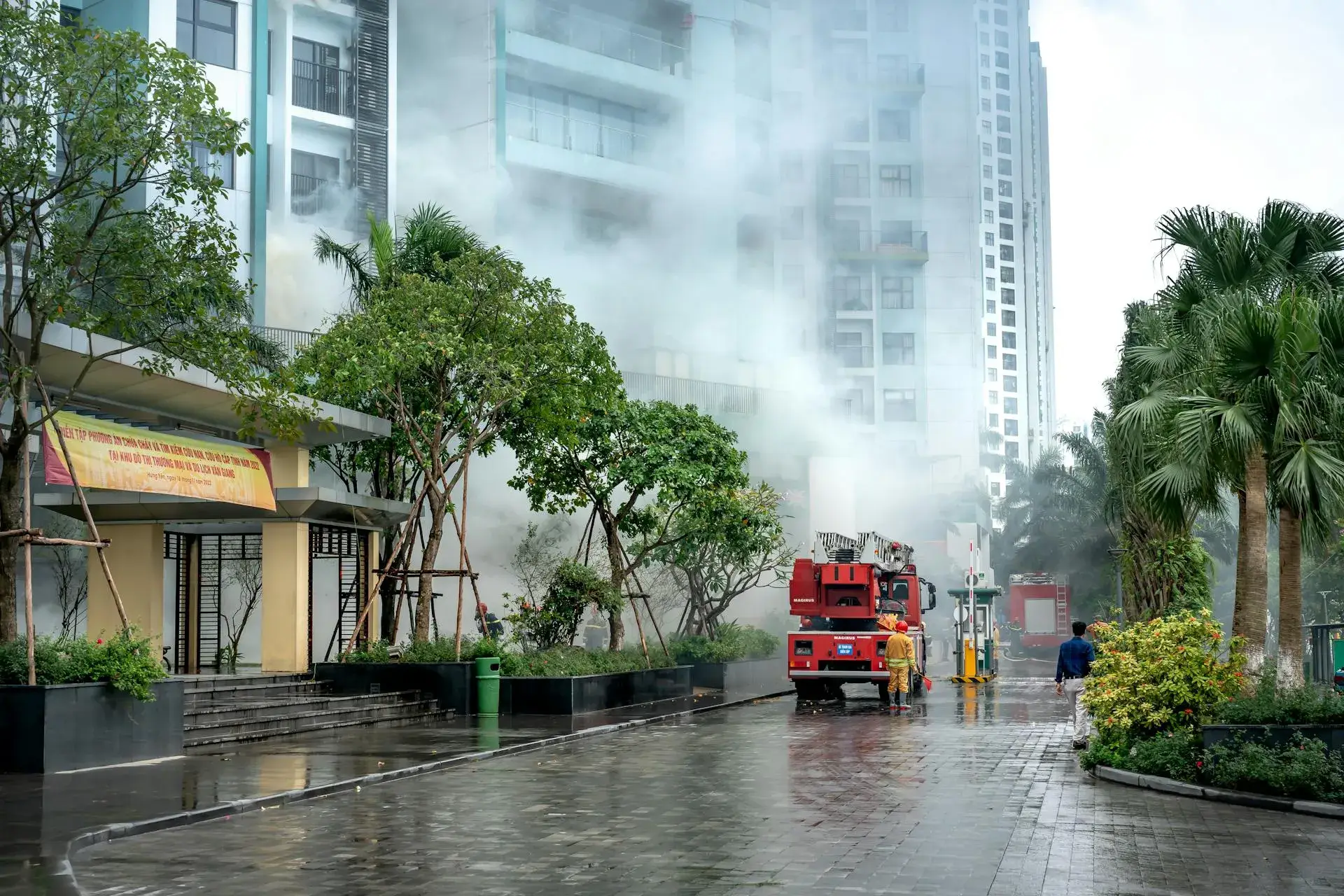
Smoke Damage Restoration in Wilmette, IL
Smoke residue bonds to surfaces within hours and becomes permanent within days. Our local team responds to Wilmette smoke damage emergencies within 60 minutes to prevent irreversible staining and odor penetration.
What Happens When You Call
A real person answers, not a call center. We assess your situation, identify the smoke source type, and begin coordinating your response immediately.
Your dedicated restoration team is dispatched from our local base serving Wilmette and the surrounding North Shore communities.
Team arrives with HEPA air scrubbers, soot removal equipment, and odor neutralization systems. Assessment and emergency cleaning begin immediately.
Affected surfaces identified and cleaned, air quality restored, odor sources neutralized. You know exactly what comes next.
Whether from a structure fire down the street, a furnace malfunction in your own basement, or a regional wildfire smoke event that penetrated your home, smoke damage is time-sensitive. Every hour that soot and smoke residue remain on surfaces, they bond more deeply, stain more permanently, and become more difficult and expensive to remove. X Response exists for exactly this moment. When you reach out, your restoration team is mobilized within minutes and on site within the hour. Call now. Your team is standing by.
Why Wilmette Homes Are Vulnerable to Smoke Damage
Wilmette is a village of 28,170 residents on Chicago's North Shore, located in Cook County with Lake Michigan as its eastern boundary. The village's residential character is shaped by its pre-war housing stock: homes built from the 1880s through the 1940s with balloon-frame construction, plaster-and-lath walls, and gravity-fed or early forced-air heating systems, alongside mid-century and newer homes with modern HVAC. This mix of construction eras creates a community where smoke damage arrives from multiple sources and affects structures in fundamentally different ways depending on their age and mechanical systems. Structure fires in the dense North Shore development expose adjacent homes to smoke even when flames never reach them. Aging heating systems in older homes produce furnace puffbacks that distribute soot throughout the living space in seconds. And regional atmospheric events can push particulate matter into thousands of homes simultaneously.
On June 27, 2023, smoke from unprecedented Canadian wildfires pushed the Air Quality Index across the entire Chicago metropolitan area into the Very Unhealthy range, with AQI readings exceeding 200 at monitoring stations across Cook County. Chicago recorded the worst air quality of any major city in the world that day, surpassing cities in India and Southeast Asia that routinely experience severe pollution. The event continued through June 28, with the entire state of Illinois under an air quality alert. For Wilmette residents, the visible haze and acrid smell were unmistakable, but the less visible impact was particulate infiltration into homes. Fine particulate matter (PM2.5) from wildfire smoke is small enough to penetrate building envelopes through every gap, crack, and ventilation opening. Homes that ran HVAC systems during the event pulled smoke-laden outdoor air through fresh-air intakes and distributed it through ductwork to every room. Homes with older construction and more air infiltration points experienced higher interior particulate levels than tightly sealed newer construction.
The June 2023 Canadian Wildfire Smoke Event
The June 2023 wildfire smoke event was unprecedented in scale for the Chicago region. Canadian wildfires burning across Quebec and Ontario produced a smoke plume that descended over the Great Lakes and Upper Midwest beginning June 25, with conditions deteriorating sharply on June 27 when winds shifted to carry the densest concentrations directly over the metropolitan area. AQI readings at Cook County monitoring stations exceeded 200 (Very Unhealthy), a level at which all individuals, not just sensitive groups, are advised to avoid outdoor exposure. The Illinois EPA issued air quality action days and the event received national media coverage. For Wilmette homes, the smoke event lasted approximately 48 hours at its worst, long enough for fine particulate matter to infiltrate building envelopes, deposit on interior surfaces, embed in soft furnishings, and contaminate HVAC systems. Homes that operated their air conditioning during the event circulated smoke-laden air through the entire duct system, depositing a fine layer of particulate on every surface served by a register. The event demonstrated that smoke damage to homes does not require a local fire; distant events hundreds of miles away can produce indoor contamination requiring professional remediation.
Furnace Puffbacks in Pre-War Heating Systems
A furnace puffback occurs when an oil or gas furnace fails to ignite properly, allowing unburned fuel to accumulate in the combustion chamber before a delayed ignition produces a small explosion that blows soot backward through the heat exchanger and into the supply ductwork. The soot is then distributed to every room in the house through the heating registers in a matter of seconds. In Wilmette's older homes, the risk of puffback events is elevated because many still operate on heating systems installed decades ago or use replacement systems connected to original ductwork that was designed for earlier furnace types. Oil-fired furnaces, while less common than they once were, remain in some of Wilmette's oldest homes and are particularly prone to puffback when ignition components deteriorate. Gas furnaces can also puff back when flame sensors, igniters, or gas valves malfunction. The result is a layer of oily, black soot deposited on walls, ceilings, furnishings, and every surface in every room connected to the duct system. Puffback soot has a petroleum or combustion-product base that makes it particularly difficult to remove from porous surfaces and textiles, and it produces a persistent chemical odor that standard cleaning cannot eliminate.
Neighbor-Fire Smoke Exposure on Compact Lots
Wilmette's residential lots are compact by suburban standards, with homes often positioned 10 to 15 feet apart, especially in the older neighborhoods east of Ridge Road where development occurred in the early 1900s. When a structure fire occurs in one home, the adjacent properties experience significant smoke exposure even if flames never spread. Smoke travels with the prevailing wind and infiltrates neighboring homes through open windows, gaps around window and door frames, soffit vents, and foundation penetrations. The 2016 cluster of six house fires in five weeks during the summer exposed multiple adjacent homes to secondary smoke damage that required professional assessment and cleaning. For homeowners, the exposure may not be immediately obvious: smoke odor develops over the days following the event as residues warm in sunlight, off-gas from absorbed surfaces, and circulate through HVAC systems that pulled in contaminated air during the fire. Many homeowners do not realize their home has been smoke-damaged by a neighbor's fire until they notice persistent odors days or weeks later, by which point the residue has bonded more deeply to interior surfaces.
Smoke Behavior in Balloon-Frame and Plaster-and-Lath Construction
Smoke travels differently through pre-war Wilmette homes than through modern construction. In balloon-frame homes (built before roughly 1930), the open stud bays that run from basement to attic act as vertical chimneys that draw smoke upward through the wall system. A puffback event or basement fire produces visible soot at first-floor registers, but the smoke also travels upward through the walls to contaminate attic spaces and upper-floor cavities that are not connected to the duct system. In homes with plaster-and-lath walls, the plaster surface prevents visual inspection of the wall cavity, meaning smoke contamination behind the walls can go undetected until odors persist despite surface cleaning. Plaster itself is a porous cementite material that absorbs smoke compounds and releases them slowly over time, producing ongoing odor even after surface soot is removed. Professional smoke restoration in these homes must account for contamination within wall cavities and behind plaster surfaces, not just on the visible exposed faces of rooms.
HVAC Distribution and Whole-House Contamination
Both forced-air heating systems and central air conditioning distribute smoke throughout a home by pulling contaminated air through the return system and pushing it through supply ductwork to every room. In Wilmette homes with older HVAC systems, the ductwork itself is often unlined sheet metal that has accumulated decades of dust and debris; when smoke passes through this ductwork, particles adhere to the existing buildup and create a sustained source of odor and particulate release that continues with every heating or cooling cycle long after the original smoke event. Modern homes with high-efficiency filters capture some particulate before it reaches the supply side, but older systems with minimal filtration (standard 1-inch fiberglass filters) allow the majority of smoke particles to pass through and deposit downstream. Comprehensive smoke restoration in Wilmette homes requires ductwork inspection and cleaning, register removal and cleaning, filter replacement, and in some cases treatment of the HVAC equipment itself (blower housing, evaporator coil, heat exchanger surfaces) to eliminate the smoke-contaminated reservoir that continues to re-contaminate the air supply.
Smoke damage in Wilmette comes from three distinct source categories, each requiring a different restoration approach. Structure fire smoke (from your own home or a neighbor's) produces heavy soot deposits and requires aggressive cleaning with specialized techniques matched to the soot chemistry. Furnace puffbacks distribute petroleum-based soot through the entire HVAC system and require both surface cleaning and ductwork decontamination. Regional wildfire smoke events produce fine particulate infiltration that affects soft furnishings, HVAC systems, and porous surfaces throughout the home. In all three cases, Wilmette's pre-war construction provides more pathways for smoke migration, more porous surfaces for smoke absorption, and more hidden cavities where contamination persists than modern homes. Effective restoration must address not just visible soot on exposed surfaces but also the contamination embedded in wall cavities, ductwork, plaster, and soft materials that continue releasing odor and particulate long after the source event ends.
What Happens to Your Home While You Wait
Within 1 Hour
Fresh soot particles sit loosely on surfaces and can be removed relatively easily with proper dry-cleaning methods. Smoke odor is noticeable but has not yet penetrated deeply into porous materials. HVAC systems that were running during the event continue distributing particles to new surfaces. This is the window where professional intervention preserves the most material and minimizes cost. In Wilmette homes with balloon-frame construction, smoke is already traveling through wall cavities to upper floors.
1–24 Hours
Soot begins bonding chemically to surfaces through a process called charge attraction. Acidic smoke residues start etching metal finishes, discoloring plastics, and staining light-colored surfaces. Smoke odor penetrates into fabric upholstery, carpeting, clothing, and soft furnishings. Plaster walls begin absorbing volatile compounds from the smoke that will later off-gas as persistent odor. The line between surfaces that can be cleaned in place and those requiring replacement begins to shift.
24–48 Hours
Permanent staining sets into porous surfaces including unfinished wood, natural stone, and grout. Smoke residue on metal surfaces (chrome, nickel, copper, brass) begins producing visible corrosion. Odor compounds penetrate deeply into carpet padding, mattresses, and upholstered furniture, often beyond the point where cleaning can fully restore them. In homes where HVAC continues operating without filter replacement, the system redistributes particles continuously, expanding the contaminated area.
48–72 Hours
Chemical bonding between soot and surfaces becomes aggressive. Cleaning that would have restored a surface at 12 hours now requires abrasive methods that may damage the underlying finish. Smoke odor becomes embedded in structural materials: plaster, wood framing, subfloor sheathing. Soft contents that could have been cleaned professionally now require disposal. Restoration scope and cost escalate substantially as the window for non-destructive cleaning closes.
One Week and Beyond
Smoke compounds fully penetrate porous building materials. Surface cleaning alone cannot resolve the odor because the source is within the material itself. Thermal fogging, ozone treatment, or sealant encapsulation becomes necessary for structural surfaces. Many soft contents are unsalvageable. HVAC ductwork that was not cleaned continues acting as a reservoir, re-contaminating spaces as the system cycles. The project shifts from cleaning to a combination of cleaning, sealing, and selective material replacement.
The difference between cleaning smoke damage and living with permanent staining and odor is measured in hours, not days. Contact X Response now. Our Wilmette team responds within 60 minutes.
How We Restore Smoke-Damaged Wilmette Homes
From the moment our team arrives, every step is documented, measured, and verified. Here is exactly what the smoke damage restoration process involves for Wilmette properties.
Source Identification and Damage Assessment
Our team identifies the smoke source type because it determines the chemistry of the residue and the cleaning methods required. Structure fire smoke, furnace puffback soot, and wildfire particulate each have different chemical compositions and behave differently on surfaces. We assess every room, inspect HVAC ductwork, check inside wall cavities where accessible, and evaluate the contamination level of soft contents (furniture, clothing, bedding). In Wilmette's pre-war homes, we inspect balloon-frame wall cavities and attic spaces where smoke migrates through open stud bays. Thermal imaging can reveal temperature differentials that indicate air movement pathways where smoke traveled. Every affected area is documented with photos and a written scope for your insurance claim.
Air Quality Restoration
HEPA air scrubbers are deployed immediately to begin reducing airborne particulate. These units filter particles down to 0.3 microns, capturing the fine soot and smoke particles that remain suspended in indoor air and continue depositing on surfaces. Activated-carbon filtration stages address volatile organic compounds that produce smoke odor. In homes where the HVAC system distributed smoke throughout the house, we shut down the system, seal registers, and rely on the portable air scrubbers until the ductwork can be properly cleaned. For homes affected by the June 2023 wildfire smoke event or similar atmospheric intrusions, air quality restoration begins with sealing the building envelope against further infiltration before cleaning what has already entered.
Surface Cleaning and Soot Removal
Professional soot removal uses dry-cleaning methods first (chemical sponges, dry vacuuming with HEPA filtration) to remove loose particles without smearing or driving them deeper into surfaces. Wet cleaning follows only after dry particulate is removed, using cleaning agents matched to the soot type: alkaline cleaners for protein-based smoke, solvent-based cleaners for petroleum soot from puffbacks, and surfactant-based cleaners for general combustion residue. In Wilmette homes with plaster walls, cleaning must be gentle enough to avoid damaging the plaster surface while thorough enough to remove bonded soot. Original woodwork, hardwood floors, and built-in cabinetry require product testing on inconspicuous areas before full-surface application to confirm the cleaner will not damage the finish. Every surface in the affected area is cleaned systematically: ceilings first, then walls top-to-bottom, then horizontal surfaces, then floors. This sequence prevents re-contamination of cleaned lower surfaces from above.
HVAC Decontamination
If the smoke source was internal (puffback or structure fire) or if the HVAC system operated during an external smoke event, the entire duct system requires professional cleaning. We remove all registers and clean them individually. Supply and return ductwork is accessed through service openings and cleaned using negative-air vacuum equipment that prevents dislodged particulate from entering living spaces. The blower housing, evaporator coil, and accessible heat exchanger surfaces are cleaned and inspected. All filters are replaced. In Wilmette homes with older unlined sheet-metal ductwork, decades of accumulated dust mixed with smoke residue creates a stubborn buildup that requires mechanical agitation combined with vacuum extraction. The system is not restarted until we confirm that operating it will not redistribute contamination.
Odor Neutralization and Verification
After all surfaces and systems are cleaned, residual odor embedded in porous materials is addressed through one or more neutralization methods depending on severity. Hydroxyl generators produce hydroxyl radicals that break down odor-causing molecules at the molecular level and are safe for use in occupied spaces with contents in place. Thermal fogging disperses a deodorizing agent as a heated vapor that penetrates the same pathways smoke originally followed, reaching into wall cavities, behind trim, and into material pores. For severe cases, ozone generators may be deployed in sealed, unoccupied spaces to oxidize stubborn compounds. We verify results by monitoring air quality and odor levels after treatment, with additional cycles applied if thresholds are not met. The job is not complete until odor is neutralized, not merely masked.
The X Response Difference
When you contact X Response for smoke damage in Wilmette, you get a team that addresses the complete contamination, not just the visible soot. Surface cleaning, HVAC decontamination, embedded-odor treatment, and air quality verification, all managed by one team with one standard.
Insurance Claim Guidance for Wilmette Homeowners
Smoke damage insurance coverage depends on the source of the smoke and how it reached your home. If the smoke originated from a covered peril on your own property (a fire, an appliance malfunction, a furnace puffback), your standard homeowner's policy typically covers the cleaning, restoration, and replacement of damaged contents. If smoke entered your home from a neighbor's fire, your own policy covers the damage to your property under your dwelling and contents coverage, though you may also have a claim against the neighbor's liability coverage depending on circumstances. Wildfire smoke events present a more complex coverage question. While wildfire is a named peril, damage from atmospheric smoke infiltration (where no fire occurred on or near your property) occupies a gray area that carriers interpret differently. Some classify it as environmental contamination, others as smoke damage from a covered peril occurring elsewhere. Documentation of the specific event, the measured indoor contamination, and the required remediation is critical for wildfire-smoke claims.
How X Response Helps
- Document all smoke-affected surfaces and contents with photos and a professional damage assessment before any cleaning begins
- Identify and document the smoke source clearly, as structure fire, furnace puffback, neighbor-fire exposure, and wildfire infiltration each trigger different coverage analyses
- Inventory all affected personal property with pre-loss condition documentation where available
- Provide air quality measurements before and after treatment to demonstrate the contamination level and the effectiveness of remediation
- Maintain a clear connection between the documented smoke source and every remediation activity in the scope of work
X Response does not file claims on your behalf, adjust claims, or make coverage determinations. We provide documentation and guidance to help you make informed decisions about your property and your policy. Coverage decisions are made solely by your insurance carrier.
Certified Restoration Specialists Serving Wilmette
When you contact X Response for smoke damage restoration in Wilmette, your team is drawn from certified professionals who work across the North Shore and understand how smoke behaves differently in pre-war construction than in modern homes. They know how balloon-frame wall cavities channel smoke between floors, how plaster absorbs volatile compounds and releases them as persistent odor, how aging HVAC systems with minimal filtration distribute soot to every register, and how the compact lot spacing in Wilmette's older neighborhoods exposes adjacent homes to smoke from a neighbor's fire. They have remediated furnace puffback events that coated entire homes in petroleum-based soot, cleaned secondary smoke damage from structure fires at adjacent properties, and addressed indoor particulate contamination from regional wildfire events. This is not a general cleaning crew guessing at products and methods. It is a restoration team that matches techniques to smoke chemistry and construction type.
Every technician on your team holds current IICRC certification in fire and smoke restoration and carries the appropriate Illinois state licensing for the work being performed. Equipment includes HEPA air scrubbers with activated-carbon VOC filtration, thermal foggers, hydroxyl generators, ozone equipment for unoccupied treatments, negative-air duct cleaning systems, and the full range of dry and wet cleaning tools required for different soot chemistries and surface types. For Wilmette homes with original plaster, period woodwork, and historic finishes, we carry testing products and specialty cleaners that remove soot without damaging underlying materials.
In Wilmette, X Response works with Scene Cleaners, an independent local restoration partner serving Cook County.
Smoke Damage Restoration FAQ for Wilmette Homeowners
Other Emergency Services in Wilmette

Water Damage Restoration
Burst pipes, storm flooding, standing water. We extract, dry, and restore before mold sets in.
Learn more
Fire Damage Restoration
Structural damage, soot, debris. We stabilize, clean, and rebuild what fire destroyed.
Learn more
Mold Remediation
Testing, containment, removal, prevention. We find the source, eliminate the growth, and stop it from returning.
Learn more
Sewage Cleanup
Sewer backups, contaminated water, biohazard. We extract, sanitize, and restore safely.
Learn moreNearby Service Areas
Also serving nearby: