
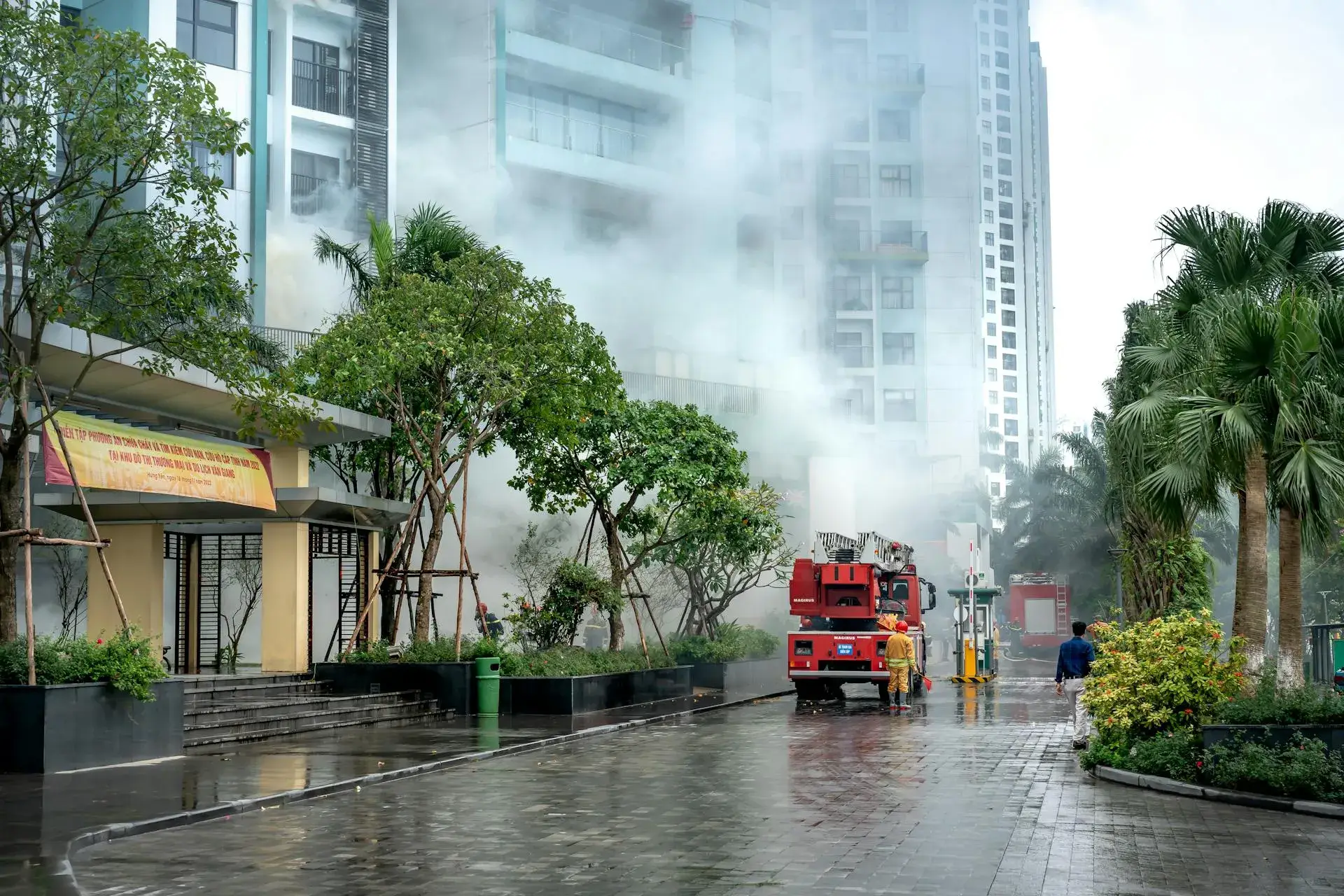
Smoke Damage Restoration in Aurora, IL
Smoke residue is acidic and corrosive, permanently damaging surfaces and degrading air quality with every hour it remains untreated. Our local team responds to Aurora emergencies within 60 minutes.
What Happens When You Call
A real person answers, not a call center. We assess your situation, ask the right questions, and begin coordinating your response immediately.
Your dedicated restoration team is dispatched from our local base serving Aurora and the surrounding Fox River Valley communities.
Team arrives with air quality monitoring equipment, HEPA filtration, and professional cleaning supplies. Assessment and mitigation begin immediately.
Damage assessed, cleaning protocol determined, air quality baseline established. You know exactly what the scope of work involves and the timeline to completion.
Smoke damage does not require a fire inside your home. Whether the source is a structure fire in your neighborhood, a wildfire smoke event blanketing the region, or a kitchen fire that filled your home with residue, the damage mechanism is the same: acidic particulates settle on surfaces, penetrate porous materials, and degrade air quality throughout the structure. X Response exists for exactly this moment. When you reach out, your restoration team is mobilized within minutes. From that point forward, one team manages everything: assessment, cleaning, odor elimination, and air quality verification. Call now. Your team is standing by.
Why Aurora Homes Are Vulnerable to Smoke Damage
Aurora is the second-largest city in Illinois with a 2020 Census population of 180,542, located along the Fox River approximately 40 miles west of downtown Chicago in Kane County. The city's geographic position in the western Chicago suburbs places it in the path of weather systems that move across the Midwest from the northwest, including the smoke plumes from Canadian wildfires that have repeatedly affected northern Illinois air quality in recent years. In late June 2023, smoke from hundreds of wildfires burning across Quebec and Ontario traveled south into the Great Lakes region, blanketing the Chicago metropolitan area, including Aurora and Kane County, in a thick haze that persisted for multiple days. The Chicago Tribune reported specifically on Aurora-area residents changing their daily routines in response to the poor air quality, with officials advising people to remain indoors, limit outdoor exertion, and close windows and doors. The Air Quality Index across northeastern Illinois reached 'very unhealthy' levels (AQI above 200) on June 27, 2023, a category in which all residents, not just sensitive groups, are advised to avoid outdoor activity. This was the worst air quality event in modern Chicago-area history, surpassing any previous industrial or traffic-related pollution episode.
The June 2023 event was not isolated. Canadian wildfire smoke returned to the Chicago region in June 2025, again triggering unhealthy air quality alerts across Kane County and the western suburbs. These recurring wildfire smoke events represent a relatively new category of smoke damage for Aurora homeowners. Unlike a structure fire that produces intense localized smoke exposure, wildfire smoke events expose the entire community simultaneously to fine particulate matter (PM2.5) over multiple days. The particles are small enough (2.5 micrometers or less) to bypass standard HVAC filters and infiltrate homes through every gap in the building envelope. For Aurora's older homes near downtown with original single-pane windows, uninsulated wall cavities, and gaps around utility penetrations, wildfire smoke infiltration is particularly significant. Even newer homes with tight construction are not immune, as HVAC fresh-air intakes draw contaminated outdoor air directly into the distribution system. The result is residue accumulation on interior surfaces, embedded odor in soft furnishings, and degraded indoor air quality that persists long after outdoor conditions improve.
The June 2023 Canadian Wildfire Smoke Event
In late June 2023, more than 450 wildfires burning simultaneously across Canada produced a smoke plume that traveled hundreds of miles south into the United States. The smoke reached northern Illinois on June 25 and persisted through June 29, creating multiple days of sustained poor air quality across the Chicago metropolitan area. On June 27, the AQI in the Chicago area reached the 'very unhealthy' category (201-300), a level at which the U.S. EPA recommends all individuals avoid prolonged outdoor exertion. Kane County, where the majority of Aurora lies, was included in the air quality alert zone. The Chicago Tribune reported specifically that Aurora-area residents modified their behaviors: outdoor workers were sent home early, recreational activities were cancelled, and residents who typically kept windows open in summer sealed their homes. The particulate matter from wildfire smoke is chemically distinct from urban pollution. It contains organic carbon compounds, trace metals, and volatile organic compounds from burning vegetation that leave residue on indoor surfaces, embed in soft materials, and create a persistent smoky odor that standard household cleaning does not remove. For homes where windows were left open during the early stages of the event, or where HVAC systems drew in contaminated air, the interior smoke load can approximate the exposure of a nearby brush fire.
Recurring Wildfire Smoke Seasons and Long-Term Exposure
The June 2023 event established a pattern that continued in subsequent years. In June 2025, Canadian wildfire smoke again reached the Chicago area, with state officials issuing another unhealthy air quality warning and the event being reported as extending through the week. NOAA research published in late 2024 documented that the 2023 Canadian wildfires generated record-breaking surface ozone pollution across the Upper Midwest, confirming that the air quality impact extended well beyond visible haze into measurable pollutant concentrations at ground level. For Aurora homeowners, this recurring pattern means repeated exposure to wildfire smoke infiltration. Each event deposits additional particulate on interior surfaces, embeds more odor compounds into soft furnishings and porous building materials, and loads HVAC filters and ductwork with fine particulate that standard maintenance does not fully remove. Homes that experienced infiltration in 2023 and were not professionally cleaned before the 2025 event accumulated a compounding residue load. The particles from wildfire smoke are so fine that they pass through standard MERV-8 furnace filters, meaning the HVAC system itself becomes a distribution mechanism, spreading contamination to every room it serves.
Neighbor and Community Fire Smoke Exposure
Beyond wildfire events, Aurora's density as the second-largest city in Illinois means residential structure fires regularly expose neighboring properties to smoke without direct flame contact. The June 2026 weekend saw three second-alarm fires within 24 hours across different Aurora neighborhoods. Each of these fires produced smoke plumes that affected adjacent homes, vehicles, and outdoor spaces. In Aurora's older neighborhoods near downtown where lot sizes are narrow and homes are separated by just a few feet, a structure fire next door can coat the exterior and infiltrate the interior of neighboring homes through open windows, HVAC intakes, and gaps in the building envelope. The smoke from residential structure fires contains particularly aggressive compounds from burning synthetic materials, plastics, and treated wood that produce heavier, more corrosive soot than wildfire smoke. Neighbors who were not directly involved in the fire often discover smoke odor in their homes days later as temperature changes cause embedded particles to off-gas from surfaces and soft materials.
Building Envelope Gaps and Smoke Infiltration Pathways
Aurora's multi-era housing stock creates vastly different smoke infiltration profiles. Homes in the historic districts near downtown, built in the 1850s through 1900s, have building envelopes characterized by single-pane windows (often with imperfect seals from decades of paint layers), uninsulated wall cavities that connect interior air directly to the outdoors through gaps at the sill plate and rim joist, original plaster with settling cracks, and utility penetrations that were never properly sealed. These homes allow outdoor smoke to enter through dozens of small pathways simultaneously. Mid-century homes from the 1950s and 1960s have tighter construction than Victorian-era homes but still feature leaky window assemblies, uninsulated band joists, and HVAC systems designed for air exchange rather than filtration. Modern homes on Aurora's far east and south sides are built to tighter energy codes with spray-foam insulation, sealed penetrations, and multi-pane windows, but they rely on mechanical fresh-air intakes for ventilation. During a wildfire smoke event, those intakes draw contaminated outdoor air directly into the home unless the system is switched to recirculation mode and the filter is upgraded to a minimum MERV-13 rating.
HVAC Distribution and Whole-Home Contamination
Virtually every home in Aurora relies on forced-air heating and cooling, which means the HVAC system serves as both a smoke distribution mechanism and a contamination reservoir. When smoke enters a home, whether from a wildfire event, a neighbor's fire, or a contained interior incident, the air handler draws smoke-laden air into the return system, passes it through a filter that captures only a fraction of fine particulate (standard MERV-8 filters capture less than 20 percent of PM2.5 particles), and distributes the remaining contamination to every room served by supply registers. The interior of the ductwork, the blower housing, the evaporator coil, and the filter rack all accumulate residue over time. When the next heating or cooling cycle begins, the system re-suspends settled particles and redistributes them. This is why smoke odor often seems to worsen when the furnace or air conditioner kicks on, even weeks after the original event. Professional smoke damage restoration in Aurora homes must include HVAC assessment and decontamination as a core step rather than an optional add-on.
Aurora's smoke damage exposure comes from three distinct sources: large-scale wildfire smoke events like June 2023 and June 2025 that infiltrate thousands of homes simultaneously, residential structure fires in the city's dense neighborhoods that expose adjacent properties, and interior smoke incidents from kitchen fires, electrical malfunctions, or heating system failures. Each produces different particulate chemistry and requires different cleaning approaches, but all share the same fundamental behavior: smoke migrates through buildings via air movement, settles on every surface, embeds in porous materials, and worsens with time if untreated. The HVAC system connects every room in the home to the contamination source, making whole-home treatment essential regardless of where the smoke originally entered.
What Happens to Your Home While You Wait
Within 1 Hour
Smoke particulate settles on all exposed surfaces including walls, ceilings, countertops, electronics, and personal items. Soot begins reacting with metal surfaces, causing tarnishing on chrome, brass, and steel fixtures. Smoke odor absorbs into soft furnishings, carpet fibers, drapes, and upholstered furniture. In Aurora homes with forced-air HVAC, the system distributes particulate to every room within minutes if it continues to operate. During a wildfire event, smoke entering through the building envelope continues to deposit particulate as long as outdoor concentrations remain elevated. The accumulation is constant and invisible at this stage.
1–24 Hours
Acidic soot compounds begin causing permanent discoloration on light-colored plastics, appliances, and painted surfaces. Metal fixtures and hardware develop visible tarnishing. Smoke residue migrates into fabric weave, carpet pile, and porous surfaces at a molecular level, making removal progressively more difficult. HVAC ductwork interior surfaces accumulate a film of fine particulate that will re-suspend with each system cycle. In Aurora's older homes with textured plaster walls and ceilings, soot embeds in the surface irregularities where it cannot be removed with simple wiping. What could be cleaned with dry methods in the first hours begins requiring chemical treatment.
24–72 Hours
Permanent staining develops on grout, natural stone, fiberglass fixtures, and unfinished wood. Smoke odor molecules undergo chemical bonding with porous substrates, transitioning from surface contamination to embedded saturation that requires thermal or chemical deodorization rather than surface cleaning. Corrosion on unprotected metals progresses beyond cosmetic tarnishing into pitting that cannot be polished away. Electronics and precision items suffer particulate infiltration that degrades performance and may void warranties. The boundary between 'cleanable' and 'requires replacement' advances steadily as hours pass. During multi-day wildfire smoke events like June 2023, homes receiving continuous infiltration over 72 or more hours accumulate damage equivalent to proximity exposure from a moderate fire.
One Week and Beyond
Smoke odor is deeply embedded in structural materials including drywall paper facing, wood framing, concrete, and insulation. Standard cleaning methods are no longer effective for odor removal; thermal fogging, hydroxyl treatment, or ozone protocols become necessary. HVAC systems have distributed and redistributed contamination throughout the home multiple times, embedding particulate in ductwork joints, the blower compartment, and the evaporator coil. Soft furnishings that could have been professionally cleaned in the first 48 hours now require replacement. In Aurora's older homes with original plaster and wood, smoke compounds have penetrated deeply enough that surface treatment alone cannot eliminate odor, potentially requiring encapsulant sealers on affected surfaces before they can be refinished.
Smoke damage is progressive and irreversible after a certain point. Materials that are cleanable today may require replacement next week. Contact X Response now. Our Aurora team responds within 60 minutes.
How We Restore Smoke-Damaged Aurora Homes
From the moment our team arrives, every step is documented, measured, and verified. Here is exactly what the smoke damage restoration process involves for Aurora properties.
Air Quality Assessment and Source Identification
Our team arrives with particulate monitoring equipment to measure current indoor air quality and establish a contamination baseline. We identify the smoke source (wildfire infiltration, neighbor's fire, interior incident) because the particulate chemistry varies and determines the cleaning approach. In Aurora homes affected by wildfire smoke infiltration, we assess which entry pathways allowed smoke into the structure, including windows, HVAC fresh-air intakes, gaps in the building envelope, and penetrations. For homes near a residential structure fire, we evaluate the direction of smoke travel and which sides of the property received the heaviest exposure. Source identification drives both the cleaning protocol and the insurance documentation, since coverage may differ between interior smoke events (typically covered) and environmental events like wildfire smoke (coverage varies by policy).
Containment and HVAC Isolation
Before cleaning begins, we isolate the HVAC system to prevent it from redistributing contamination during the cleaning process. The air handler is shut down, supply and return registers are sealed, and portable HEPA air scrubbers are positioned to provide negative air pressure in the most contaminated areas. This prevents cross-contamination from areas being cleaned into areas not yet addressed. In Aurora homes with finished basements connected to the same HVAC system as upper floors, isolation prevents smoke that settled in lower levels from being pushed upward during cleaning. We establish clean zones and work systematically from least contaminated areas toward the source to prevent re-contamination of already-cleaned spaces.
Surface Cleaning and Soot Removal
Professional soot removal begins with dry methods: HEPA vacuuming with soft-brush attachments for delicate surfaces and chemical dry sponges for walls and ceilings. Dry methods are critical as the first step because applying any liquid to soot pushes it into porous surfaces and creates permanent staining. After dry removal captures the majority of loose particulate, we proceed with wet chemical cleaning appropriate to each surface type. In Aurora's historic homes with original plaster, wood trim, and decorative elements, we use pH-neutral cleaners that remove soot without damaging irreplaceable materials. For modern drywall and painted surfaces, we use degreasing agents that cut through the oily component of smoke residue. Every surface in affected areas is addressed: walls, ceilings, trim, fixtures, cabinet interiors, closet interiors, and shelving.
Odor Elimination
Smoke odor cannot be masked. The molecules must be neutralized at a chemical level or they re-emerge when temperature and humidity change. We deploy thermal fogging to reach smoke molecules in concealed wall cavities, above ceilings, and inside enclosed spaces that cannot be physically accessed for surface cleaning. The fog particles are small enough to follow the same pathways smoke used to enter these spaces. Hydroxyl generators provide continuous odor treatment throughout occupied areas without requiring evacuation. For heavily saturated structures, ozone treatment (in unoccupied conditions) provides the most aggressive molecular breakdown of odor compounds. The treatment protocol is selected based on smoke density, material types present, and whether the home can be vacated during treatment. Verification testing after treatment confirms odor elimination before we consider the job complete.
HVAC Decontamination
The HVAC system receives dedicated cleaning as a required step rather than an optional service. We clean supply and return ductwork, the air handler blower assembly, the evaporator coil (which traps particulate in its condensate), the filter compartment, and all register and grille faces. For Aurora homes with ductwork routed through attic spaces or crawl spaces where additional contamination may have entered through gaps in the duct system itself, we inspect for duct damage and seal any breaches before re-commissioning. New high-efficiency filters (minimum MERV-13) are installed before the system is restarted. The system is then operated while portable particulate monitors verify that it is distributing clean air rather than residual contamination.
Verification and Completion
Before the project is considered complete, we conduct a final assessment including visual inspection of all cleaned surfaces, air quality measurement with particulate monitoring, and odor verification in multiple rooms and at different temperatures (since smoke odor can re-emerge when surfaces warm). Documentation includes before-and-after photos, air quality readings, a complete record of all cleaning methods and products used, and the scope of work summary your insurance company needs. If any area fails our quality check, we repeat treatment until it passes. There is no partial completion.
The X Response Difference
Smoke damage restoration requires more than surface cleaning. It demands understanding how smoke travels through a structure, where it settles, and how to reach and neutralize it at every point. When you contact X Response, you get a team that addresses the full contamination system rather than just the visible evidence.
Insurance Claim Guidance for Aurora Homeowners
Smoke damage insurance coverage in Illinois depends on the source of the smoke and how it entered your property. Smoke damage from a fire within your home or from a neighbor's fire that infiltrated your property is generally covered under the standard homeowner's fire peril. Smoke damage from environmental sources, including wildfire smoke events like the June 2023 Canadian wildfire episode that affected all of Kane County, presents a more complex coverage question. Some carriers treat environmental smoke infiltration as a covered event under 'smoke' as a named peril. Others classify it as air pollution and may limit or exclude coverage. The distinction often comes down to policy language and the carrier's interpretation of whether wildfire smoke that traveled hundreds of miles constitutes 'hostile fire smoke' or 'environmental contamination.' Aurora homeowners affected by the 2023 or 2025 wildfire smoke events should review their specific policy language with their agent before assuming coverage.
How X Response Helps
- Document all smoke damage with professional photos, air quality readings, and detailed scope of work from day one
- Identify the smoke source clearly, as interior fire, neighbor's fire, and environmental wildfire smoke each trigger different coverage considerations under Illinois policies
- Preserve physical evidence of contamination (soot samples, filter condition, photos of residue) before cleaning begins to support your claim
- Align restoration scope with standard insurance categories so your adjuster can process the claim efficiently
- Explain your policy's likely coverage based on the smoke source before you file, so you understand your options
X Response does not file claims on your behalf, adjust claims, or make coverage determinations. We provide documentation and guidance to help you make informed decisions about your property and your policy. Coverage decisions are made solely by your insurance carrier.
Certified Restoration Specialists Serving Aurora
When you contact X Response for smoke damage restoration in Aurora, your team is drawn from certified professionals who understand how smoke behaves in the diverse building stock across Illinois's second-largest city. They know how Aurora's Victorian-era homes with single-pane windows and uninsulated cavities allow environmental smoke to infiltrate at far higher rates than modern construction, how mid-century homes with original HVAC systems distribute contamination through aging ductwork with unsealed joints, and how even tight modern construction on the city's far east side is vulnerable through fresh-air intakes. They have restored homes after structure fires in the dense downtown neighborhoods, after kitchen fires in suburban subdivisions, and after the community-wide wildfire smoke events that blanketed Aurora and Kane County in 2023 and 2025. This is not a crew dispatched from hours away with no local context. It is a local team with local expertise, operating under national quality standards.
Every technician on your team holds current IICRC certification in fire and smoke restoration (FSRT) and carries the appropriate Illinois state licensing for the work being performed. Equipment includes HEPA air scrubbers, particulate monitoring instruments, thermal foggers, hydroxyl generators, ozone treatment units, professional duct-cleaning systems, and the full range of specialized soot-removal chemistry required for different surface types and residue compositions. When your team arrives, they bring the capability to assess, contain, clean, deodorize, and verify results without waiting for separate specialists or additional equipment mobilization.
In Aurora, X Response works with Scene Cleaners, an independent local restoration partner serving Kane County.
Smoke Damage Restoration FAQ for Aurora Homeowners
Other Emergency Services in Aurora
Water Damage Restoration
Burst pipes, storm flooding, standing water. We extract, dry, and restore before mold sets in.
Learn more
Fire Damage Restoration
Structural damage, soot, debris. We stabilize, clean, and rebuild what fire destroyed.
Learn more
Mold Remediation
Testing, containment, removal, prevention. We find the source, eliminate the growth, and stop it from returning.
Learn more
Sewage Cleanup
Sewer backups, contaminated water, biohazard. We extract, sanitize, and restore safely.
Learn more