
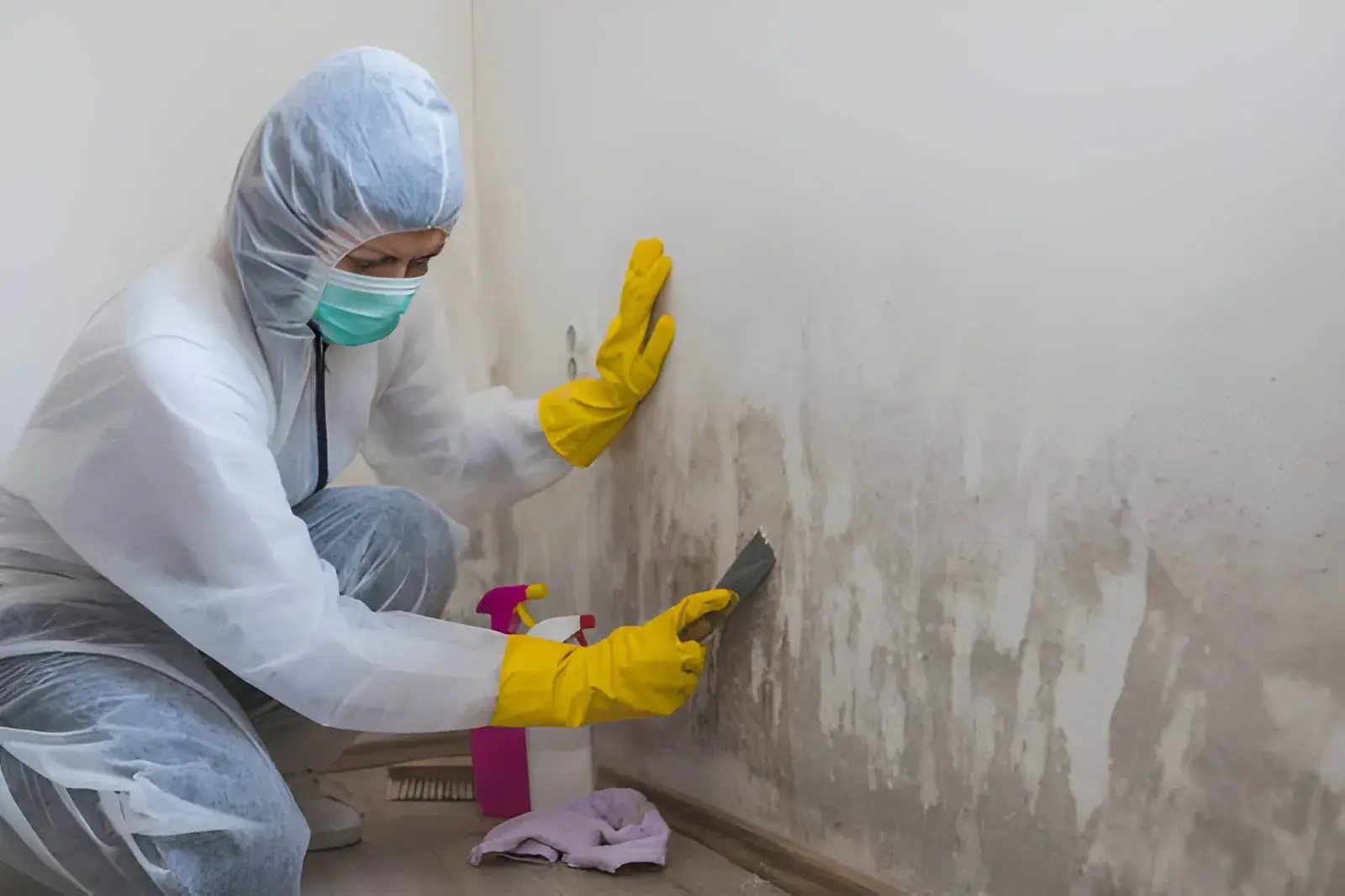
Mold Remediation in Orange City, FL
Mold spreads through wall cavities, under flooring, and into HVAC systems while remaining invisible from living spaces. In Orange City's subtropical humidity, a small moisture source becomes a large mold problem in days, not weeks. Professional assessment identifies the full scope.
What Happens When You Call
A real person answers your call. We discuss your observations, identify likely moisture sources based on your home's location in Orange City, and schedule your professional assessment.
Your dedicated assessment team arrives with moisture detection equipment, thermal imaging, and air quality testing capability to map the full extent of the problem.
Assessment complete: you receive a clear explanation of where the mold is, what is causing it, and exactly what remediation involves. No surprises, no hidden costs.
Remediation begins with proper containment, proceeds through safe removal, and concludes with post-remediation verification confirming the problem is resolved.
You have found mold in your Orange City home, or you suspect it. Maybe there is a musty odor you cannot locate, or visible growth behind furniture, or discoloration spreading along a baseboard. The problem is almost certainly larger than what you can see because mold grows where moisture accumulates: inside wall cavities, beneath flooring, behind cabinetry, and in HVAC ductwork. In Orange City's climate, visible mold is the last stage, not the first. By the time growth appears on a surface, the moisture source has been active long enough to support colonization throughout the surrounding structure. You need a professional assessment to determine the full scope, followed by proper containment and remediation that addresses both the mold and its moisture source. Call now. Your assessment team is standing by.
Why Orange City Homes Are Vulnerable to Mold
Orange City lies within the Blue Spring recharge zone, occupying a unique position in the Florida mold landscape because of its geology. Situated directly atop the Floridan Aquifer in classic karst terrain, The same porous limestone bedrock that feeds Blue Spring State Park with approximately 102 million gallons of water per day creates an aquifer system where the water table sits close to the surface and responds rapidly to rainfall. During wet periods, groundwater rises to within inches of slab level in low-lying areas of Orange City, and moisture migrates upward through concrete foundations via capillary action. This moisture is invisible from inside the home. There is no flooding, no visible water, no dramatic event to trigger concern. Instead, there is a persistent low-level moisture supply rising through the slab and into the wall cavities above, creating exactly the conditions mold requires to colonize: a moisture source, a food source (drywall paper, wood framing, carpet backing), and warmth. Orange City's year-round average relative humidity of 74 to 76 percent ensures that any moisture introduced into a building assembly is slow to dry and fast to support biological growth.
Florida is one of the few states that licenses mold-related services under specific statute. Chapter 468, Part VIII of the Florida Statutes establishes licensing requirements for mold assessors and mold remediators as separate disciplines, requiring that the company performing the initial assessment and the company performing the remediation be different licensed entities. This separation exists to prevent conflicts of interest where a company might overstate a mold problem to generate remediation revenue, or understate it to reduce the scope of work they must perform. For Orange City homeowners, this means that any legitimate mold remediation project involves at least two licensed parties: an independent assessor who identifies and scopes the problem, and a licensed remediator who performs the physical removal and structural treatment. Post-remediation clearance testing must then be performed by the original assessor or another independent licensed assessor to verify that the remediation met its objectives. X Response operates within this framework, coordinating with licensed independent assessors to ensure your project meets all Florida statutory requirements while providing you with a single point of contact throughout the process.
Karst Geology and Chronic Subslab Moisture
Orange City's karst geology creates a mold risk that is fundamentally different from communities where mold follows a single water damage event. In most locations, mold remediation follows a pipe burst, a roof leak, or a flood: a discrete event introduces moisture, mold colonizes the wet materials, and remediation addresses both the growth and the moisture source. In Orange City, the moisture source is the aquifer itself, rising through the porous limestone and the concrete slab via capillary action. This is not a one-time event that can be repaired and forgotten. It is a persistent condition that fluctuates with rainfall, aquifer levels, and seasonal water table variation. During the wet season from June through October, when daily thunderstorms deliver intense rainfall that recharges the shallow aquifer, subslab moisture levels peak and the risk of mold colonization in wall cavities above the slab is highest. Properties that have been built without adequate moisture barriers between the ground and the slab, or where barriers have been compromised by settling, cracking, or root intrusion, face ongoing mold risk that requires both remediation of existing growth and long-term moisture management to prevent recurrence.
Slab-on-Grade Construction Without Moisture Barriers
The dominant foundation type in Orange City is slab-on-grade: a concrete pad poured directly on prepared ground with the finished floor sitting on or slightly above the slab surface. Modern construction typically includes a polyethylene vapor barrier between the ground and the concrete to retard moisture migration, but the effectiveness of this barrier depends on installation quality, and in older Orange City construction, particularly homes built before the 1990s near the original town center, vapor barriers were either not installed, installed without proper overlap and sealing, or have been compromised over decades by slab cracking and soil movement. Without an intact vapor barrier, moisture from the saturated karst below migrates freely through the concrete via capillary action and enters the living space at the slab perimeter, beneath flooring materials, and into wall cavities where the bottom plate of the wall frame sits directly on the slab. The mold growth that results typically appears first at the bottom of drywall in corners, behind baseboards, beneath vinyl or laminate flooring that traps moisture against the slab surface, and inside cabinetry toe kicks where dark, unventilated space meets moisture from below.
Year-Round Humidity and Condensation Dynamics
Orange City's subtropical climate maintains outdoor relative humidity between 74 and 76 percent on average year-round, with peaks above 90 percent during summer mornings before daytime heating. Air conditioning, which runs in Orange City homes for nine to ten months of the year, cools interior air below the outdoor dew point, creating condensation potential on any surface that is not adequately insulated from exterior conditions. Cold supply ductwork running through unconditioned attic spaces sweats when humidity enters the attic through soffit vents and contacts the cooler duct surface. The condensation drips onto ceiling drywall or insulation below, creating a hidden moisture source that can support mold growth for months before it becomes visible as a ceiling stain. Similarly, the temperature differential between air-conditioned interior walls and the warm, humid air in wall cavities against exterior surfaces can produce condensation on the back side of drywall, creating mold growth that is completely invisible from the living space. These condensation-driven mold problems are systemic rather than event-driven and require addressing the building science failure, not just removing the visible mold.
Post-Storm Hidden Moisture and Delayed Mold Discovery
Orange City experienced significant flooding during Hurricane Ian (September 2022), Hurricane Nicole (November 2022), and Hurricane Milton (October 2024). Properties that were affected by stormwater intrusion during these events and repaired may harbor concealed mold growth from moisture that was never fully addressed during the initial restoration. Incomplete drying leaves moisture in wall cavities, beneath flooring, behind cabinetry, and in structural framing connections where it is invisible to occupants but sufficient to support mold colonization. The mold may grow slowly in these hidden locations for months or years before producing enough spores to create a detectable musty odor or before growth extends to a visible surface. By the time a homeowner discovers it, the colonization has often spread far beyond the initial damp area. For Orange City properties with any history of storm-related water intrusion, mold assessment should include investigation of previously flooded areas even if they appear dry today, because the hidden growth from incomplete prior restoration is one of the most common sources of mold problems discovered months or years after the original event.
Florida Chapter 468 Licensing and Dual-Party Requirements
Florida regulates mold-related services more strictly than most states. Chapter 468, Part VIII of the Florida Statutes requires separate licenses for mold assessment and mold remediation, and mandates that the party performing the assessment and the party performing the remediation be different licensed entities. This prevents conflicts of interest but also means that homeowners must navigate a two-party system where the assessor identifies the problem and the remediator solves it, with the assessor returning for post-remediation clearance testing to verify success. Unlicensed mold work in Florida can void insurance coverage, create liability for the property owner during resale, and result in remediation that does not meet the standard required for clearance. When hiring a mold remediator in Orange City, verify that they hold a current Florida Mold Remediator License and that they are working from an assessment protocol written by a separately licensed Florida Mold Assessor. X Response maintains current licensing and coordinates with independent licensed assessors to ensure the complete process meets Florida statutory requirements.
Mold in Orange City is not a random event. It is a predictable consequence of building homes on karst terrain with a shallow aquifer in a subtropical climate that maintains humidity above 70 percent year-round. The geology provides the moisture from below, the humidity prevents natural drying from above, and the slab-on-grade construction offers no buffer between the two. Effective remediation must address both the visible mold and the moisture conditions that produced it, or recurrence is inevitable. Florida's Chapter 468 licensing framework ensures that assessment and remediation are performed by qualified, accountable professionals operating under independent oversight.
What Happens to Your Home While You Wait
First Signs
Mold becomes visible or detectable through musty odor when the moisture source has been active long enough for colonization to reach a surface or produce significant spore volume. In Orange City's warm, humid conditions, this typically means the underlying moisture problem has existed for weeks to months before discovery. The visible growth on a baseboard, the musty smell in a closet, or the dark spots along a ceiling edge represent the visible tip of colonization that has already spread behind the surface into wall cavities, beneath flooring, and along framing members. At the moment of discovery, the actual extent of mold growth is virtually always larger than what is visible. Professional assessment with moisture detection and thermal imaging reveals the full scope.
Days After Discovery
Mold that has been growing continues to produce spores that become airborne and distribute throughout the home via air currents and the HVAC system. In Orange City's climate, where homes are closed up with air conditioning running constantly, the forced-air system becomes an efficient spore distribution mechanism. Spores landing on surfaces in previously unaffected areas of the home will colonize any location where sufficient moisture exists. Areas with condensation on ductwork, bathrooms with poor ventilation, closets against exterior walls, and any location with subslab moisture migration become secondary colonization sites. What started as a single moisture source and a localized mold colony begins to appear in multiple locations throughout the home.
Weeks Without Remediation
Mold penetrates into the substrate of colonized materials. Growth is no longer limited to the surface of drywall paper facing but has extended through the paper into the gypsum core. Wood framing develops deeper colonization that extends into the grain rather than sitting on the surface. Structural members at bottom plates, corner studs, and connections where moisture accumulates show progressive decay as the mold breaks down cellulose. The remediation scope expands from surface cleaning to material removal and replacement. More importantly, the ongoing spore load in the home's air affects occupant health: persistent respiratory irritation, allergic responses, and headaches that worsen indoors.
Months Without Remediation
Extensive colonization throughout wall cavities, floor systems, and the HVAC ductwork. Structural wood shows visible decay and loss of load-bearing capacity at affected connections. The HVAC system has become a reservoir of mold growth on the evaporator coil, in the drain pan, and throughout the ductwork, requiring comprehensive system decontamination or component replacement. The entire remediation project now involves large-scale demolition of affected wall and floor assemblies, structural repair, HVAC system overhaul, and reconstruction. Cost and timeline multiply significantly compared to early-stage intervention. For Orange City properties where the moisture source is the aquifer itself, the mold will continue returning regardless of how thoroughly existing growth is removed unless the subslab moisture migration pathway is addressed with barrier systems, perimeter drainage, or building envelope corrections.
Mold does not plateau or self-limit in Orange City's climate. Without intervention, it continues spreading as long as moisture is present. The longer remediation is delayed, the larger the scope, the higher the cost, and the greater the health impact on occupants. Contact X Response now to schedule a professional assessment.
How We Restore Mold-Affected Orange City Homes
Mold remediation in Florida follows a structured process governed by Chapter 468 licensing requirements and IICRC S520 professional standards. Here is exactly what that process involves for your Orange City property.
Independent Mold Assessment
A Florida-licensed mold assessor performs a comprehensive inspection of your property, using moisture meters, thermal imaging cameras, and air or surface sampling to identify all areas of mold growth and determine the moisture source driving the colonization. In Orange City, the assessment specifically evaluates subslab moisture migration from the karst aquifer below, HVAC condensation pathways, building envelope integrity, and any history of storm-related water intrusion from the 2022-2024 hurricane cycle. The assessor produces a written Mold Assessment Report and Remediation Protocol that specifies exactly what must be done, where containment boundaries must be established, and what clearance criteria must be met for the project to pass post-remediation verification. This document becomes the roadmap for the entire remediation project.
Containment and Engineering Controls
Before any mold-affected material is disturbed, the remediation area is isolated using physical containment barriers, typically polyethylene sheeting sealed with tape, combined with negative air pressure maintained by HEPA-filtered air machines that prevent spores from escaping the work area into unaffected portions of the home. In Orange City's humid climate, the containment zone must be actively dehumidified to prevent condensation from forming on the inside of containment barriers and creating additional moisture problems during the project. Workers enter and exit through an airlock or decontamination chamber. The HVAC system is isolated from the work area to prevent contaminated air from entering the duct system. These engineering controls remain in place throughout the physical remediation and are not removed until post-remediation clearance testing confirms acceptable conditions.
Mold Removal and Material Disposition
Mold-affected materials are removed according to the remediation protocol. Materials that can be cleaned in place, typically structural members like framing and subfloor sheathing, are treated with antimicrobial agents and mechanically cleaned using wire brushing, sanding, or media blasting depending on the surface and depth of colonization. Porous materials that cannot be adequately cleaned, including drywall, insulation, carpet, and carpet padding, are removed, bagged in the containment area, and disposed of as construction debris. In Orange City homes where mold is driven by chronic subslab moisture, the remediation extends to addressing the moisture pathway: installing or repairing vapor barriers, applying sealants to the slab perimeter, and ensuring that the wall assembly above the slab is designed to tolerate the moisture conditions present at this location rather than assuming dry conditions that do not exist.
Structural Drying and Moisture Source Correction
Removing visible mold without addressing the moisture source guarantees recurrence. After mold-affected materials are removed, the remaining structure is dried to target moisture levels using commercial dehumidification and air movement equipment. For Orange City properties where the moisture source is subslab migration from the karst aquifer, structural drying alone is not sufficient because the moisture will return when the water table rises during the next wet season. The moisture correction component of the project may include installing perimeter drainage systems, applying crystalline waterproofing treatments to the slab surface, sealing expansion and control joints, improving exterior grading to reduce surface water infiltration, or installing mechanical dehumidification systems designed for continuous operation in the affected spaces. The specific solution depends on the moisture source identified during the initial assessment and the construction characteristics of your home.
Post-Remediation Verification and Clearance
After remediation is complete and the area has been cleaned, a Florida-licensed mold assessor (independent from the remediator per Chapter 468) returns to perform post-remediation verification. This includes visual inspection to confirm that all mold-affected materials identified in the protocol have been properly addressed, moisture readings to verify that remaining materials are within acceptable ranges, and air or surface sampling to confirm that mold spore levels in the remediated area meet the clearance criteria specified in the original protocol. If any criteria are not met, additional remediation is performed until clearance is achieved. The assessor issues a Post-Remediation Verification Report documenting that the project met its objectives. This document is important for property records, insurance documentation, and future real estate transactions where disclosure of prior mold remediation may be required.
The X Response Difference
When you contact X Response for mold remediation in Orange City, you get a structured, licensed process that meets Florida statutory requirements. Independent assessment, professional remediation, verified results. Not paint-over, not guesswork, not unlicensed work that creates more problems than it solves.
Insurance Claim Guidance for Orange City Homeowners
Mold damage insurance coverage in Florida depends on the moisture source that caused the mold growth. Standard homeowner's policies cover mold remediation when the mold resulted from a covered water damage event, such as a sudden pipe burst, appliance failure, or wind-driven rain intrusion from a named storm. However, most Florida policies include a mold remediation sublimit, typically $10,000 to $50,000, that caps the insurer's mold-related obligation even when the underlying water damage has a higher coverage limit. Mold from long-term maintenance issues, chronic moisture intrusion, or conditions that existed before the policy was written is typically excluded. For Orange City properties where mold is driven by subslab moisture from the aquifer, establishing a covered triggering event is critical to accessing insurance benefits.
How X Response Helps
- Document the moisture source and connect it to a covered event when possible, because mold claims require a demonstrated causal link between a covered water damage event and the resulting mold growth
- Identify your policy's mold remediation sublimit early, because this cap determines budget constraints and may affect decisions about scope and approach
- Maintain the independent licensed assessor's Mold Assessment Report and Remediation Protocol as the primary supporting document for scope justification
- Document all remediation work with daily progress photos, material removal records, and moisture readings to demonstrate that the work performed aligns with the approved protocol
- Secure the Post-Remediation Verification Report as the completion document confirming the project met its objectives, supporting the final claim settlement
X Response does not file claims on your behalf, adjust claims, or make coverage determinations. We provide documentation and guidance to help you make informed decisions about your property and your policy. Coverage decisions are made solely by your insurance carrier.
Certified Restoration Specialists Serving Orange City
When you contact X Response for mold remediation in Orange City, your team holds current Florida Mold Remediator licensing under Chapter 468 and IICRC certification in mold remediation (AMRT). They understand the specific mold conditions that Orange City's karst geology and subtropical climate produce: the chronic subslab moisture from the Floridan Aquifer, the condensation dynamics of air conditioning in high-humidity environments, the post-storm hidden moisture problems from the 2022-2024 hurricane cycle, and the building envelope challenges of both older and newer construction types in the community. They work within the Chapter 468 dual-party framework, coordinating with independent licensed assessors to ensure the complete process meets statutory requirements while providing you with a single point of contact and clear communication throughout.
Equipment includes commercial dehumidifiers capable of maintaining target conditions in Orange City's humid climate, HEPA-filtered negative air machines for containment and air scrubbing, thermal imaging cameras and professional moisture meters for assessment support, antimicrobial treatment systems, and the full range of demolition, cleaning, and reconstruction tools required for projects ranging from a single wall cavity to whole-home remediation. When your team arrives, they bring the capability to begin work immediately once the assessment protocol is in hand, without waiting for specialty equipment to be delivered or subcontractors to be scheduled.
In Orange City, X Response works with Hugo Fire and Water, an independent local restoration partner serving Volusia County.
Mold Remediation FAQ for Orange City Homeowners
Other Emergency Services in Orange City

Water Damage Restoration
Burst pipes, storm flooding, standing water. We extract, dry, and restore before mold sets in.
Learn more
Fire Damage Restoration
Structural damage, soot, debris. We stabilize, clean, and rebuild what fire destroyed.
Learn more
Smoke Damage Restoration
Soot residue, chemical odors, HVAC contamination. We decontaminate surfaces, eliminate odors, and restore air quality.
Learn more
Sewage Cleanup
Sewer backups, contaminated water, biohazard. We extract, sanitize, and restore safely.
Learn more