
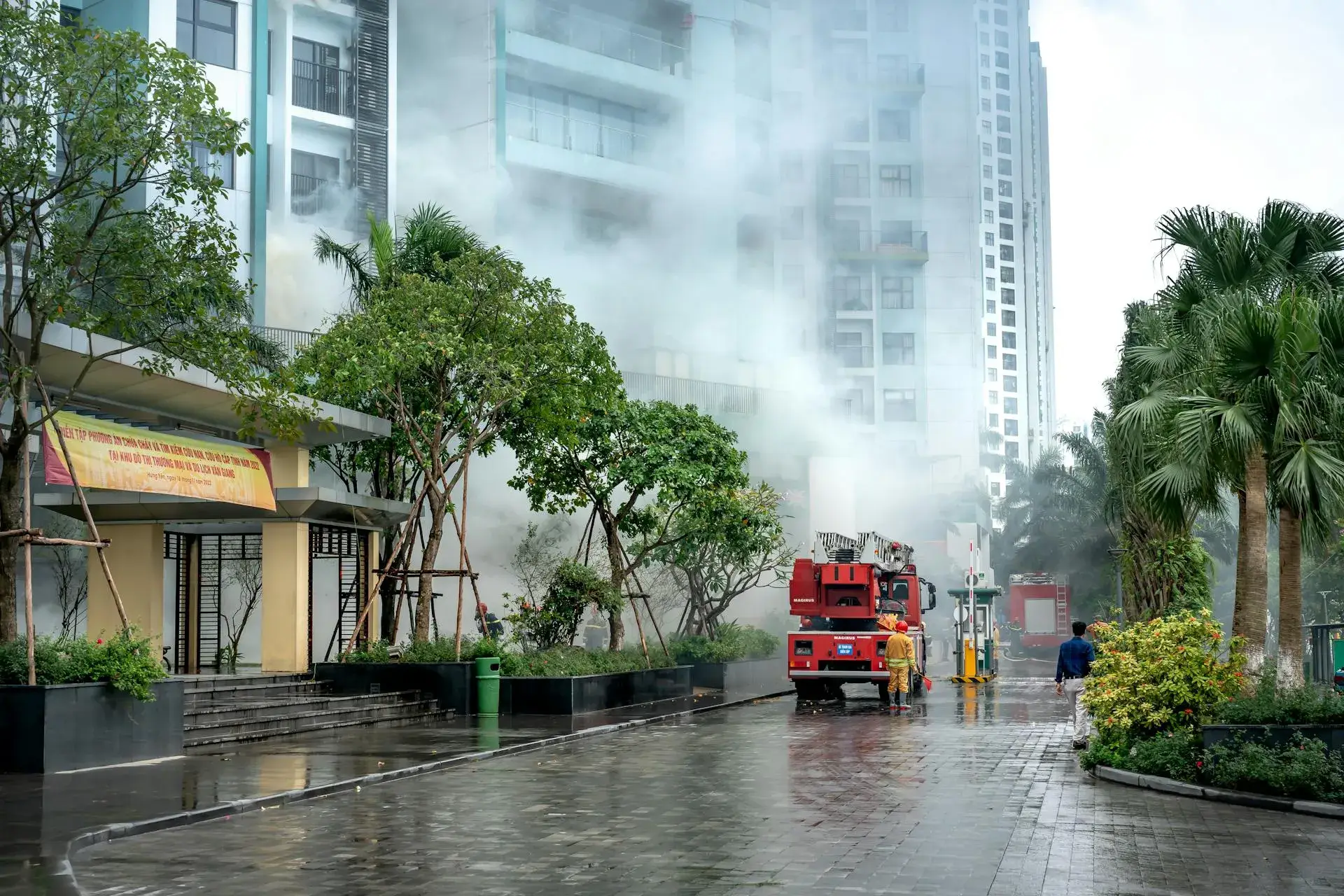
Smoke Damage Restoration in Orange City, FL
Smoke residue is acidic and bonds deeper into surfaces with every passing hour. Whether from a nearby wildfire or a structure fire down the street, smoke inside your Orange City home requires professional remediation before permanent damage sets in.
What Happens When You Call
A real person answers your call. We assess your smoke exposure situation, identify the likely source and residue type, and begin coordinating your response immediately.
Your dedicated restoration team is dispatched from our local base serving Orange City and the surrounding Volusia County communities.
Team arrives with air quality testing equipment, HEPA air scrubbers, and specialized smoke cleaning supplies. Assessment and initial air filtration begin immediately.
Contamination mapped, air scrubbers running, restoration plan documented. You know exactly what comes next and what the timeline looks like.
Smoke is inside your home and the damage is progressing right now. Every hour that soot particles remain on surfaces, they bond more deeply and become harder to remove. Smoke odor penetrates into fabrics, ductwork, and porous materials. Acidic residues corrode metal and discolor finishes. You need professional remediation, not air fresheners. When you reach out to X Response, your smoke restoration team mobilizes immediately. From that point forward, one team manages the entire process: air quality assessment, surface decontamination, HVAC cleaning, content restoration, and odor elimination. Call now. Your team is standing by.
Why Orange City Homes Are Vulnerable to Smoke Damage
Orange City sits in western Volusia County at the intersection of residential development and some of Florida's most fire-prone conservation lands. In June 2026, the Rookery Fire at the Lake Woodruff National Wildlife Refuge grew to nearly 4,000 acres after a lightning strike ignited dry vegetation in northwest Volusia County, just miles from Orange City's northern boundary. Officials warned nearby residents about smoke and ash drifting into communities, and smoky conditions persisted for days even after the fire was contained. This was not an isolated event. Earlier the same month, dual 250-acre brush fires in the Maytown area of southern Volusia County sent smoke drifting across Interstate 95 and into surrounding communities. In April 2025, the Powerline Fire burned 270 acres east of neighboring Deltona, producing massive smoke plumes visible across the region. Each of these wildfire events pushes particulate matter, volatile organic compounds, and fine ash into residential areas well beyond the fire perimeter, infiltrating homes through HVAC intake vents, door and window seals, attic soffits, and any gap in the building envelope.
Smoke damage in Orange City is not limited to wildfire events. Structure fires within the community and in neighboring Deltona, DeBary, and DeLand produce localized smoke plumes that affect adjacent properties even when those properties sustain no direct fire damage. A structure fire produces dense, toxic smoke carrying soot particles, incomplete combustion products from synthetic materials, and volatile chemicals that spread through the immediate neighborhood. Properties downwind receive this contamination through open windows, HVAC systems running at the time of the fire, and the normal air exchange that occurs through every building envelope. Additionally, Orange City's prescribed burn season, when land managers conduct controlled fires in conservation areas to reduce fuel loads, routinely drifts smoke across residential neighborhoods. The February 2026 citywide burn ban was enacted specifically because conditions made both wildfires and prescribed burns too dangerous, but during normal years, prescribed burn smoke exposure is a recurring seasonal event that introduces particulate matter into Orange City homes multiple times between January and June.
Lake Woodruff and Conservation Land Proximity
Lake Woodruff National Wildlife Refuge lies directly northwest of Orange City, encompassing over 22,000 acres of marsh, hardwood swamp, and pine flatwoods. Blue Spring State Park borders Orange City to the west. Additional undeveloped conservation lands and timber tracts extend to the north and east. When these areas burn, whether from lightning, human cause, or prescribed management, the smoke travels on prevailing winds directly into Orange City's residential neighborhoods. The June 2026 Rookery Fire demonstrated the scale: a single lightning-caused ignition in drought conditions grew to nearly 4,000 acres within days, producing smoke and ash warnings for nearby communities. The fire persisted for over a week before sufficient rainfall tamped down activity. During that period, Orange City residents experienced sustained exposure to wildfire smoke that infiltrated homes through every available pathway. This is not a one-time event. The combination of large conservation lands, Florida's lightning frequency (the highest in the United States), and seasonal drought cycles means wildfire smoke exposure recurs in Orange City with a frequency that most residential communities never experience.
Wildfire Smoke Composition and Health Impact
Wildfire smoke from burning palmetto, pine, and marsh vegetation contains fine particulate matter (PM2.5), carbon monoxide, volatile organic compounds, polycyclic aromatic hydrocarbons, and nitrogen oxides. The PM2.5 particles are small enough to bypass the body's natural filtration in the nose and throat and penetrate deep into the lungs. When wildfire smoke infiltrates a home, these particles settle on every surface and become trapped in soft materials, HVAC filters, and ductwork. Unlike the visible ash that settles on outdoor surfaces and can be swept away, the fine particulate contamination inside the home is largely invisible but measurable with air quality testing equipment. Residents with respiratory conditions, children, and elderly occupants are particularly affected by indoor PM2.5 levels that remain elevated long after outdoor conditions improve. The particles embed in carpet fibers, upholstery, bedding, and clothing, becoming resuspended in indoor air with every footstep and movement. Simply airing out the house after the outdoor smoke clears does not address the embedded contamination, which requires professional extraction and air filtration to bring indoor air quality back to safe levels.
HVAC System as Smoke Distribution Network
Central air conditioning systems, universal in Orange City's subtropical climate, become the primary pathway for smoke infiltration and the primary distribution mechanism once smoke enters the home. The HVAC intake draws outdoor air through a fresh air vent, and standard residential filters (MERV 8 to 10) cannot capture the fine PM2.5 particles that constitute the most harmful component of wildfire smoke. Once past the filter, these particles deposit throughout the ductwork, on the evaporator coil, in the blower housing, and on every interior vent register. Every time the system cycles after the outdoor smoke event has passed, it redistributes particulates from the ductwork back into the living space. Homeowners often notice a persistent smoky smell for weeks after a wildfire event and cannot identify the source because the contamination is inside the HVAC system rather than on visible surfaces. Professional smoke remediation in Orange City must include comprehensive HVAC decontamination: duct cleaning, coil cleaning, blower cleaning, and filter replacement with appropriately rated media. Without this step, the system continues recirculating trapped smoke particles indefinitely.
Building Envelope Gaps in Older Construction
Orange City's housing stock includes older homes near the town center along Graves Avenue and Holly Avenue that were built before modern energy efficiency standards and have building envelopes with significantly more air exchange than newer construction. These homes have gaps around window frames, unsealed penetrations for plumbing and electrical, poorly fitted attic access panels, and weathered door seals that allow outdoor smoke to migrate indoors with minimal resistance. During a sustained smoke event like the June 2026 Rookery Fire, which produced elevated smoke conditions for days, these older homes accumulate substantially more indoor contamination than newer, tighter-built construction on the growth edges. The contamination level inside corresponds directly to the duration and intensity of the outdoor smoke event multiplied by the building's air exchange rate. A home with a loose envelope exposed to smoke for five consecutive days accumulates far more embedded particulate matter than the same home exposed for five hours. The sustained duration of Volusia County wildfire smoke events, often persisting for a week or more, makes Orange City's older housing stock particularly vulnerable to deep contamination that requires comprehensive professional remediation.
Structure Fire Smoke Exposure to Adjacent Properties
When a structure fire occurs in Orange City or the immediately surrounding area, properties downwind receive smoke exposure that can require professional remediation even though they sustained no direct fire damage. Structure fire smoke is distinctly more toxic than wildfire smoke because it contains combustion products from synthetic building materials, plastics, treated wood, insulation, and household chemicals. These materials produce hydrogen cyanide, formaldehyde, acrolein, and other compounds that are absent from wildfire smoke. The soot particles from structure fires are also different: they tend to be oily, adhesive, and more difficult to remove from surfaces than the dry, powdery ash from wildfire smoke. For Orange City neighbors of a structure fire, the smoke contamination often enters through open windows or the HVAC system during the fire event itself, depositing a thin film of toxic soot on surfaces throughout the home. The contamination may not be immediately visible but becomes apparent as an odor that does not dissipate, a sticky film on smooth surfaces, or discoloration that appears on light-colored walls and ceilings over the following days as soot particles continue settling from the air.
Smoke damage restoration in Orange City must address both the recurring wildfire exposure from adjacent conservation lands and the localized impact of structure fires within the community. The source determines the contamination type, the cleaning approach, and the health considerations. Wildfire smoke requires PM2.5 extraction and HVAC decontamination. Structure fire smoke requires specialized chemical cleaning for synthetic soot and toxic residue neutralization. Both require professional equipment and trained technicians who understand which approach applies and how to verify that contamination levels have returned to safe baselines.
What Happens to Your Home While You Wait
Within 1 Hour
Smoke particles begin settling on horizontal surfaces throughout the home. Soot deposits on countertops, shelving, electronics, and any exposed surface. The HVAC system, if running during the smoke event, distributes particles into ductwork and throughout the home. Fine particulate matter embeds in carpet fibers and upholstery. At this stage, contamination is largely invisible but measurable with air quality testing. Surfaces that are cleaned immediately respond to standard methods. The earlier professional intervention begins, the less aggressive the cleaning required.
1–24 Hours
Soot particles begin bonding to surfaces through a process accelerated by Orange City's humidity. The moisture in the air acts as a binder, helping fine particles adhere to walls, ceilings, and smooth surfaces rather than remaining loosely deposited. Acidic components in smoke residue begin etching metal surfaces, including fixtures, appliances, electronics, and decorative hardware. Smoke odor penetrates into porous materials: drywall paper facing absorbs volatile compounds, wood grain opens in the humidity and draws in odor molecules, and textiles trap particles in their fiber structure. Standard household cleaning becomes less effective as the bonding progresses.
24–48 Hours
Smoke odor molecules embed deeply into porous substrates. Drywall, wood, concrete, and grout absorb smoke compounds below the surface layer, meaning that cleaning the visible surface no longer eliminates the odor source. Metal corrosion from acidic soot becomes visible as tarnish and pitting on brass, copper, and unfinished steel. Electronics exposed to soot and humidity develop corrosion at circuit-board solder joints. Orange City's warm, humid conditions accelerate every chemical reaction involved in smoke damage progression. Materials that could have been cleaned in place within the first 24 hours begin requiring more intensive treatment or replacement.
48–72 Hours
Permanent staining sets in on porous surfaces as smoke compounds chemically bond with substrate materials. Paint discolors beneath the soot layer. Grout absorbs smoke pigment that cannot be extracted through surface cleaning alone. Metal finishes develop permanent pitting. Soft goods including clothing, upholstery, and bedding that have not been removed to a clean environment begin developing permanent odor retention as smoke molecules cross-link with synthetic and natural fibers. The restoration scope expands from surface cleaning to material replacement for heavily affected areas.
One Week and Beyond
Smoke odor becomes embedded throughout the home's materials and structure. Standard cleaning, painting, and consumer odor eliminators cannot reach the contamination because it has migrated into materials below the surface: into drywall backing, into wood grain below the finish layer, into concrete pores, into insulation, and into every component of the HVAC system. Professional thermal fogging, ozone treatment, or hydroxyl generation becomes necessary to reach embedded odor molecules. For Orange City homes exposed to sustained wildfire smoke over multiple days during events like the Rookery Fire, the contamination depth and distribution after a week of exposure is significantly more extensive than a brief, intense exposure from a nearby structure fire. Full remediation requires treating the home as a complete system rather than addressing individual surfaces.
The longer smoke contamination remains in your Orange City home, the more deeply it embeds and the more intensive the remediation required. Contact X Response now. Our team responds within 60 minutes to begin air quality assessment and filtration.
How We Restore Smoke-Damaged Orange City Homes
From the moment our team arrives at your Orange City property, every step is documented, measured, and verified. Here is exactly what the smoke damage restoration process involves.
Air Quality Assessment and Source Identification
Our team arrives with particulate monitoring equipment and performs a comprehensive air quality assessment to quantify the contamination level and identify the smoke source. Wildfire smoke from burning vegetation produces different residues than structure fire smoke from synthetic materials, and the cleaning approach differs accordingly. We test air quality at multiple points throughout the home, check HVAC ductwork and filter conditions, and identify the infiltration pathways that allowed smoke to enter. For Orange City properties affected by wildfire events like the Rookery Fire, we assess whether the exposure was a brief, intense event or sustained over multiple days, because duration directly determines contamination depth and remediation scope. All findings are documented with readings and photos as the baseline for measuring restoration progress and for your insurance documentation.
HVAC Isolation and Air Filtration
The first mitigation step is isolating the HVAC system to prevent continued redistribution of trapped smoke particles, then deploying HEPA air scrubbers throughout the home to begin reducing airborne particulate levels. In Orange City's climate, simply shutting off the AC is not an option for extended periods because the heat and humidity create habitability and mold concerns. We isolate the supply and return vents in the most contaminated areas while maintaining limited climate control to prevent secondary moisture damage. HEPA air scrubbers capture particles down to 0.3 microns, well below the PM2.5 particle size that constitutes the primary health concern from wildfire smoke. These run continuously throughout the remediation process, creating clean-air zones that expand as surface cleaning progresses through the home.
Surface Decontamination
With air filtration running, crews begin systematic surface cleaning starting from the least contaminated areas and working toward the most affected zones to prevent cross-contamination. The cleaning method depends on the residue type. Wildfire smoke from pine and palmetto typically leaves a dry, powdery residue that responds to dry sponging, HEPA vacuuming, and wet wiping with appropriate solutions. Structure fire smoke from synthetic materials leaves oily, adhesive soot that requires chemical sponges, degreasing agents, and sometimes abrasive methods on hard surfaces. Every surface is addressed: walls, ceilings, cabinetry, trim, light fixtures, outlet covers, window frames, and structural members in exposed areas. For Orange City homes with textured surfaces, popcorn ceilings, or unpainted wood, additional attention is required because these surfaces trap particles in their texture and require specialized techniques to extract embedded contamination.
HVAC Decontamination
The HVAC system receives dedicated professional cleaning because it is both the primary distribution pathway and the largest reservoir of trapped smoke particles in most Orange City homes. Crews clean all supply and return ductwork using negative-pressure extraction with HEPA filtration, removing deposited soot and particulates from duct walls. The evaporator coil, blower assembly, and drain pan are cleaned and treated. Supply and return registers are removed and cleaned individually. The system's filter is replaced with high-efficiency media appropriate for the system's static pressure specifications. After cleaning, the system is run and air quality is tested at registers throughout the home to confirm that recirculated air meets acceptable particulate levels. Without this step, the system will continue redistributing trapped smoke particles for months, and residents will continue experiencing odor and respiratory irritation long after visible surfaces appear clean.
Odor Elimination and Verification
After surfaces are cleaned and the HVAC system is decontaminated, residual odor embedded in porous materials is addressed using professional-grade odor elimination technology. Options include thermal fogging, which disperses a deodorizing agent as a heated mist that penetrates into the same pores and crevices where smoke molecules embedded; ozone treatment, which uses reactive oxygen to break down odor-causing compounds at the molecular level; and hydroxyl generators, which produce hydroxyl radicals that neutralize volatile organic compounds without the occupant-exclusion requirements of ozone. The appropriate method depends on contamination depth, material types, and whether the space will be occupied during treatment. For Orange City homes with extensive wildfire exposure over multiple days, combination approaches are often necessary because the contamination depth varies across different materials and building assemblies. Final air quality testing verifies that particulate levels and volatile compound readings have returned to baseline before the project is complete.
The X Response Difference
When you contact X Response for smoke damage in Orange City, you get a team that treats smoke contamination as the measurable, removable problem it is. Professional assessment, systematic decontamination, HVAC cleaning, and verified results. Not air fresheners, not surface-only cleaning, not guesswork.
Insurance Claim Guidance for Orange City Homeowners
Smoke damage insurance coverage depends on the source of the smoke and your policy type. Standard Florida homeowner's policies cover smoke damage from a sudden, accidental fire event, whether the fire occurred on your property or on a neighboring property whose smoke affected your home. Wildfire smoke damage from regional events may be covered under the fire peril of your policy, but coverage determinations can be more complex because the smoke source is distant and the damage accumulates gradually rather than from a single identifiable event. Coverage for prescribed burn smoke exposure depends on policy language and the specific circumstances. Understanding your coverage position before filing helps you make informed decisions about the claim process and out-of-pocket exposure.
How X Response Helps
- Document contamination levels with professional air quality readings, surface samples, and photographic evidence from the initial assessment before any cleaning begins
- Identify and document the smoke source clearly, because coverage for structure fire smoke damage to neighboring properties differs from wildfire or prescribed burn exposure in many policies
- Inventory affected contents with pre-loss condition documentation, because smoke-damaged textiles, electronics, and soft goods often require replacement rather than cleaning
- Maintain air quality test records throughout the project showing progression from contaminated baselines to acceptable levels, providing objective evidence of the work performed
- Document HVAC contamination separately with before-and-after photos of ductwork, coils, and filters, as this is often the most expensive single line item and requires clear justification for the adjuster
X Response does not file claims on your behalf, adjust claims, or make coverage determinations. We provide documentation and guidance to help you make informed decisions about your property and your policy. Coverage decisions are made solely by your insurance carrier.
Certified Restoration Specialists Serving Orange City
When you contact X Response for smoke damage in Orange City, your restoration team is drawn from certified professionals who work across Volusia County and understand the specific smoke exposure patterns this region produces. They know how wildfire smoke from burning palmetto and pine differs from structure fire smoke containing synthetic combustion products. They understand the infiltration pathways that allow smoke into Orange City's different housing types, from older homes near the town center with loose building envelopes to newer construction on the growth edges with tighter seals but larger HVAC systems drawing contaminated outdoor air. They have worked on properties exposed to the sustained wildfire events that affect western Volusia County during drought periods, and they know that duration of exposure, not just intensity, determines remediation scope. This is local experience applied to your specific situation.
Every technician on your team holds current IICRC certification in fire and smoke restoration and operates professional-grade equipment: HEPA air scrubbers rated to capture particles down to 0.3 microns, particulate monitoring instruments for quantitative air quality assessment, negative-pressure duct cleaning systems, thermal foggers, ozone generators, and hydroxyl generation units for deep odor treatment. When your team arrives, they bring diagnostic capability and remediation equipment together so the assessment and initial mitigation happen in the same visit rather than separated by days of scheduling.
In Orange City, X Response works with Hugo Fire and Water, an independent local restoration partner serving Volusia County.
Smoke Damage Restoration FAQ for Orange City Homeowners
Other Emergency Services in Orange City

Water Damage Restoration
Burst pipes, storm flooding, standing water. We extract, dry, and restore before mold sets in.
Learn more
Fire Damage Restoration
Structural damage, soot, debris. We stabilize, clean, and rebuild what fire destroyed.
Learn more
Mold Remediation
Testing, containment, removal, prevention. We find the source, eliminate the growth, and stop it from returning.
Learn more
Sewage Cleanup
Sewer backups, contaminated water, biohazard. We extract, sanitize, and restore safely.
Learn more