
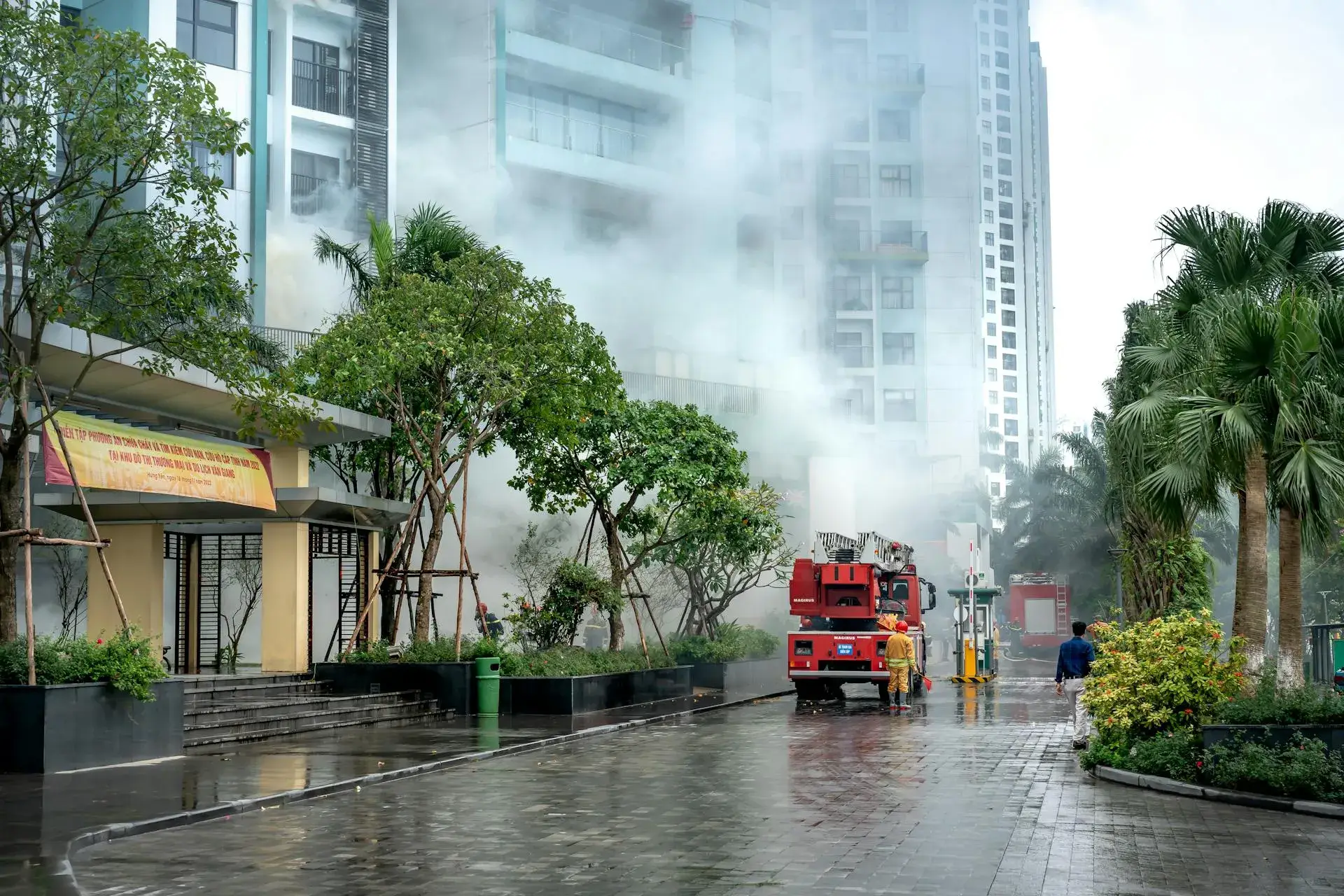
Smoke Damage Restoration in Rolling Meadows, IL
Smoke residue bonds permanently to surfaces within 48 to 72 hours. Every hour of delay turns a cleaning job into a replacement job. Our local team responds within 60 minutes.
What Happens When You Call
A real person answers, not a call center. We assess your situation, ask the right questions, and begin coordinating your response immediately.
Your dedicated restoration team is dispatched from our local base serving Rolling Meadows and the surrounding northwest Cook County communities.
Team arrives with HEPA air scrubbers, soot removal equipment, thermal fogging units, and testing instruments. Assessment and treatment begin immediately.
Contamination boundaries mapped, treatment plan documented, restoration underway. You know exactly what comes next.
Smoke has contaminated your property. Whether it came from a fire next door, a furnace malfunction in the basement, or wildfire haze that infiltrated through your HVAC system, the residue is already bonding to surfaces and penetrating materials. Smoke does not wait. It is acidic, it is corrosive, and it migrates into every space air can reach. X Response exists for exactly this moment. When you reach out, your restoration team is mobilized within minutes and on site within the hour. From that point forward, one team manages everything: assessment, cleaning, deodorization, and restoration. Call now. Your team is standing by.
Why Rolling Meadows Homes Are Vulnerable to Smoke Damage
Rolling Meadows is a residential city of approximately 24,200 people in northwest Cook County, positioned roughly 25 miles from downtown Chicago in the heart of the suburban corridor that runs along the Northwest Tollway. The city's housing stock spans from original 1950s Kimball Hill ranch homes to multi-family complexes built through the 1970s and 1980s, all of which rely on forced-air heating and cooling systems that can distribute smoke particulates building-wide within minutes of contamination entering the air handler. On June 27, 2023, smoke from Canadian wildfires pushed Chicago-area air quality into the 'Very Unhealthy' range with AQI readings above 200, giving Chicago the worst air quality among major cities worldwide that day. The entire state of Illinois was placed under an air quality alert as fine particulate matter (PM2.5) from fires burning thousands of miles away blanketed Cook County in a visible orange-brown haze. For Rolling Meadows residents, the smoke entered homes through fresh-air intakes, open windows, door seals, and every gap in the building envelope, depositing fine particles on surfaces, in ductwork, and on HVAC filters that were not designed to capture wildfire-scale particulate loads.
The June 2023 wildfire smoke event was the most dramatic external smoke exposure Rolling Meadows has experienced, but smoke damage to properties occurs far more frequently from local sources. The city's concentration of multi-family housing means that a fire in one condominium or apartment unit produces smoke exposure across neighboring units through shared ductwork, wall cavities, and structural connections. A furnace puffback in one of the 1950s homes sends a burst of oily soot through every supply register in the house in seconds. A neighbor's grill fire or garage fire on a typical suburban lot exposes adjacent homes to smoke that enters through open windows, fresh-air returns, and HVAC intake vents. Each of these sources produces a different type of smoke residue with different cleaning requirements, but all share the same urgency: soot is acidic, it bonds to surfaces within hours to days, and once that bond forms, cleaning becomes replacement.
The June 2023 Canadian Wildfire Smoke Event
During late June 2023, smoke from record-breaking Canadian wildfires traveled thousands of miles south into the Great Lakes region and settled over the Chicago metropolitan area. On June 27, Chicago's AQI climbed above 200 into the 'Very Unhealthy' category, the worst air quality among major cities globally that day. The entire state of Illinois was placed under an air quality alert. For Rolling Meadows residents, this was not merely an outdoor nuisance. Fine particulate matter from wildfire smoke, primarily PM2.5 particles, penetrates indoor spaces through every opening in the building envelope: fresh-air intakes on HVAC systems, gaps around windows and doors, dryer vents, bathroom exhaust duct connections, and the natural air exchange that even tight homes experience. Homes that ran their HVAC systems during the event pulled smoke-laden air through return ducts and across filter media, depositing particles throughout the duct network and on every surface the conditioned air touched. Standard HVAC filters (MERV 8 and below) cannot capture the ultra-fine particles that wildfire smoke produces.
Furnace Puffbacks in 1950s Heating Systems
Rolling Meadows' original Kimball Hill homes are now over 70 years old, and many still operate gas furnaces that have been replaced only once or twice since construction. A furnace puffback occurs when fuel fails to ignite properly during a start cycle, vapor accumulates in the combustion chamber, and then ignites explosively, sending a burst of soot and combustion byproducts backward through the heat exchanger and out through every supply register in the home. The result is instantaneous whole-house contamination: oily black soot coats walls, ceilings, furniture, clothing, and every surface in every room connected to the forced-air system. Puffbacks are more common in aging equipment where ignition components, flame sensors, and flue connections have degraded over decades of thermal cycling. They occur predominantly during the heating season startup in October and November when furnaces fire after months of dormancy, and during deep-winter cold snaps when the burner cycles continuously and components fatigue.
Multi-Unit Smoke Migration
Rolling Meadows has a substantial inventory of condominium and apartment buildings from the 1960s through 1980s. In these structures, smoke from a fire in one unit does not stay contained. It travels through shared HVAC plenums, wall penetrations for electrical and plumbing, gaps around fire-stop assemblies that were not installed to modern standards, and common attic or ceiling spaces. The December 2020 Coach Light condo fire on Algonquin Road and the March 2015 Carriageway Drive fire both produced smoke contamination that extended well beyond the fire-damaged units into adjacent spaces throughout the buildings. Unit owners who had no fire in their space still faced soot-coated surfaces, smoke-saturated soft goods, and HVAC systems filled with particulates. This secondary smoke exposure requires the same professional treatment as direct fire damage but is often underestimated because there are no visible flames or char to signal the severity of the contamination.
Neighbor Fires and Proximity Exposure
Rolling Meadows' residential neighborhoods place single-family homes on standard suburban lots with limited separation between structures. When a fire, grill flare-up, garage fire, or vehicle fire occurs at one property, the smoke plume drifts across neighboring properties and can infiltrate adjacent homes through open windows, fresh-air intakes, and building envelope gaps. Even a brief exposure, 20 to 30 minutes of heavy smoke drifting across a neighboring property, is sufficient to deposit measurable soot on exterior surfaces, contaminate screened porches, coat vehicles, and penetrate interiors where windows or HVAC systems were open. The resulting damage is lighter than a direct structure fire but still requires professional assessment because soot acids begin degrading surfaces immediately, and smoke odor embeds in soft furnishings, carpet, and drapes during the exposure window.
HVAC Distribution as Contamination Multiplier
Nearly every home and building in Rolling Meadows uses forced-air heating and cooling with ductwork running through ceiling cavities, floor systems, or basement spaces. This ductwork serves as both a distribution pathway during a smoke event and a long-term reservoir of contamination afterward. When smoke enters a home from any source, whether wildfire particulates through the fresh-air intake, a puffback through the supply registers, or a neighboring fire through an open window, the HVAC blower distributes particulates to every room the system serves within minutes. After the event, soot settles inside the ducts, on the evaporator coil, across the blower fan, and in the filter housing. Every time the system cycles afterward, it re-aerosolizes a portion of that settled contamination and redistributes it through the home. Until the ductwork is professionally cleaned and the system is verified clear, the HVAC system continues recontaminating spaces that have already been surface-cleaned.
These smoke sources each produce different residue types and require different restoration approaches. Wildfire smoke deposits ultra-fine PM2.5 particles that embed in soft materials and HVAC systems. Furnace puffbacks produce oily, sticky soot that smears when touched and bonds aggressively to surfaces. Structure fires generate a mix of synthetic and protein-based soot depending on what burned. Neighbor exposures deposit lighter contamination over broader areas. But all share the same core urgency: smoke residue is acidic and corrosive, it bonds more permanently with each passing hour, and the HVAC system in every Rolling Meadows home is either the source of contamination, the distribution pathway, or the ongoing reservoir that recontaminates cleaned spaces until it is treated. Effective smoke damage restoration here means identifying the smoke type, mapping the contamination boundary through the entire HVAC distribution path, and treating every affected surface and system before the bonding becomes irreversible.
What Happens to Your Home While You Wait
Within 1 Hour
Smoke residue settles on horizontal surfaces throughout the home. The HVAC system distributes fine particles to every room it serves. Acidic soot contacts metal fixtures, electronics, and appliance surfaces, beginning a corrosion process that accelerates with humidity. Smoke odor molecules begin penetrating soft furnishings, carpet fibers, and fabric upholstery. The contamination is still fresh and maximally responsive to professional cleaning at this stage.
1–24 Hours
Soot acids etch into metal surfaces: chrome fixtures discolor, exposed copper corrodes, electronic circuit boards begin degrading. Smoke odor molecules penetrate deeper into porous materials. On painted walls and ceilings, soot begins bonding into the paint film and textured surfaces. The window for cleaning without surface damage begins closing. In homes where the HVAC system continues running, it redistributes settled soot with each cycle, maintaining elevated particulate levels throughout the conditioned space.
24–72 Hours
Permanent staining develops on porous surfaces: natural stone, grout, unfinished wood, textured ceilings, and light-colored fabrics. Metal corrosion becomes visible on brass, chrome, and stainless steel. Smoke odor embeds deeply enough in structural materials that surface cleaning alone cannot eliminate it. The HVAC system's evaporator coil, blower fan, and duct interiors accumulate layers of fine particulate that standard filter replacement cannot address. What was recoverable through prompt professional cleaning now requires more aggressive treatment methods or material replacement.
3–7 Days
Soot chemistry permanently alters the surfaces it contacts. Restoration shifts from cleaning to replacement for porous materials that have absorbed smoke residue past the point of extraction. Electronics exposed to corrosive soot show functional degradation. Smoke odor becomes structurally embedded in wall cavities, framing, and insulation where surface treatment cannot reach, requiring thermal fogging or hydroxyl generation to neutralize. Restoration costs increase substantially as the scope crosses from cleaning and deodorization to material replacement.
One Week and Beyond
Widespread permanent damage to surfaces, fixtures, and finishes. HVAC system requires full professional cleaning including coil washing, blower disassembly, and duct treatment to stop ongoing recontamination. Soft furnishings, clothing, and upholstered items that were not removed and treated within the first days may be unrecoverable. The home requires a comprehensive restoration scope rather than targeted cleaning, and insurance claims become more complex as carriers question whether prompt action could have reduced the loss.
The difference between cleaning your home and replacing large portions of it often comes down to how quickly smoke residue is addressed after the event. Contact X Response now. Our Rolling Meadows team responds within 60 minutes.
How We Restore Smoke-Damaged Rolling Meadows Homes
From the moment our team arrives, every step is documented, measured, and verified. Here is exactly what the smoke damage restoration process involves for Rolling Meadows properties.
Smoke Source Identification and Contamination Mapping
Our team arrives with air quality testing equipment, surface sampling tools, and thermal imaging to identify the smoke source and map the contamination boundary. This matters because the restoration approach depends entirely on the smoke type. Wildfire particulates require different treatment than furnace puffback soot, which differs from structure-fire residue. We test air quality levels, assess HVAC system contamination by sampling supply registers and return grilles, check wall cavities and ceiling spaces for smoke migration, and photograph every affected area with detailed notes. The contamination map defines the scope of work: every surface, system, and material within the boundary receives treatment, and the boundary is not drawn until we have verified where contamination ends.
Air Quality Stabilization
Before surface cleaning begins, we stabilize indoor air quality using commercial HEPA air scrubbers that filter particulates down to 0.3 microns. For wildfire smoke events in Rolling Meadows where PM2.5 infiltrated the entire home through the HVAC system, we position scrubbers in each affected zone and run them continuously until airborne particulate levels drop below safe thresholds. The HVAC system is shut down during this phase to prevent it from redistributing settled contamination. For puffback events, containment barriers isolate the most heavily affected rooms while scrubbers clear the air throughout the home. This phase ensures that surface cleaning does not simply stir settled soot back into the air column.
Surface Cleaning and Soot Removal
With air quality stabilized, systematic surface cleaning begins. The technique depends on the soot type. Wildfire residue requires HEPA vacuuming followed by wet-wiping with appropriate solvents. Puffback soot demands chemical sponges and specialized degreasing agents that lift the oily residue without smearing it deeper into surfaces. Structure-fire soot varies by what burned: protein residue from kitchen fires responds to enzymatic cleaners, while synthetic soot from plastics and furnishings requires different chemistry. We work from ceilings downward, cleaning every surface within the contamination boundary. Porous materials that have absorbed soot beyond the point of extraction, including heavily contaminated carpet, drapes, and upholstered furnishings, are documented and removed for professional off-site cleaning or replacement.
HVAC Decontamination
The HVAC system receives dedicated treatment because it served as the distribution pathway during the event and continues as a contamination reservoir afterward. We clean supply and return ductwork using negative-pressure equipment that captures loosened particulates rather than pushing them into the living space. The evaporator coil is accessed and cleaned of accumulated soot film that restricts airflow and harbors odor. The blower fan assembly is disassembled and cleaned of the particulate layer that accumulates on blade surfaces. New filtration is installed, and the system is sealed and tested before being returned to operation. For multi-family buildings where shared HVAC serves multiple units, we coordinate system-wide treatment to prevent recontamination from untreated sections.
Deodorization and Verification
Smoke odor molecules penetrate beyond where visible soot reaches, embedding in structural wood, insulation, concrete, and materials inside wall cavities. Surface cleaning removes the soot but not the odor. We deploy thermal fogging that generates a deodorizing vapor with penetration characteristics matching those of the original smoke, reaching the same hidden spaces. For severe contamination, hydroxyl generators provide continuous odor neutralization over multiple days, breaking down odor molecules at the molecular level without requiring the space to be vacated. Air quality testing verifies that particulate levels and volatile organic compounds have returned to safe levels before we declare the space clear. If any area does not pass verification, treatment continues until it does.
The X Response Difference
When you contact X Response for smoke damage, you get a team that treats the complete contamination footprint, not just the surfaces you can see. One team, systematic treatment, verified results.
Insurance Claim Guidance for Rolling Meadows Homeowners
Smoke damage insurance coverage depends on the source of the smoke and whether it resulted from a covered peril. Smoke damage from a fire (whether in your home, your building, or a neighboring property) is typically covered under standard homeowner's policies as a direct consequence of a covered peril. Furnace puffbacks are generally covered as sudden and accidental equipment failure. Wildfire smoke infiltration is more complex: some policies cover it as wind-driven smoke from a wildfire (a covered peril), while others exclude it as gradual environmental contamination rather than a discrete insured event. The June 2023 Canadian wildfire smoke event affected thousands of Cook County homes simultaneously, creating a mass-event scenario where individual claim handling varied significantly by carrier. For Rolling Meadows condo owners whose smoke exposure came from a fire in another unit, your individual policy should cover the contamination to your space as fire-related damage, while the building's master policy addresses common elements.
How X Response Helps
- Document the contamination source clearly, as coverage depends on whether the smoke resulted from a covered peril
- Record air quality measurements and surface contamination levels with photos to establish the scope of damage objectively
- Maintain a record of when the exposure occurred and when treatment began, as carriers may evaluate whether timely mitigation could have reduced scope
- For wildfire smoke events, document that the infiltration was involuntary and that the home was secured (windows closed, HVAC in recirculation mode) to counter potential 'maintenance' exclusion arguments
- For puffback events, retain the furnace inspection report and any maintenance records that demonstrate the failure was not due to neglect
X Response does not file claims on your behalf, adjust claims, or make coverage determinations. We provide documentation and guidance to help you make informed decisions about your property and your policy. Coverage decisions are made solely by your insurance carrier.
Certified Restoration Specialists Serving Rolling Meadows
When you contact X Response for smoke damage in Rolling Meadows, your restoration team is drawn from certified professionals who work across northwest Cook County and understand the specific smoke exposure patterns this community experiences. They know how the 1950s forced-air systems in Kimball Hill homes distribute puffback soot in seconds, how the multi-family buildings along Algonquin Road and Kirchoff Road allow smoke to migrate between units through shared structural pathways, and how wildfire smoke events like June 2023 infiltrate homes through fresh-air intakes and envelope gaps that standard maintenance does not address. They have worked through puffback events in aging furnaces, post-fire smoke contamination in multi-unit buildings, kitchen-fire residue in single-family neighborhoods, and regional wildfire smoke infiltration across entire blocks. This is not a general cleaning crew with no smoke-specific training. It is a specialized team that identifies the soot type, matches the treatment method to the chemistry, and verifies results with objective testing.
Every technician on your team holds current IICRC certification in fire and smoke restoration (FSRT) and carries the appropriate Illinois state licensing for the work being performed. Equipment includes HEPA air scrubbers, thermal foggers, hydroxyl generators, negative-pressure duct cleaning systems, air quality monitoring instruments, and the full range of soot-specific cleaning chemistry for protein, synthetic, and fuel-oil residues. When your team arrives, they bring everything needed to begin air quality stabilization immediately and transition into systematic cleaning without waiting for equipment deliveries or subcontractor coordination.
In Rolling Meadows, X Response works with Scene Cleaners, an independent local restoration partner serving Cook County.
Smoke Damage Restoration FAQ for Rolling Meadows Homeowners
Other Emergency Services in Rolling Meadows

Water Damage Restoration
Burst pipes, storm flooding, standing water. We extract, dry, and restore before mold sets in.
Learn more
Fire Damage Restoration
Structural damage, soot, debris. We stabilize, clean, and rebuild what fire destroyed.
Learn more
Mold Remediation
Testing, containment, removal, prevention. We find the source, eliminate the growth, and stop it from returning.
Learn more
Sewage Cleanup
Sewer backups, contaminated water, biohazard. We extract, sanitize, and restore safely.
Learn moreNearby Service Areas
Also serving nearby: