
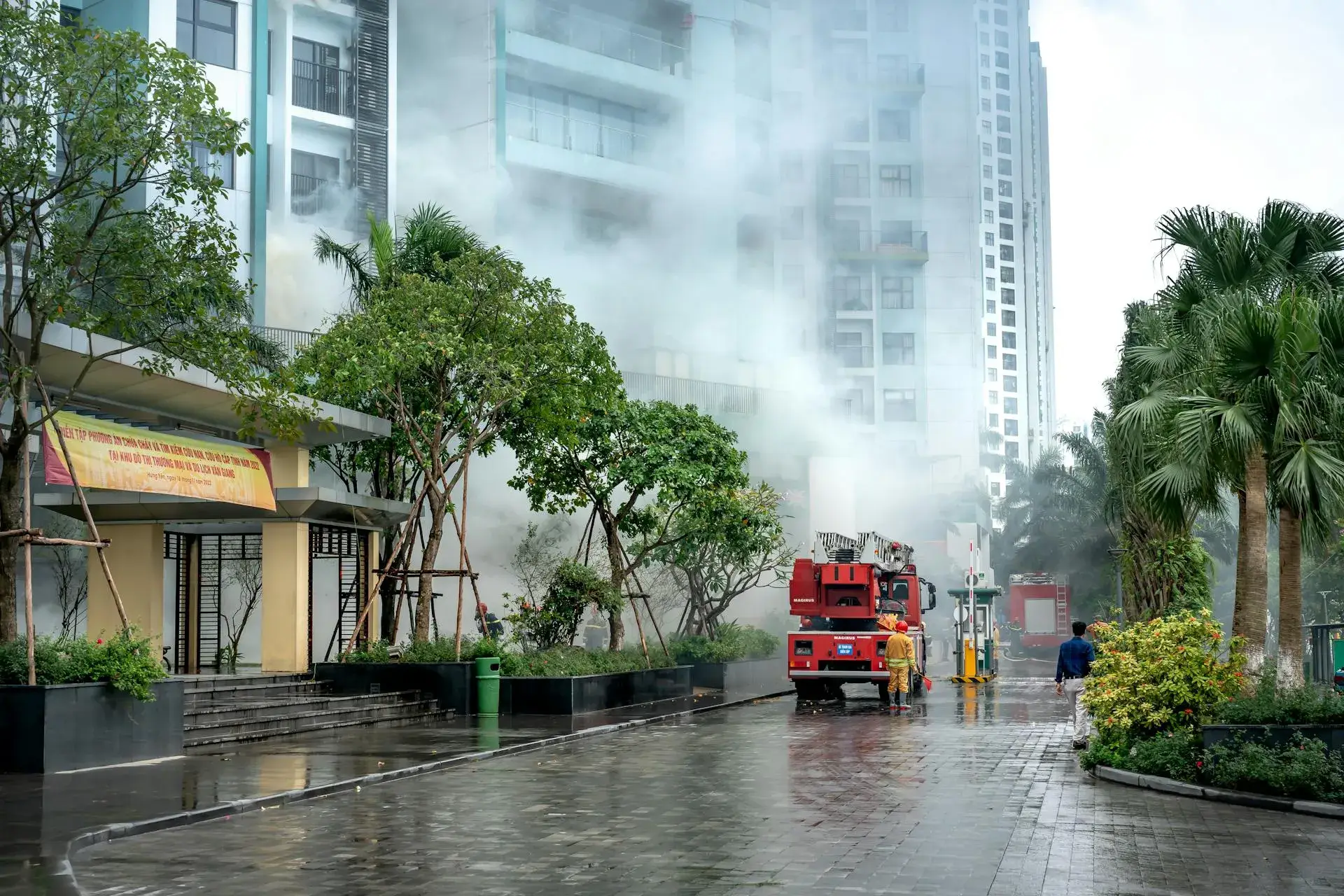
Smoke Damage Restoration in Mount Prospect, IL
Smoke residue bonds to surfaces within hours and odor embeds deeper with each passing day. Our local team responds to Mount Prospect emergencies within 60 minutes.
What Happens When You Call
A real person answers, not a call center. We assess your situation, identify the smoke source type, and begin coordinating your response immediately.
Your dedicated restoration team is dispatched from our local base serving Mount Prospect and the surrounding northwest Cook County communities.
Team arrives with HEPA filtration, soot removal compounds, and deodorization equipment. Assessment and emergency cleaning begin immediately.
Contamination mapped, cleaning plan executed, deodorization deployed. You know exactly what comes next.
Smoke damage does not require a fire in your home. A neighbor's fire, a furnace malfunction, or wildfire smoke infiltration from hundreds of miles away can contaminate your property with soot, particulates, and persistent odor that worsens the longer it sits. X Response exists for exactly this moment. When you reach out, your restoration team is mobilized within minutes and on site within the hour. From that point forward, one team manages everything: assessment, cleaning, deodorization, and HVAC decontamination. Call now. Your team is standing by.
Why Mount Prospect Homes Are Vulnerable to Smoke Damage
Mount Prospect sits in northwest Cook County, about 20 miles from downtown Chicago and squarely within the airshed that Canadian wildfire smoke blanketed during the summer of 2023. On June 27, 2023, smoke from Quebec wildfires pushed the Chicago metropolitan area's Air Quality Index above 250, registering as 'very unhealthy' and making Chicago's air the worst in the world that day according to IQAir monitoring. The National Weather Service blamed winds pulling smoke across Wisconsin, Michigan, and northern Illinois. Schools kept students indoors, the Park District canceled outdoor programs, and the Illinois EPA declared an Air Pollution Action Day. For Mount Prospect's nearly 57,000 residents, the haze was visible and the smell was unmistakable, but the less obvious impact was the fine particulate matter that infiltrated homes through HVAC systems, window gaps, and attic ventilation, depositing an invisible film of wildfire soot on interior surfaces and embedding smoke odor in soft furnishings, ductwork, and wall cavities.
The June 2023 event was not isolated. In June 2025, Canadian wildfire smoke again degraded Chicago-area air quality to 'unhealthy' levels for three consecutive days, with the Illinois EPA issuing Air Pollution Action Days and the NWS posting alerts across Cook County. These events are becoming a recurring pattern as western Canadian fire seasons intensify, and each episode drives fine particulate smoke deep into residential structures through the same forced-air heating and cooling systems that serve Mount Prospect's housing stock. Beyond wildfire infiltration, Mount Prospect residents face smoke damage from more localized sources: furnace puffbacks that coat basements and first floors with oily soot, kitchen fires that distribute grease-laden smoke through ductwork, and neighboring structure fires that send combustion byproducts downwind into adjacent homes through fresh-air intakes and open windows.
Canadian Wildfire Smoke Infiltration
The June 2023 wildfire smoke event demonstrated that homes hundreds of miles from active fire can sustain real smoke damage. PM2.5 particles (2.5 microns and smaller) from wildfire combustion bypass standard HVAC filters, entering homes through return-air ductwork, window seals, and attic ventilation. Once inside, they deposit on surfaces, embed in soft furnishings, and accumulate in ductwork where they continue off-gassing for weeks. The AQI exceeded 250 across the Chicago metro on June 27, 2023, and returned to 'unhealthy' levels during June 2025. For Mount Prospect homes with older forced-air systems running MERV 8 or lower filters, virtually no wildfire particulate was captured before it entered living spaces. Residents who ran their HVAC systems during the events, believing they were filtering the air, were actually pulling outdoor smoke through the system and distributing it to every room served by the ductwork.
Furnace Puffback Events
A furnace puffback occurs when unburned fuel accumulates in the combustion chamber and ignites in a delayed explosion that forces oily soot back through the furnace housing and into the ductwork. The pressurized blast distributes soot to every room connected to the forced-air system within seconds. Mount Prospect's housing stock relies heavily on gas-fired forced-air furnaces, many of which date to the 1980s or 1990s and are approaching or past their expected service life. A puffback can coat an entire home's surfaces with a fine, greasy black residue that resists ordinary cleaning and embeds deeply in porous materials. The odor is distinctive, acrid, and persistent. Unlike wildfire smoke, puffback residue is petroleum-based and requires different cleaning chemistry to remove without damaging surfaces.
Forced-Air HVAC as a Smoke Distribution System
Nearly every home in Mount Prospect uses forced-air heating and cooling with ductwork running through basement ceiling cavities, interior wall chases, and between-floor spaces. When smoke enters the system from any source, whether wildfire infiltration, a furnace puffback, a kitchen fire, or a neighboring structure fire, the blower distributes particulates to every room, register, and return connected to the network. The ductwork itself becomes a reservoir of contamination that continues releasing smoke odor and particles every time the system cycles, even weeks or months after the original event. This is why smoke damage in a forced-air home is almost always a whole-house problem regardless of where the smoke originated.
Neighboring Fire Smoke Exposure
Mount Prospect's residential density means that a structure fire at one property produces smoke exposure across multiple neighboring homes. The June 2024 Orion Parkview Apartments fire sent heavy smoke over the surrounding blocks for more than eight hours. Homes downwind received direct soot deposition on exterior surfaces and smoke infiltration through HVAC fresh-air intakes, open windows, and attic ventilation during the extended burn. Even for residents who kept windows closed, the pressure differential created by wind-driven smoke forces particulates through gaps around doors, windows, and utility penetrations. The result is smoke contamination in homes that had no fire of their own, with soot films on surfaces, embedded odor in soft goods, and particulate accumulation in ductwork that the homeowner may not notice for days or weeks.
Northern Illinois Heating Season and Sealed-Home Conditions
Mount Prospect homes are sealed tightly against the cold from November through March, with windows closed, weatherstripping compressed, and the furnace cycling continuously. A smoke event during heating season, whether from a puffback, a kitchen incident, or a neighbor's fire, traps contamination inside the home because there is no natural ventilation to dilute it. The same energy-efficient construction that keeps heat in also keeps smoke in. Smoke odor molecules adsorb to cold surfaces during winter (drywall, window glass, metal ductwork) and then release again when the surface warms in spring, creating a pattern where odors seem to disappear during the winter and return when temperatures rise. This delayed re-emission often confuses homeowners who believe the problem resolved on its own.
These factors interact to make smoke damage in Mount Prospect both more common and more difficult to resolve than many homeowners expect. Wildfire smoke infiltrates through HVAC systems during events that happen with increasing frequency. Furnace puffbacks deliver whole-house contamination from within. Residential density means neighboring fires expose multiple properties. And the sealed-home conditions of northern Illinois winters trap smoke inside with no natural ventilation path. Effective smoke damage restoration means identifying the residue type (wildfire particulate, petroleum-based puffback, protein/grease from cooking, or synthetic combustion from a structure fire), because each requires different cleaning chemistry, different deodorization methods, and different HVAC decontamination approaches.
What Happens to Your Home While You Wait
Within 1 Hour
Smoke particles settle on exposed surfaces throughout the home. Soot films begin forming on countertops, appliance finishes, and light-colored surfaces. Odor molecules adsorb into soft furnishings, bedding, clothing, and upholstered furniture. In Mount Prospect homes with forced-air systems, the contamination has already reached every room connected to the ductwork. Surfaces that appear clean carry microscopic residue that will bond more tightly as hours pass.
1–24 Hours
Soot residue begins chemical bonding to surfaces. Acidic components in combustion byproducts start etching into metal fixtures, synthetic countertops, and glass surfaces. Smoke odor penetrates deeper into porous materials: drywall, wood trim, carpet fibers, and insulation. The HVAC ductwork accumulates a film of residue with each system cycle. Soft goods that could be cleaned within the first day begin absorbing odor to a depth that requires specialized deodorization equipment rather than simple laundering.
24–72 Hours
Soot becomes progressively harder to remove from porous surfaces without aggressive cleaning that risks damaging finishes. Smoke odor molecules embed in the thermal envelope of the home, particularly in insulation, between drywall layers, and within wall cavities. Chrome and stainless finishes show permanent discoloration from acidic soot compounds. Clothing and textiles in closets absorb odor even though smoke never visibly entered the space, because HVAC distribution has carried particles into every connected area.
72 Hours–One Week
What could have been addressed with surface cleaning and targeted deodorization now requires more invasive methods. Drywall in heavily affected areas absorbs residue too deeply for surface treatment and may need replacement. HVAC ductwork harbors enough accumulated residue to re-contaminate the home with each cycle, requiring professional duct cleaning before any other restoration can hold. Soft goods cross from restorable to total-loss territory as odor penetrates fiber cores.
One Week and Beyond
Smoke odor becomes structurally embedded. Surface cleaning alone cannot resolve it because the source is within porous building materials rather than on them. The home smells normal on cold days when molecules are bound to surfaces, then releases odor during warm periods, creating an intermittent pattern that makes homeowners believe the problem is resolving when it is actually cycling. Full restoration at this stage requires thermal fogging or hydroxyl generation plus potential demolition of heavily affected porous materials.
Smoke residue bonds tighter to surfaces with every passing hour. The difference between cleaning your home and gutting porous materials is measured in days of delay. Contact X Response now. Our Mount Prospect team responds within 60 minutes.
How We Restore Smoke-Damaged Mount Prospect Homes
Smoke damage restoration requires identifying the residue type, mapping how far contamination has spread through the structure, and applying the correct cleaning chemistry and deodorization method for the specific smoke source. Here is how our team approaches a Mount Prospect smoke restoration.
Source Identification and Contamination Mapping
Our team arrives and immediately identifies the smoke source type, because it determines every downstream decision. Wildfire smoke produces fine, dry particulate that embeds in filters and ductwork. Furnace puffbacks produce oily, petroleum-based residue that requires alkaline degreasers. Kitchen fires produce protein-based films with distinctive yellow discoloration. Structure fire smoke produces complex residue from multiple burned materials. We test surfaces throughout the home with soot sponges and chemical indicators to map the contamination boundary, testing rooms at increasing distance from the source until we find clean areas. In Mount Prospect's forced-air homes, we always test the ductwork interior and the furthest registers from the source, because if smoke entered the HVAC system, every connected space is affected.
HVAC Isolation and Air Quality Control
Before cleaning begins, we isolate the HVAC system to prevent it from redistributing residue during the restoration process. The blower is shut off, supply registers are sealed, and HEPA air scrubbers are positioned to create negative pressure in the work area, pulling particulates toward the filtration equipment rather than allowing them to migrate further into the home. For Mount Prospect homes where smoke entered through the HVAC system, this step is critical: if the system continues running during restoration, it re-contaminates cleaned surfaces faster than our crew can address them. The system remains isolated until ductwork decontamination is complete.
Surface Cleaning and Residue Removal
With the HVAC isolated and air scrubbers running, systematic surface cleaning begins. We work from the furthest contaminated point back toward the source to prevent cross-contamination of cleaned areas. Each surface type requires matched chemistry: dry chemical sponges for light soot on painted walls, alkaline cleaners for petroleum-based puffback residue, enzyme-based agents for protein smoke films, and specialized solvents for synthetic residue on non-porous surfaces. We clean ceilings first, then walls, then horizontal surfaces, working with gravity rather than against it. For Mount Prospect's 1950s textured ceilings and popcorn finish surfaces, we use techniques that remove residue without damaging the texture, since replacement of these finishes triggers asbestos testing requirements for pre-1980 materials.
HVAC Decontamination
Once surfaces are clean, we address the ductwork that has been serving as a smoke reservoir. Professional HVAC decontamination involves mechanical agitation of duct interior surfaces, HEPA-vacuum extraction of dislodged particulates, and antimicrobial treatment of the duct lining. For Mount Prospect homes with older galvanized ductwork running through open basement ceiling cavities, we access and clean both the interior duct surfaces and the exterior surfaces that accumulated soot in the basement environment. The furnace blower housing, evaporator coil, and filter compartment are cleaned separately. The system is not returned to operation until the entire air path from the return grille through the blower, coil, supply trunk, and branch runs to the registers tests clean.
Structural Deodorization
Surface cleaning removes visible residue but does not eliminate odor embedded in porous materials, wall cavities, and insulation. We deploy hydroxyl generators, which produce reactive hydroxyl radicals that neutralize smoke odor molecules at the molecular level without harmful chemicals or ozone damage to rubber and fabric. For severe cases, thermal fogging introduces a heated deodorizing agent as a dry vapor that follows the same paths smoke traveled, penetrating wall cavities, ductwork interiors, and porous materials to neutralize odor at its source. For protein smoke and puffback residue, we may also apply shellac-based sealants to cleaned surfaces before repainting to permanently encapsulate any residual odor molecules that cleaning could not reach.
The X Response Difference
When you contact X Response for smoke damage in Mount Prospect, you get a team that understands the difference between wildfire particulate, furnace puffback residue, protein smoke, and structure-fire combustion byproducts, and applies the specific cleaning chemistry, HVAC decontamination, and deodorization method each one demands.
Insurance Claim Guidance for Mount Prospect Homeowners
Smoke damage insurance coverage depends on the source. Smoke from a fire on your own property is covered as part of the fire claim. Smoke from a neighbor's fire is typically covered under your own policy as smoke damage, a named peril. Furnace puffbacks are generally covered as sudden and accidental mechanical failure. Wildfire smoke infiltration from regional events like the June 2023 Canadian wildfire episode is less clearly covered and depends on your carrier's interpretation, as some consider it gradual outdoor contamination rather than a sudden loss event. The distinction matters because it determines whether your deductible applies, which coverage responds, and whether the full scope of HVAC decontamination and structural deodorization is included.
How X Response Helps
- Document the smoke source clearly, as neighbor's fire, puffback, kitchen fire, and wildfire infiltration each trigger different coverage responses
- Photograph soot films on surfaces throughout the home before any cleaning occurs to establish the contamination scope
- Document that smoke entered the HVAC system, as duct cleaning and deodorization are restoration costs your carrier should cover when the system distributed the contamination
- Inventory soft goods (clothing, bedding, upholstered furniture) that absorbed smoke odor, as contents claims require individual item documentation
- Establish the timeline: when the event occurred, when you discovered the damage, and when mitigation began, to support the sudden-loss classification
X Response does not file claims on your behalf, adjust claims, or make coverage determinations. We provide documentation and guidance to help you make informed decisions about your property and your policy. Coverage decisions are made solely by your insurance carrier.
Certified Restoration Specialists Serving Mount Prospect
When you contact X Response for smoke damage restoration in Mount Prospect, your team is drawn from certified professionals who work across northwest Cook County and understand the specific smoke exposure patterns this area faces. They have worked through wildfire smoke infiltration events that affected entire neighborhoods simultaneously, furnace puffbacks that contaminated homes from basement to attic through the ductwork, kitchen fires in the multi-family complexes along Golf Road, and cross-property smoke exposure from neighboring structure fires in the dense residential blocks near Central Road and Busse Road. They know how Mount Prospect's 1950s forced-air systems distribute contamination and how the textured ceilings and original woodwork in older homes require different cleaning approaches than newer construction.
Every technician holds current IICRC certification in fire and smoke restoration (FSRT) with specialized training in odor control and deodorization chemistry. Equipment includes HEPA air scrubbers for particulate capture, hydroxyl generators for structural deodorization, thermal foggers for deep odor penetration, professional duct cleaning systems, and the full range of residue-matched cleaning compounds for different smoke types. When your team arrives, they bring the diagnostic tools to identify the residue type and the cleaning equipment to address it correctly the first time.
In Mount Prospect, X Response works with Scene Cleaners, an independent local restoration partner serving Cook County.
Smoke Damage Restoration FAQ for Mount Prospect Homeowners
Other Emergency Services in Mount Prospect

Water Damage Restoration
Burst pipes, storm flooding, standing water. We extract, dry, and restore before mold sets in.
Learn more
Fire Damage Restoration
Structural damage, soot, debris. We stabilize, clean, and rebuild what fire destroyed.
Learn more
Mold Remediation
Testing, containment, removal, prevention. We find the source, eliminate the growth, and stop it from returning.
Learn more
Sewage Cleanup
Sewer backups, contaminated water, biohazard. We extract, sanitize, and restore safely.
Learn moreNearby Service Areas
Also serving nearby: